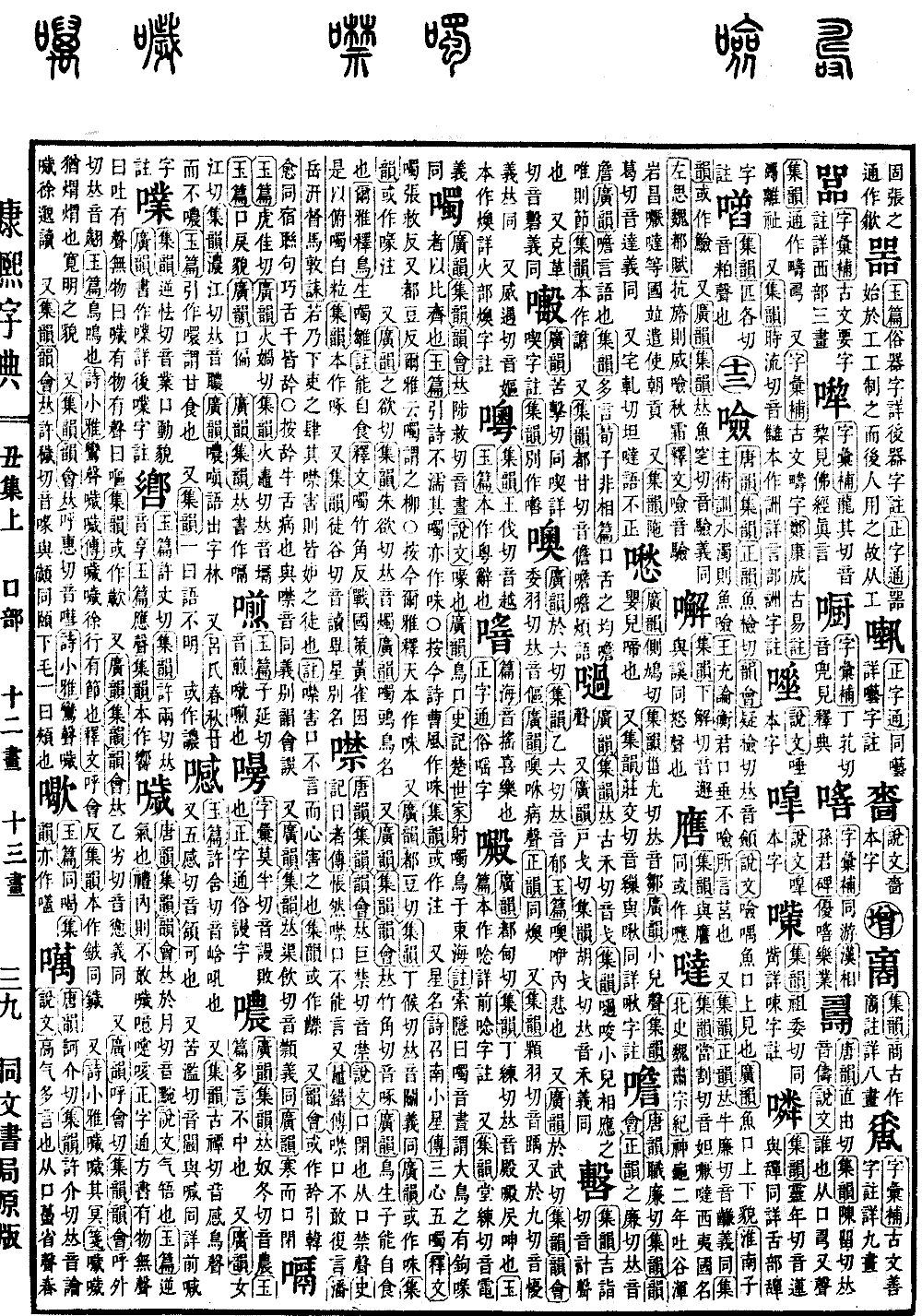
Chou Collection, Upper Volume
Radical: Mouth (kǒu)
Character: hui
Kangxi stroke count: 16
Page 209, Entry 38
Pronounced yue (falling tone).
Sayings of the Tang Dynasty (Tangyun), Collection of Rhymes (Jiyun), and Comprehensive Rhyme Compendium (Yunhui) all state the pronunciation is based on combining characters resulting in yue (falling tone).
In the Discussion of Script and Explanation of Characters (Shuowen Jiezi), it refers to an obstruction of breath.
In the Jade Chapters (Yupian), it refers to rebellious breath.
In the Book of Rites (Liji), Inner Chapters section: Do not dare to retch, belch, sneeze, or cough.
In the Correct Meaning Guide (Zhengzitong), medical texts state: when there is matter but no sound, it is called vomiting; when there is sound but no matter, it is called retching; when there is both matter and sound, it is called throwing up.
In the Collection of Rhymes (Jiyun), it is sometimes written in a variant form.
Also, pronounced yue (falling tone). The meaning is the same.
Also, pronounced hui (falling tone).
In the Jade Chapters (Yupian), it refers to the sound of a bird calling.
In the Book of Odes (Shijing), Minor Odes section: The sound of the bells on the carriage is hui-hui.
The Commentary (Zhuan) states: Hui-hui describes moving slowly and rhythmically.
The Explanation of Text (Shiwen) records the pronunciation.
In the Collection of Rhymes (Jiyun), it is originally written as a variant form and is equivalent to another variant.
Also, in the Book of Odes (Shijing), Minor Odes section: The brightness is hui-hui.
The Notes (Jian) state: Hui-hui is the same as hui-hui, the appearance of expansive brightness.
Also, pronounced hui (falling tone).
In the Collection of Rhymes (Jiyun) and Comprehensive Rhyme Compendium (Yunhui), pronounced hui (falling tone).
In the Book of Odes (Shijing), Minor Odes section: The sound of the bells on the carriage is hui-hui. Xu Miao reads it as this.
Also, pronounced hui (falling tone).
Equivalent to a variant form. Refers to the hair under the chin. Another source defines it as the cheeks.