You Collection, Lower Volume
Radical: Carriage (chē)
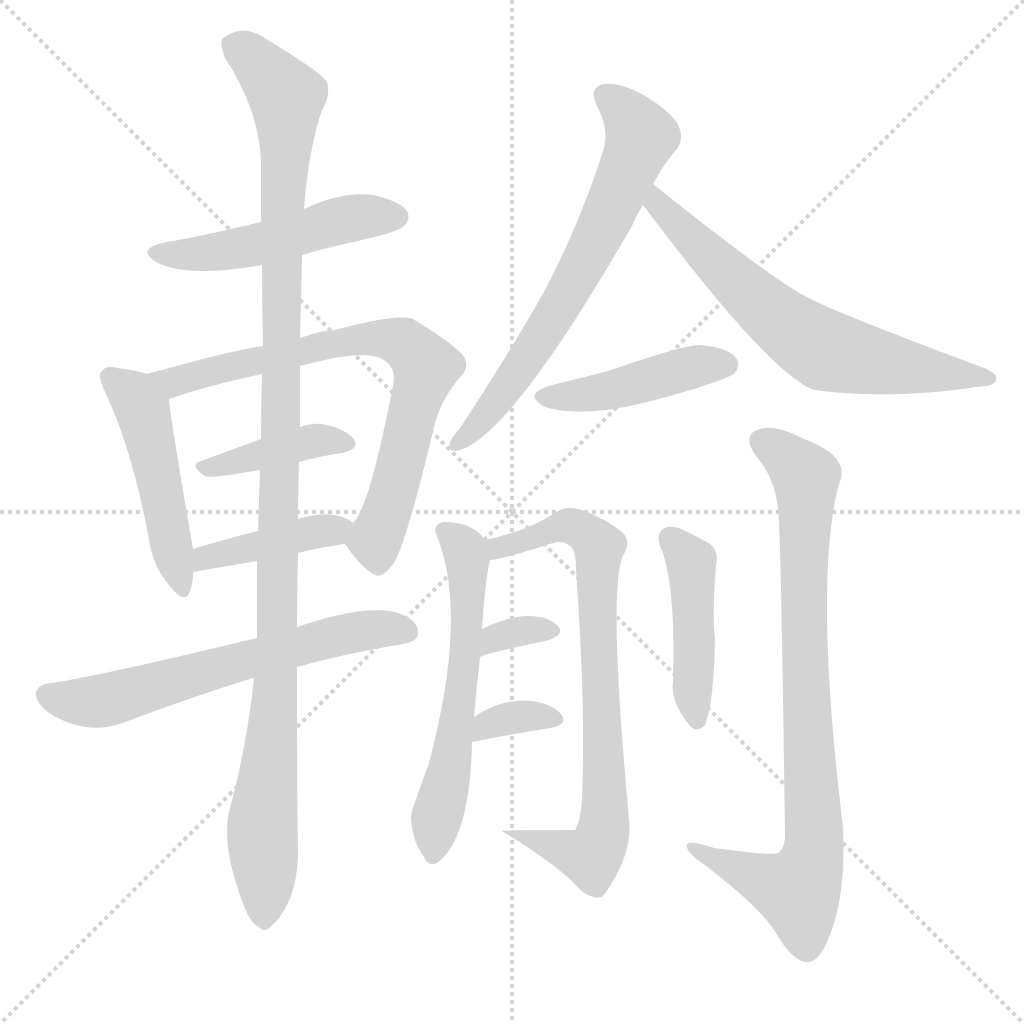
輸; Kangxi strokes: 16; Page 1246, Entry 23
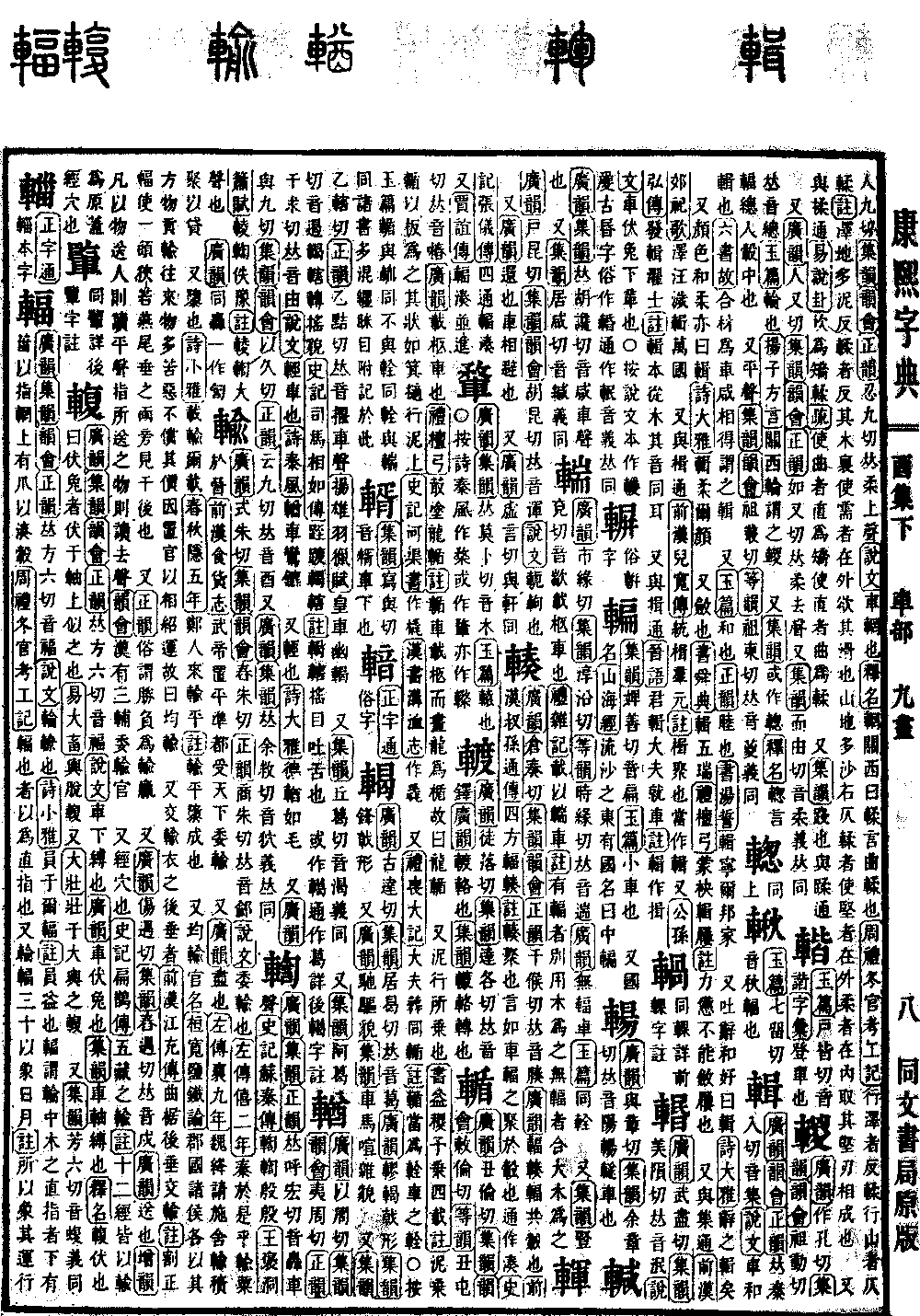
According to Broad Rimes (Guangyun), Extended Rimes (Jiyun), and Dictionary of Rimes (Yunhui), the pronunciation is shu. According to Corrected Rimes (Zhengyun), the pronunciation is the same as the character for Shu (Shu).
Shuowen Jiezi defines it as to transport or to convey.
Left Commentary on the Spring and Autumn Annals (Zuo Zhuan), Second Year of Duke Xi: The State of Qin thereupon transported grain to the State of Jin.
History of the Former Han (Qian Hanshu), Treatise on Food and Money: Emperor Wu of Han established the Bureau of Equitable Standardization to unify the receipt of goods transported from various regions.
Also, according to Broad Rimes (Guangyun), it is defined as to exhaust.
Left Commentary on the Spring and Autumn Annals (Zuo Zhuan), Ninth Year of Duke Xiang: Wei Jiang requested that benevolence be bestowed and that stored wealth be taken out for lending.
It is also defined as to destroy or to ruin.
Book of Odes (Shijing), Lesser Odes of the Kingdom: To tilt and ruin the cargo upon your carriage.
Spring and Autumn Annals (Chunqiu), Fifth Year of Duke Yin: The people of Zheng came to "abandon peace."
Note: "Abandon peace" means to destroy an existing treaty.
There is also the official title "Equitable Transport" (junshu).
Huan Kuan, Discourses on Salt and Iron (Yantie Lun): Each commandery, kingdom, and vassal state offered tributes and transported local specialties; since the goods moving back and forth were mostly crude and did not match their value, officials were appointed to take charge of transport and allocation, hence the term "Equitable Transport."
There is also "interlocking hang" (jiaoshu), referring to the trailing part of a garment's back.
History of the Former Han (Qian Hanshu), Biography of Jiang Chong: The trailing portions of the curved-hem garment are intertwined.
Note: Cutting a full width of cloth so that one end is narrow like a swallow's tail, hanging on both sides of the garment, visible from the back.
Additionally, according to Corrected Rimes (Zhengyun), in common parlance, victory or defeat is called "winning and losing" (shuying).
Also, according to Broad Rimes (Guangyun) and Extended Rimes (Jiyun), the pronunciation is shu.
Broad Rimes (Guangyun) defines it as to present a gift.
Added Rimes (Zengyun): Whenever one gives an object to another person, it is pronounced in the level tone. If it refers to the object being given itself, it is pronounced in the departing tone.
Dictionary of Rimes (Yunhui): During the Han dynasty, there were officials appointed in the Three Metropolitan Districts to manage the transfer of goods.
It also refers to acupuncture points on the meridians.
Records of the Grand Historian (Shiji), Biography of Bian Que: The acupuncture points of the five viscera.
Note: All twelve meridians use the "shu" points as the source points, referring to the points on the meridians.