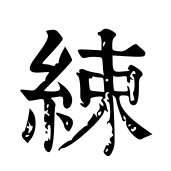
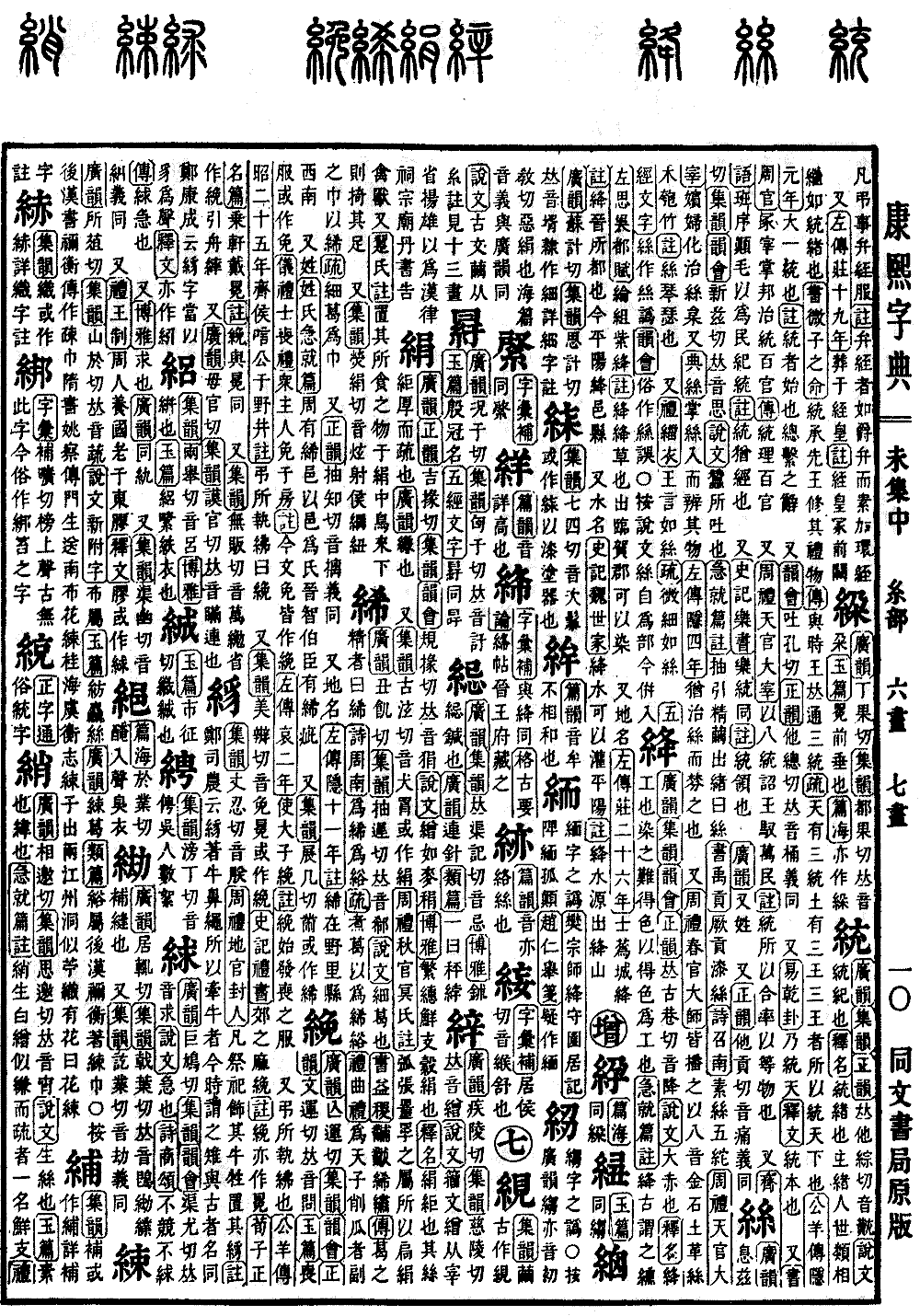
Wei Collection, Middle Volume
Radical: Silk (mì)
Shu (level tone)
Kangxi stroke count: 13
Page 924, Entry 31
Broad Rimes (Guangyun): Pronounced shu. Collected Rimes (Jiyun): Pronounced shu.
Explaining Graphs and Analyzing Characters (Shuowen Jiezi), Newly Appended Characters: A type of cloth.
Comprehensive Collection of Characters (Yupian): To spin coarse silk.
Broad Rimes (Guangyun): A coarse hemp fabric (shuge).
Classified Anthology (Leipian): A type of fine-grained hemp cloth (xi).
In the Later Han Dynasty, Mi Heng wore a headband made of this fabric. Note: In the Biography of Mi Heng within the History of the Later Han (Hou Hanshu), it is written as a coarse cloth headband. In the Biography of Yao Cha within the Book of Sui (Suishu), it is recorded that his students presented him with southern-style floral cloth. According to the Record of Observations from the South (Guihai Yuheng Zhi), the shu fabric originates from the Liangjiang prefecture and county regions; it resembles ramie and is woven with floral patterns, referred to as floral shu.