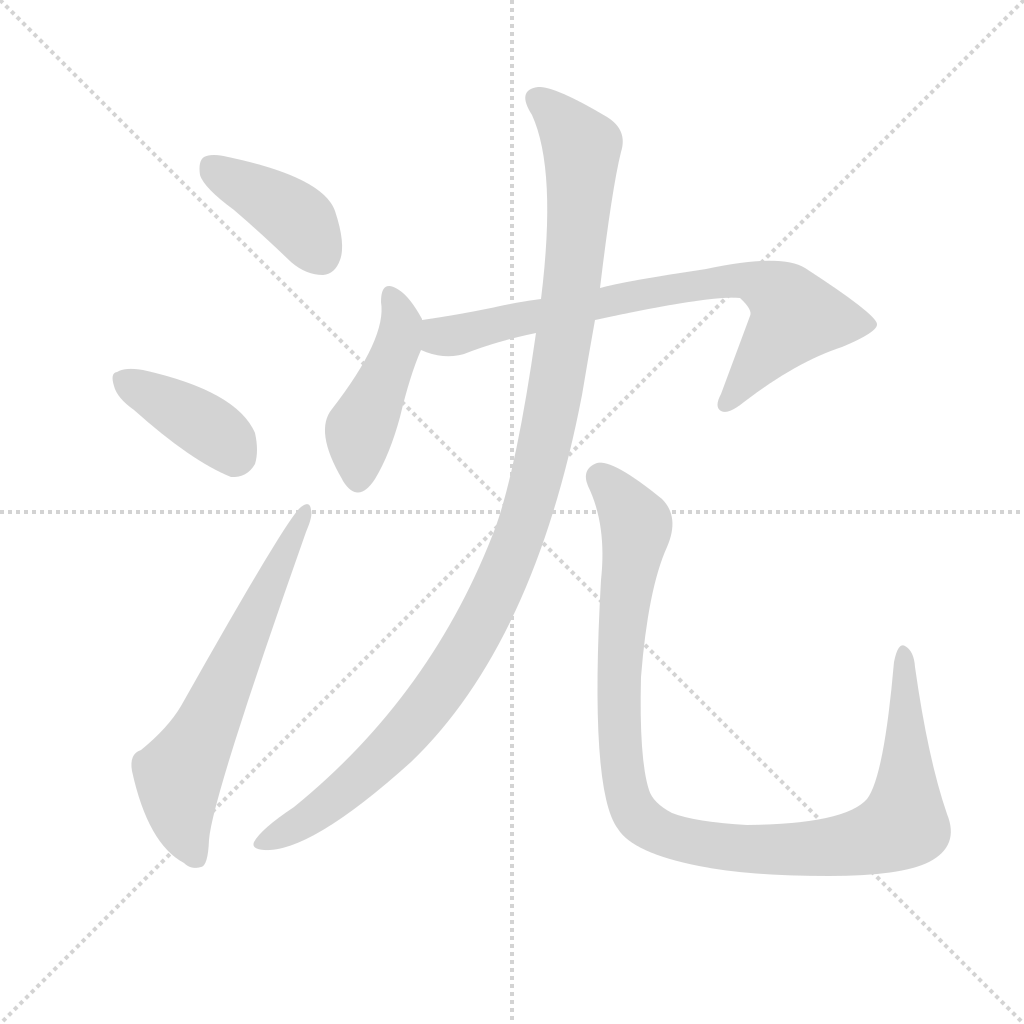
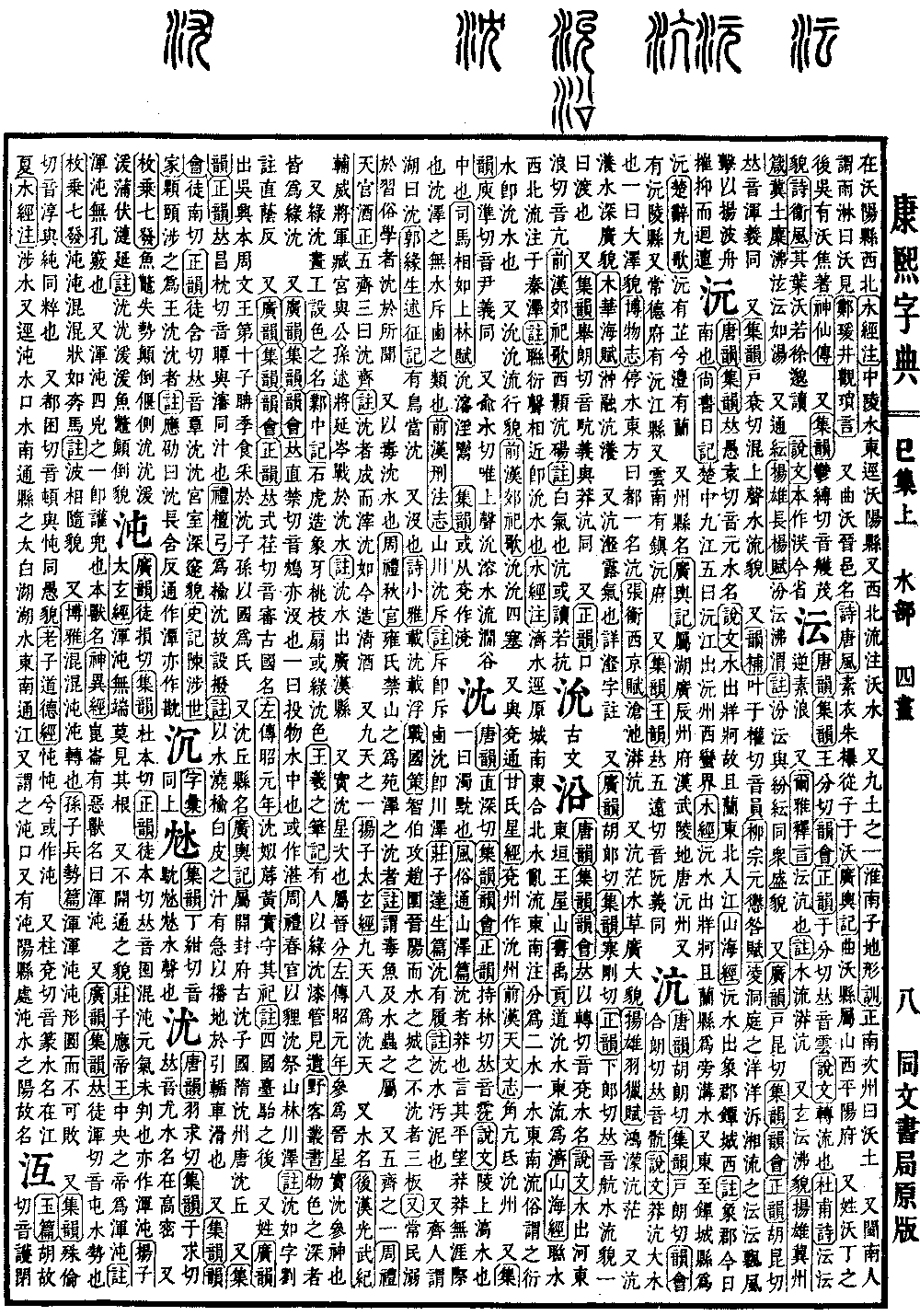
Si Collection, Upper Volume
Radical: Water (shuǐ)
Kangxi stroke count: 8
Page 610, Entry 06
Pronounced shen (level tone).
Pronounced shen (level tone).
Pronounced shen (level tone).
According to Explaining Graphs and Analyzing Characters (Shuowen), this refers to deep water accumulated on a mountain ridge. Another interpretation suggests it describes a turbid and murky appearance.
According to Comprehensive Customs and Traditions: Chapters on Mountains and Marshes (Fengsu Tong - Shanze Pian), "shen" denotes vastness without limits, describing an expanse that stretches out broadly with no discernible boundary. "Shen-ze" refers to land that is saline or alkaline, lacking standing water.
According to the History of the Former Han (Qianhan Shu): Treatises on Law and Institutions (Fazhi), there are mountains, rivers, and "shen-ze" as well as saline and alkaline lands. The commentary explains that the saline and alkaline lands are the "chi" and the "shen" refers to rivers and marshes.
According to the Zhuangzi: Cultivating Life (Dasheng Pian), "in the 'shen' there are shoes." The commentary notes that "shen" water refers to sludge or mud.
In the Qi region, people refer to a lake as a "shen."
According to Guo Yuansheng's Record of Travels (Shuzheng Ji), there are birds facing the "shen."
Also denotes sinking or submerging.
According to the Book of Odes (Shijing): Lesser Odes (Xiaoya), "Sometimes sinking down, sometimes floating up."
According to the Strategies of the Warring States (Zhan Guo Ce), when Zhi Bo attacked the state of Zhao and besieged Jinyang, he used water to flood the city; only three slabs' worth of the city wall remained unsubmerged.
Also, ordinary people are "sunk" (immersed) in customs, while scholars are constrained by the limited knowledge they have heard.
Also refers to placing toxic substances into water.
According to the Rites of Zhou (Zhou Li): Autumn Officials (Qiuguan), the Yong clan forbade the building of enclosures on mountains and the poisoning of waters in marshes. The commentary notes this refers to poisoning fish and water-borne insects.
Also refers to one of the five types of unfiltered turbid wine.
According to the Rites of Zhou (Zhou Li): Heavenly Officials (Tianguan - Jiuzheng), among the five types of turbid wine, the third is called "shen-qi." The commentary explains that "shen" means that after brewing, the dregs sink to the bottom, similar to the process of making clear wine today.
Also refers to one of the nine heavens.
According to the Yangzi: Great Mystery (Taixuan Jing), of the nine heavens, the eighth is the "shen" heaven.
Also refers to the name of a river.
According to the History of the Later Han (Houhan Shu): Annals of Emperor Guangwu, the General Fuwei Zang Gong fought against Yan Cen, a general under Gongsun Shu, at the Shen River. The commentary notes that the Shen River originates in Guanghan County.
Also "Shi-shen," the name of a stellar division corresponding to the region of Jin.
According to the Zuo Commentary (Zuo Zhuan): First Year of Duke Zhao, the Can constellation is the star of the Jin state, and Shi-shen is the spirit of the Can constellation.
Also "Lü-shen," a term for colors used by painters.
According to the Records of Yezhong (Yezhong Ji), Shi Hu manufactured fans made of ivory and peach wood, some of which used "lü-shen" (deep green) color.
According to Wang Xizhi's Treatise on the Art of the Brush (Bizhen Tu), someone presented me with a "lü-shen" lacquered brush holder.
According to the Wild Guest Anthology (Yeke Congshu), deep-colored objects can all be referred to as "lü-shen."
Pronounced zhen (level tone).
Also denotes sinking or submerging. One interpretation is the act of placing objects into water. Sometimes written as "zhan."
According to the Rites of Zhou (Zhou Li): Spring Officials (Chunguan), burial and immersion sacrifices were used to offer rites to the mountains, forests, rivers, and marshes. The commentary notes that "shen" is read in its primary pronunciation, though Liu Changzong gives the pronunciation as zhen.
Pronounced shen (rising tone).
The name of an ancient state.
According to the Zuo Commentary (Zuo Zhuan): First Year of Duke Zhao, the four states of Shen, Si, Ru, and Huang guarded the sacrifices through the generations. The commentary notes that these four states were descendants of Tai Tao.
Also a surname.
According to the Guangyun, it originates from Wuxing Commandery. Originally, it was the tenth son of King Wen of Zhou, Dan Ji, who held his fief in the territory of Shen; his descendants used the name of the state as their surname.
Also Shenqiu, the name of a county.
According to the Guangyu Ji, it was under the jurisdiction of Kaifeng Prefecture; it was the ancient state of Shen Zi, became Shen Prefecture during the Sui Dynasty, and Shenqiu County during the Tang Dynasty.
Pronounced shen (level tone).
Same as "shen" (referring to juices).
According to the Book of Rites (Liji): Tan Gong, a "bo" (a type of sliding tool) was set up because of the sap of the elm tree. The commentary notes this refers to pouring the juice of white elm bark, which was sprinkled on the ground in emergencies to act as a lubricant for pulling the hearse.
Pronounced tan (level tone).
"Shen-shen," describing the appearance of a palace as deep and secluded.
According to the Records of the Grand Historian (Shiji): Hereditary House of Chen She, "Ah! Chen She, when he became king, lived in such a deep and vast residence!" The commentary notes that Ying Shao said "shen" is read as tan. It is interchangeable with "tan." Also written as a variant form.