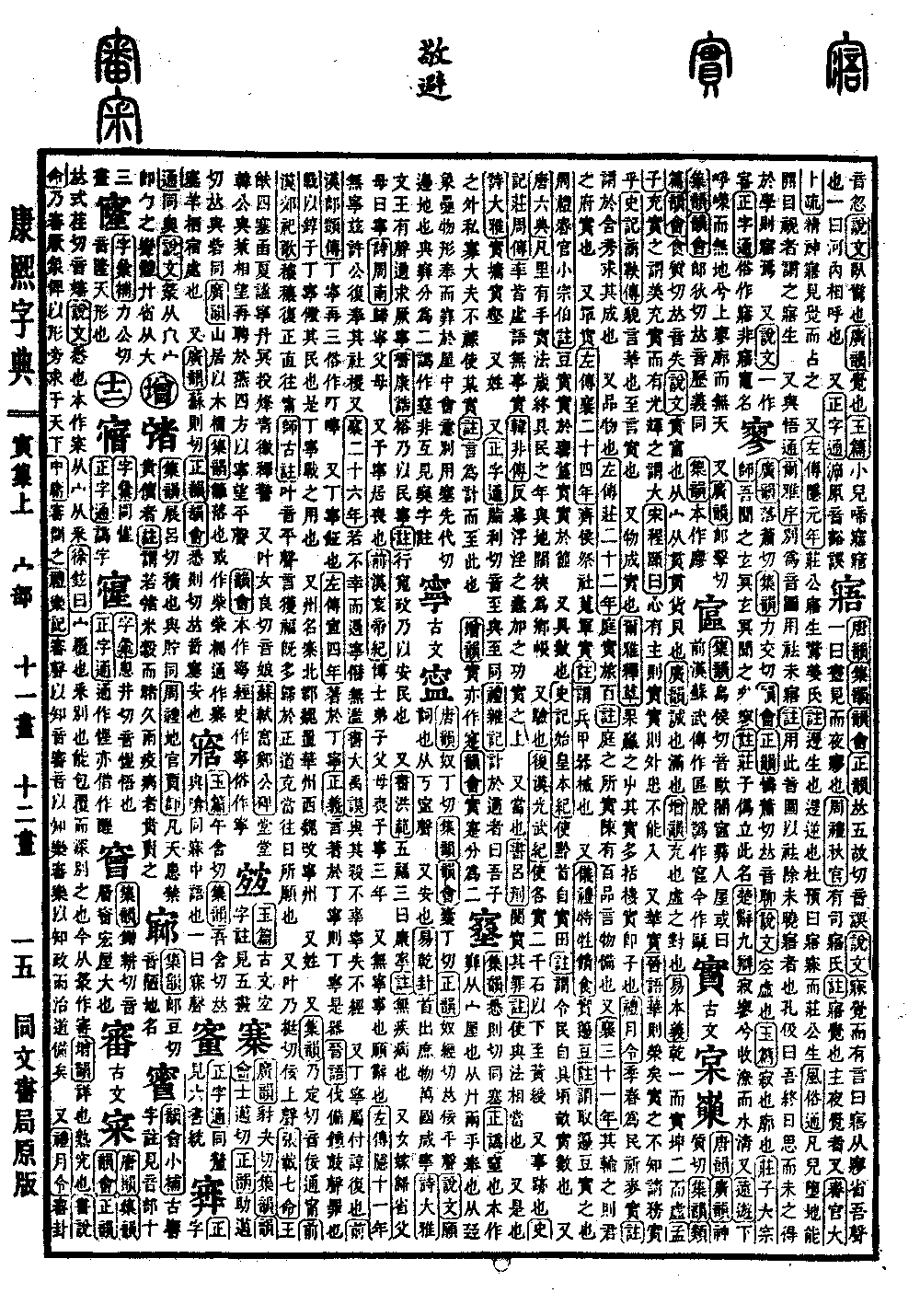
Yin Collection, Upper Volume
Radical: Roof (bù)
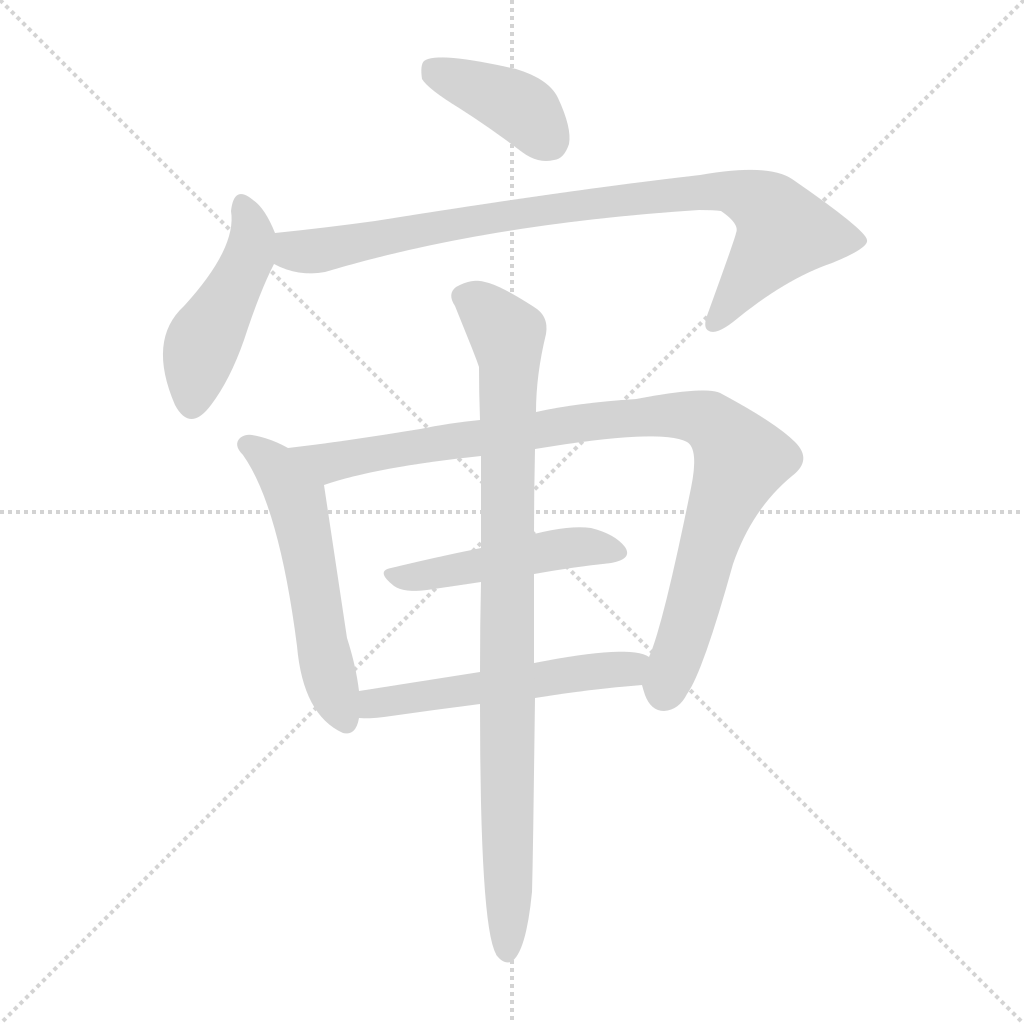
Entry: 审
Kangxi stroke count: 15
Page 291, Entry 02
Ancient form: 宷. According to Tang Rhymes (Tangyun), Collection of Rhymes (Jiyun), Dictionary of Rhymes (Yunhui), and Correct Rhymes (Zhengyun), it is pronounced shen (third tone). According to Explaining Graphs and Analyzing Characters (Shuowen), it means to know thoroughly. It was originally written as 宷, composed of the Roof radical and the gather component. Xu Xuan states that the Roof radical represents coverage, and the gather component represents discernment; it signifies the ability to cover and deeply discern. It is currently written as 审 based on the seal script. According to Added Rhymes (Zengyun), it means to be detailed and to investigate deeply. In the Book of Documents (Shujing), specifically the Charge to Yue (Shuoming), it is written: Therefore, examine the image carefully, and have people search extensively throughout the world according to that shape. In the Doctrine of the Mean (Zhongyong), it refers to inquiring in detail. In the Book of Rites (Liji), specifically the Record of Music (Yueji), it states: Distinguish sounds to understand tones, distinguish tones to understand music, and distinguish music to understand politics; in this way, the method of governing a state is complete. Furthermore, in the Book of Rites (Liji), specifically the Monthly Ordinances (Yueling), it refers to examining the auspicious or ominous signs of divination. The commentary notes that this means to inspect and record. Also, in the Zhuangzi, specifically the Xu Wugui chapter, it states: Water's attachment to the earth is certain, the shadow's attachment to the person is certain, and things' attachment to things is certain. The commentary by Guo Xiang states: To have no intent is to rest in one's own nature, hence it is certain. The Xunben commentary states: This means that these principles are mutually dependent and never separated, just as water is attached to earth, shadows to people, and things to things, certain and unchanging. Also, the trial of a legal case is called shen. In the Book of Documents (Shujing), specifically the Marquis of Lu on Punishments (Luxing), it says: Investigate them in detail. Also, it means a bundle. In the Rites of Zhou (Zhouli), specifically the Earth Officer (Diguan) section regarding the Feather Master, it states: Ten feathers constitute one shen. The commentary notes: The ancients collected feathers to use as decorations for banners and for bows and arrows. Shen means a bundle. Also a surname. In the Han dynasty, there was Shen Shiqi. According to Correct Meaning (Zhengzitong), during the Han dynasty, there was a gentleman named Shen Zhong who submitted a memorial during the reign of Emperor Ling regarding the crimes of Cao Jie and others. Also, according to the Dictionary of Rhymes (Yunhui), it is identical to the word for coiling, meaning water spiraling. In the Zhuangzi, specifically the Fit for Emperors and Kings (Yingdiwang) chapter, it states: Still water spirals to become an abyss. The commentary notes: Pronounced pan. The text says: Pan means to gather.