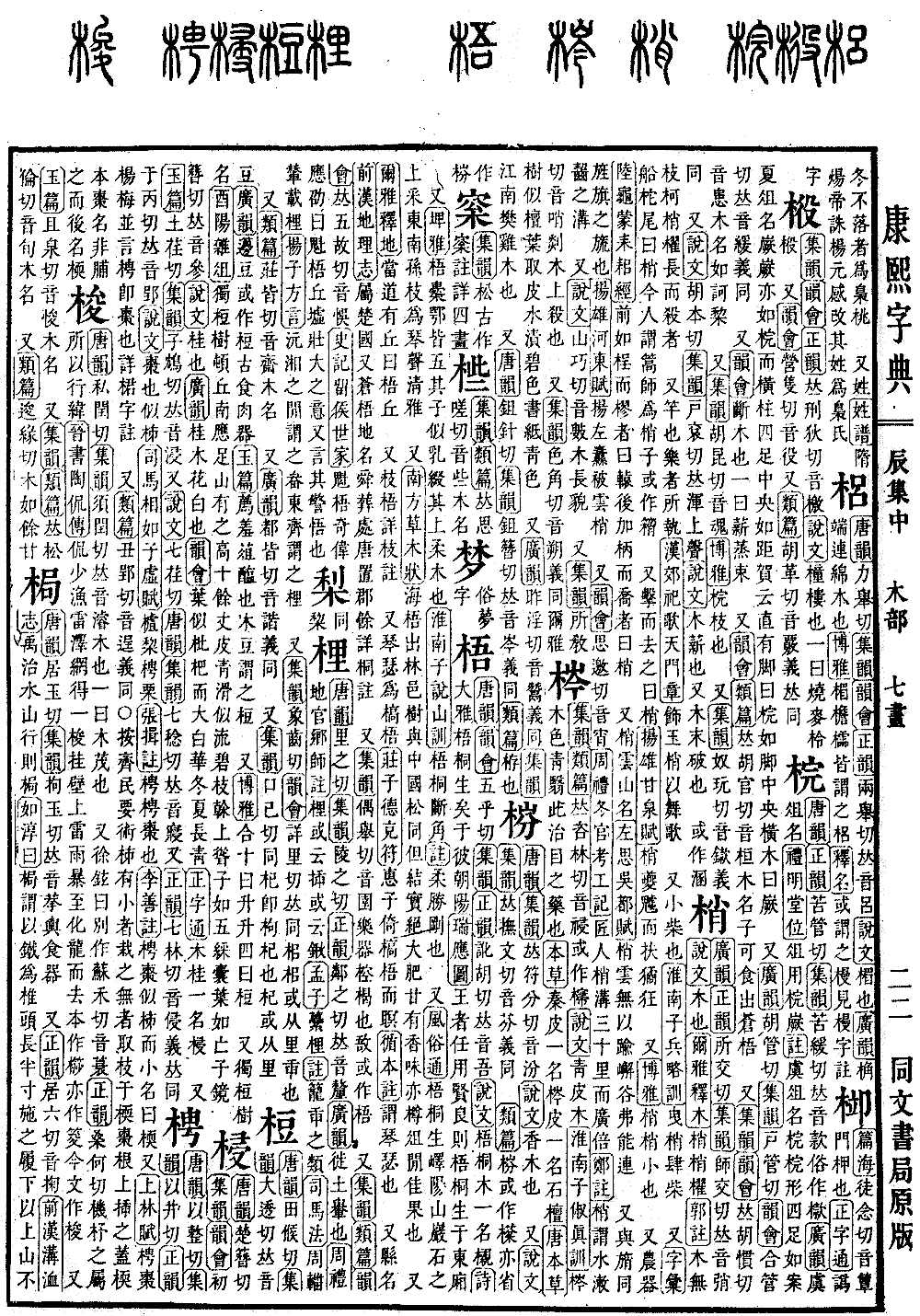
Chen Collection, Middle Volume
Radical: Tree (mù)
Kangxi Strokes: 11
Page 530, Entry 05
Pronounced shao.
According to the Explaining Graphs and Analyzing Characters (Shuowen Jiezi), it is the name of a tree.
According to the Approaching Standard (Erya), in the section on trees, it refers to a tree that lacks branches and has a trunk that grows long and gradually tapers. It also refers to a bamboo pole used as a prop by dancers in musical performances.
In the Han dynasty Songs of Suburban Sacrifices (Jiaosi Ge), specifically the Heavenly Gate Chapter, it refers to using a pole decorated with fine jade to accompany dance and song.
It also refers to small firewood. According to the Huainanzi, in the Treatise on Military Strategy (Binglue Xun), it means to drag small firewood and scatter brushwood.
According to the Comprehensive Collection of Characters (Zihui), the rear part of a ship rudder is called a shao. Nowadays, the person who poles a boat is called a shaozi. It is sometimes written in a variant form.
It also means to drive away or repel. According to Yang Xiong’s Rhapsody on the Sweet Springs (Ganquan Fu), it refers to driving away monsters like Kui and Xu, and lashing out at evil things like the Xu and Kuang.
According to the Extensive Refinement (Boya), shao-shao means minute or slight.
It also refers to an agricultural tool. According to Lu Guimeng’s Classic of the Plow (Leisi Jing), the curved part in front that resembles the rail of a carriage is called the yuan, and the part with a handle added in the back that is higher is called the shao.
It also refers to Mount Shaoyun. According to Zuo Si’s Rhapsody on the Capital of Wu (Wudu Fu), Mount Shaoyun is so high it cannot be traversed, and the Xie Valley cannot be linked to it.
It is also used interchangeably with the character for a streamer on a banner. According to Yang Xiong’s Rhapsody on the River East (Hedong Fu), it refers to raising the feathered banner on the left, with the streamers flowing like clouds.
Pronounced xiao.
According to the Meeting of Rhymes (Yunhui), in the Rites of Zhou (Zhouli), specifically the section on the Winter Bureau in the Record of Trades (Kaogong Ji), it states that the drainage ditch is thirty li long and twice the width. According to Zheng’s commentary, shao refers to a ditch eroded and carved out by water flow.
Pronounced shao.
According to the Explaining Graphs and Analyzing Characters (Shuowen Jiezi), it describes the appearance of a tree growing high.
Pronounced shao.
According to the Collected Rhymes (Jiyun), it means to whittle wood to make the upper part gradually thinner.
Pronounced shuo.
According to the Collected Rhymes (Jiyun), the meaning is the same as that found in the Approaching Standard (Erya).
Textual Research: In Yang Xiong’s Rhapsody on the Sweet Springs (Ganquan Fu), the original text reads to lash out at the Xu and Kuang. The text has been corrected from the original fu to tie.