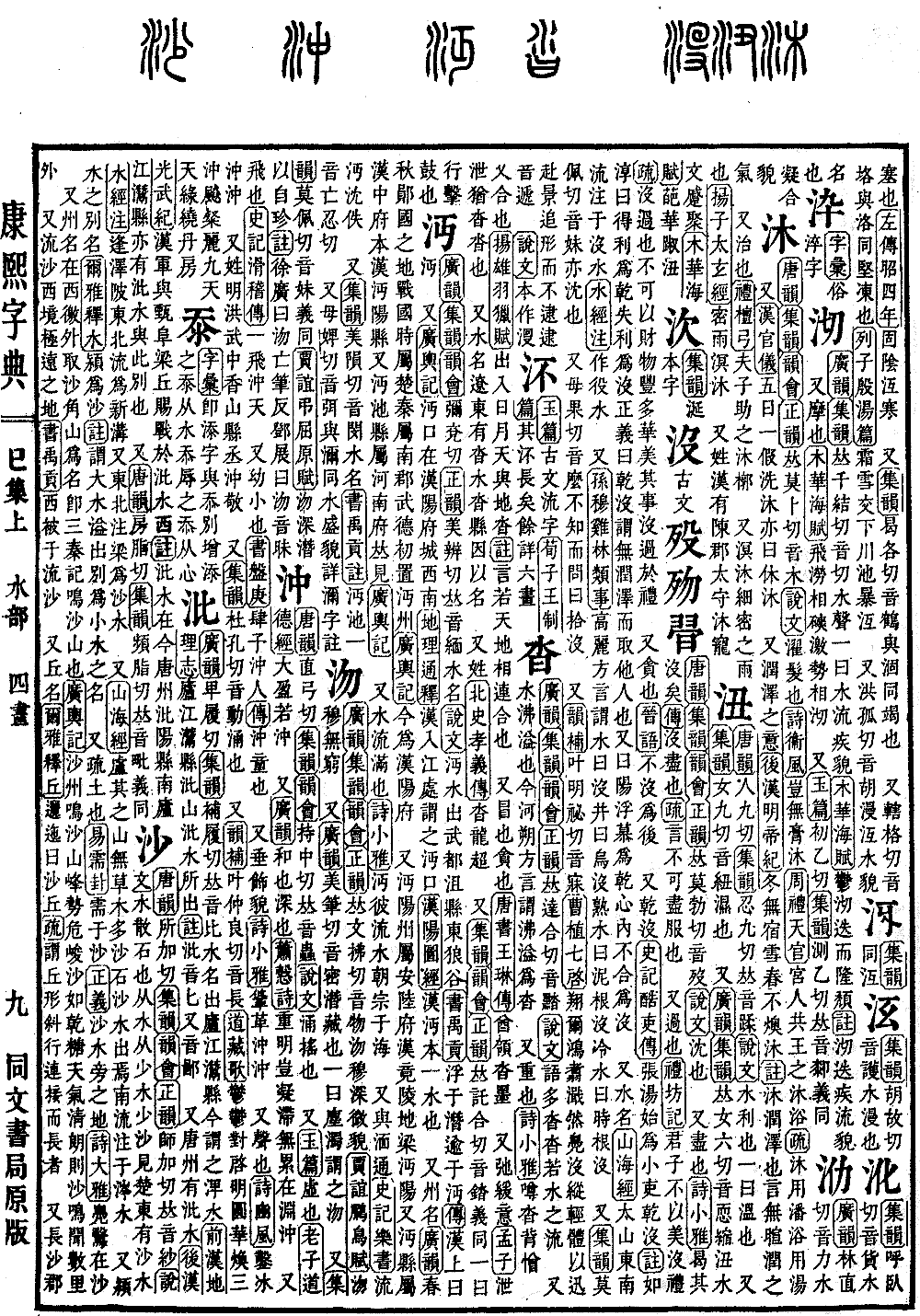
Si Collection, Upper Volume. Radical: Water (shuǐ); Kangxi stroke count: 8; Page 611, Entry 21.
Pronounced sha.
According to the Explaining Graphs and Analyzing Characters (Shuowen Jiezi), it refers to the scattering of stones by water. Composed of the radicals for water and few; when water is scarce, sand is revealed. To the east of Chu, there is the Sha River.
According to the Commentary on the Water Classic (Shuijing Zhu), the Fengze marsh flows northeast to become the Xin Canal, and further northeast flows into the Liang to become the Sha River.
Also mentioned in the Classic of Mountains and Seas (Shanhai Jing): Luqi Mountain has no vegetation, but is rich in sand and stones, from which the Sha River emerges, flowing south into the Cen River.
Also a variant name for the Ying River. According to the Erya, a dictionary of water terms, the Ying is the Sha. The commentary states that this refers to a name for a smaller stream formed when a larger body of water overflows.
Also, loose soil. According to the Book of Changes (Yijing), in the Xu hexagram, waiting in the sand. The sub-commentary explains that sand refers to land beside the water.
In the Book of Odes (Shijing), wild ducks are in the sand.
Also a prefecture name, located beyond the western frontier; named after Shajiao Mountain, which is the Mingsha Mountain mentioned in the Records of the Three Qin (Sanqin Ji).
According to the Gazetteer of the World (Guangyu Ji), there is Mingsha Mountain in Shazhou; the peaks are steep and the sand is like dried sugar. When the weather is clear, the sand emits a sound that can be heard from several miles away.
Also, Flowing Sand (Liusha), a place in the extreme western territory. According to the Book of Documents (Shangshu), in the Tribute of Yu (Yugong), to the west it reaches the Flowing Sand.
Also a hill name. The Erya defines a winding hill as a sand dune. The sub-commentary explains that this refers to hills shaped in a winding, connected, and elongated manner.
Also Changsha, a commandery name belonging to Chu. The Gazetteer of the World notes that the modern Huguang Changsha Prefecture contains Changsha County.
Also Changsha, a star name. Located beside the Zhen constellation, it governs longevity. Found in the Records of the Grand Historian (Shiji), Treatise on the Celestial Offices (Tianguan Shu).
Also, areas in water containing sand are called shayan. In the Biography of the Son of Heaven (Tianzi Zhuan), the Son of Heaven traveled east, crossing the sand shoals in the south.
Also shatai, see the note on the character tai.
According to the Xie Chawei Mathematical Classic (Xie Chawei Suanjing), ten dusts equal one sand, ten sands equal one fiber.
Also a tree name. According to Fan Chengda in his Notes on the Flora of Guilin (Guihai Caomu Ji), the sand tree belongs to the same class as the fir but is taller and larger, with pointed leaves in clusters; the ears differ from those of the fir.
Also a bean name. According to Cui Bao in his Records of Antiquity and Modernity (Gujin Zhu), the raccoon bean is also called raccoon sand or hunting sand. The tiger bean is also called tiger sand. The horse bean is also called horse sand.
Also blowing sand, a fish name. In the Erya, fish section, it is called sha-tuo. Guo Pu’s commentary states that this is the modern blowing sand fish. Lu Ji’s commentary states that the fish is narrow and small, and often opens its mouth to blow sand, hence the name.
Also a term for something small and sweet. According to Han Yanzhi’s Record of Oranges (Julu), the sand orange is named for its fine and sweet quality; some say it is because it is planted on the sands of Shazhou, making its flavor particularly rare. However, people of that region use the term sand for anything small and sweet, such as sand melon, sand honey, or sand sugar, which is merely a regional dialect.
Also shamen, meaning diligent practice. According to the Sutra of Forty-two Chapters (Fo Shuo Sishierzhang Jing), leaving one's family to serve, recognizing the heart and reaching the source, understanding the non-conditioned law, is called a shamen.
Also a surname. A courageous general of the Song dynasty was named Sha Shijian.
Also used as a loan for the character for fine silk (sha). According to the Rites of Zhou (Zhouli), in the Ministry of Heaven (Tianguan), the internal dress is of plain sha. The commentary states that plain sha is modern white thin silk. Used as a lining to make it prominent. Modern thin silks are named from this origin.
Pronounced suo. A pavilion name located in Yuancheng. According to the Spring and Autumn Annals (Chunqiu), in the seventh year of Duke Ding, the Marquis of Qi and the Marquis of Wei formed an alliance at Sha. The commentary states that today, to the southeast of Yangping Yuancheng County, there is Sha Pavilion.
Also interchangeable with the character for sacrificial vessel (xi). In the Book of Odes (Shijing), L颂 (Lusong), the sacrificial vessels are glorious. Zheng’s commentary says it is pronounced su-he. Mao’s commentary states it has sand-like ornamentation.
Also a wine name. In the Book of Etiquette and Ceremonial (Yili), in the commentary on the presentation of two vessels of wine in the Great Archery Ritual (Dashe Yi), the word for offering is read as sha. Sand wine is turbid and must be specially filtered; one must grind it with sand.
Pronounced shi. Also land beside water.
Pronounced sa. A hoarse voice. According to the Rites of Zhou, in the Ministry of Heaven, the inner kitchen officials prepare birds and tan-colored animals that make a hoarse sound. The commentary says the sound of sha is pronounced su-jia, or sometimes su-ta. The sub-commentary notes that sha originally has the pronunciations su-he and shan-yi, so it is unnecessary to categorize it under the ge, zhi, or ye rhyme groups. These are now deleted.