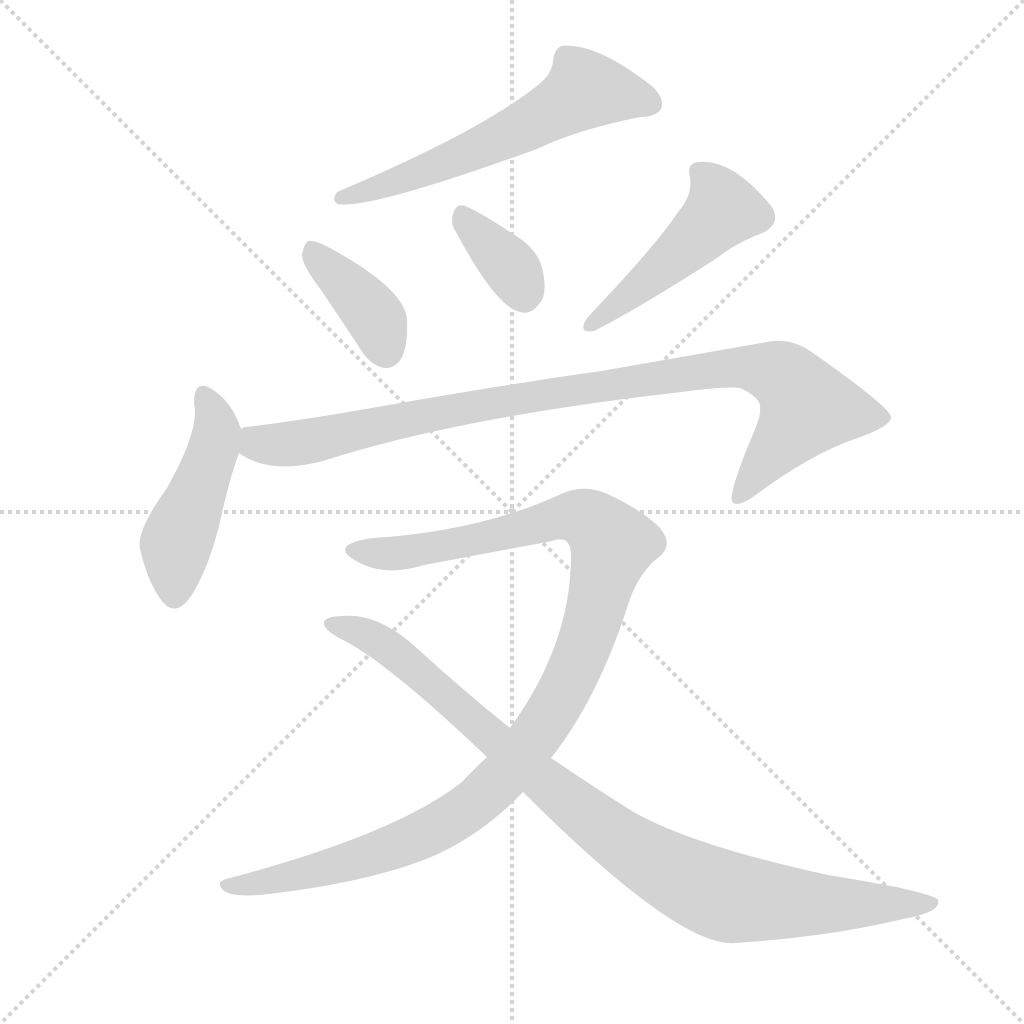
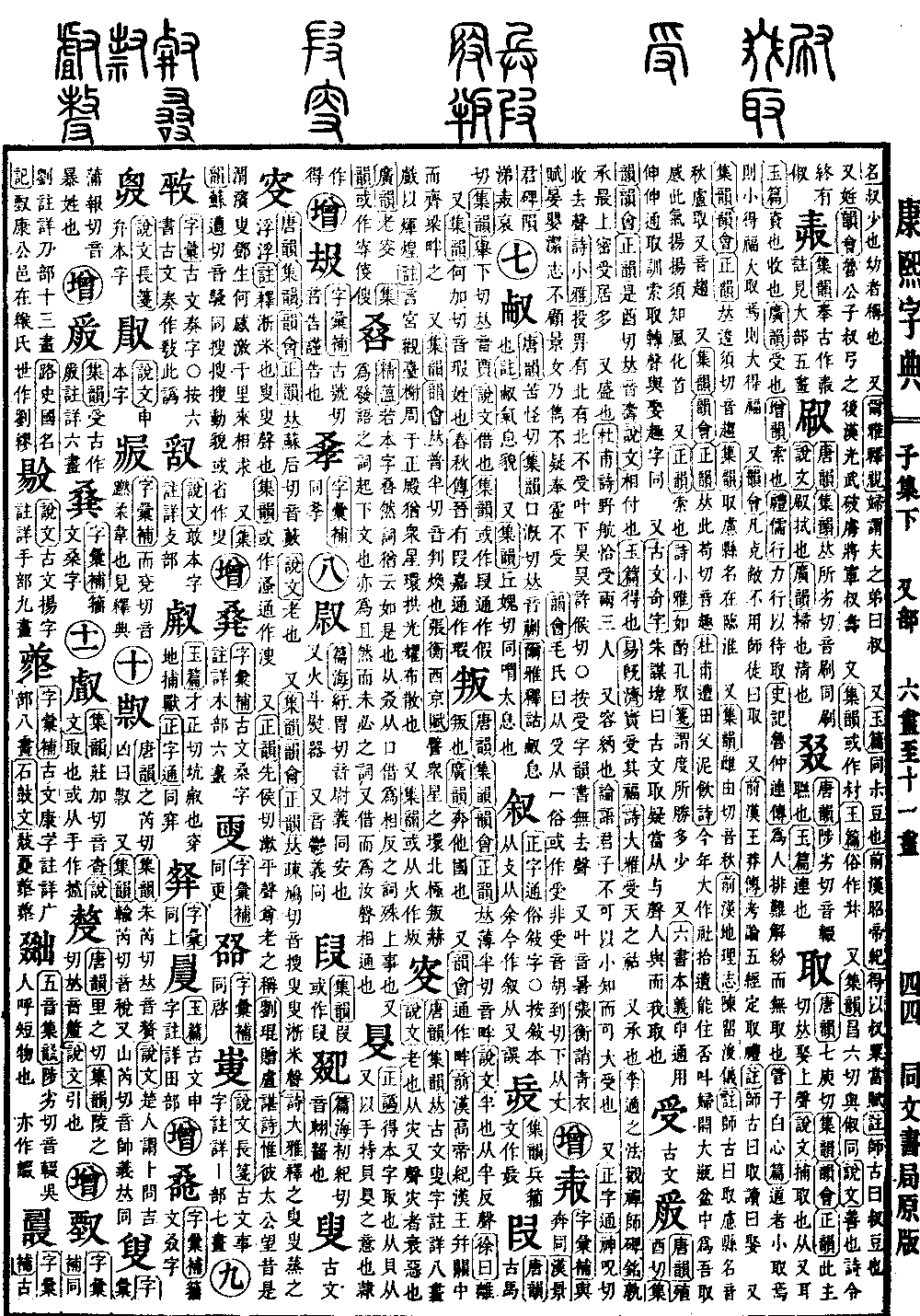
Zi Collection, Page Position: Lower
Radical: Again (yòu)
Kangxi Strokes: 8
Page 166, Entry 05
Pronounced shou (falling tone).
Sayings of Tang (Tangyun): Pronounced shou (rising tone).
Collected Rhymes (Jiyun), Rhyme Meetings (Yunhui), Correct Rhymes (Zhengyun): Pronounced shou (rising tone).
Pronounced identical to shou (falling tone).
Explaining Graphs (Shuowen): Indicates to deliver or give.
Jade Chapters (Yupian): Indicates to obtain.
Book of Changes (Yijing): Actually obtaining that good fortune.
Book of Odes (Shijing): To receive the blessings of Heaven.
Also indicates to inherit or receive.
Inscription for Dharma Teacher Faguan by Li Shizhi: Who can inherit the most profound law, secretly receiving and accepting the most?
Also indicates to be full or contain.
Poems of Du Fu: The small boat at the wild ferry can just accommodate two or three people.
Also indicates to accept or tolerate.
Analects of Confucius (Lunyu): A gentleman cannot be understood through small matters, yet he can bear great responsibilities.
Also, Correct Character Mastery (Zhengzitong): Pronounced shen (rising tone) and zhou (falling tone), with the character receiving a falling tone.
Book of Odes (Shijing): Cast into the northern wilderness, even the north does not accept it. It rhymes with the following character, hao. Hao is pronounced xu (rising tone).
Note: In rhyme books, the character shou does not have a falling tone pronunciation.
Also, rhymes with the sound of shu (rising tone).
Qingyi Rhapsody by Zhang Heng: Yan Ying had high and pure aspirations, and did not pay attention to the daughter of Duke Jing. As for Juan Buyi, he followed the orders of Huo Guang and did not accept.
Rhyme Meetings (Yunhui): Master Mao says the character form is derived from the cover radical. It is sometimes written incorrectly as a variant form. The pronunciation is hu (rising tone) and dao (falling tone), with the lower portion derived from zhang (falling tone).