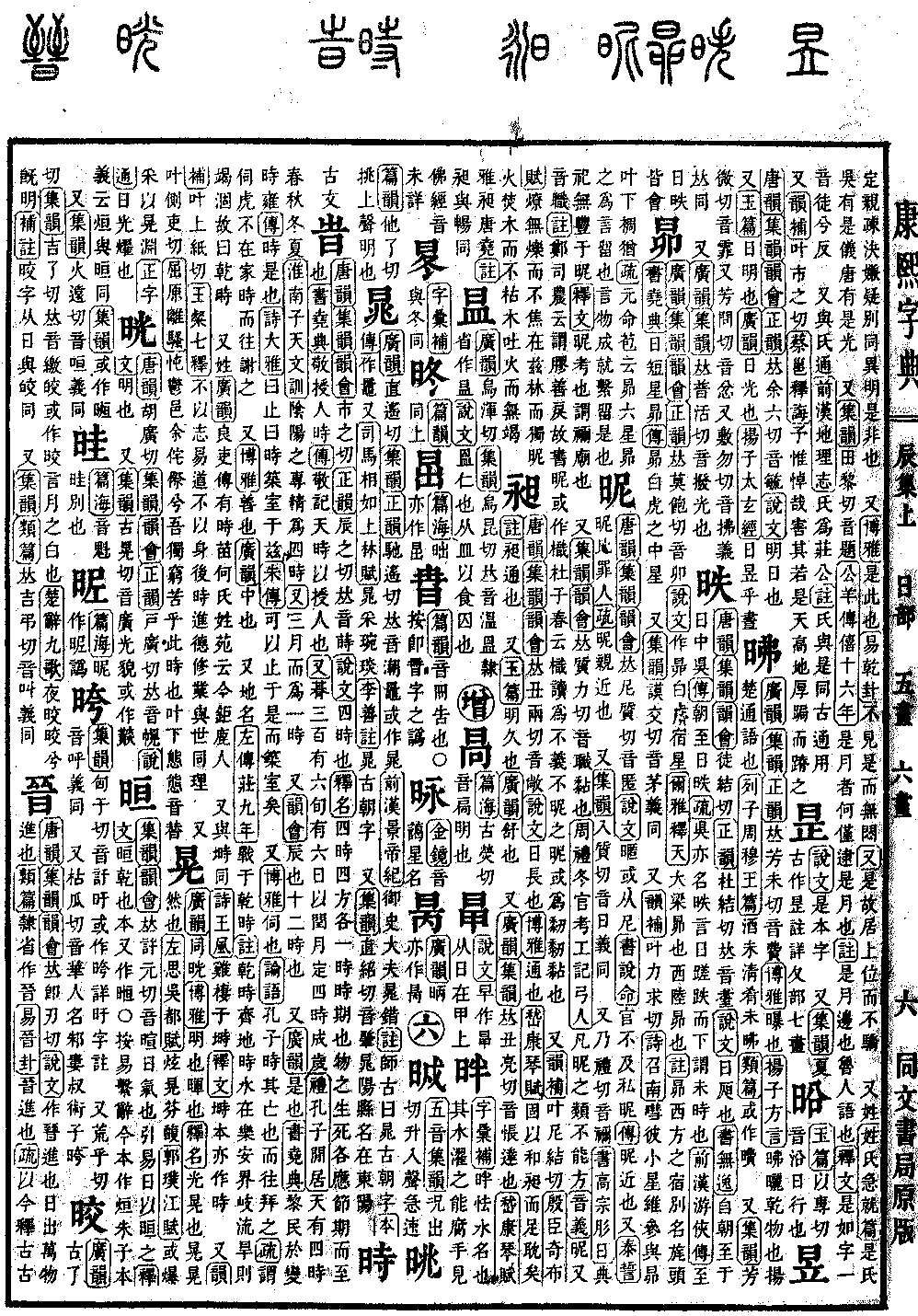
Chen Collection, Upper Volume
Radical: Sun (rì)
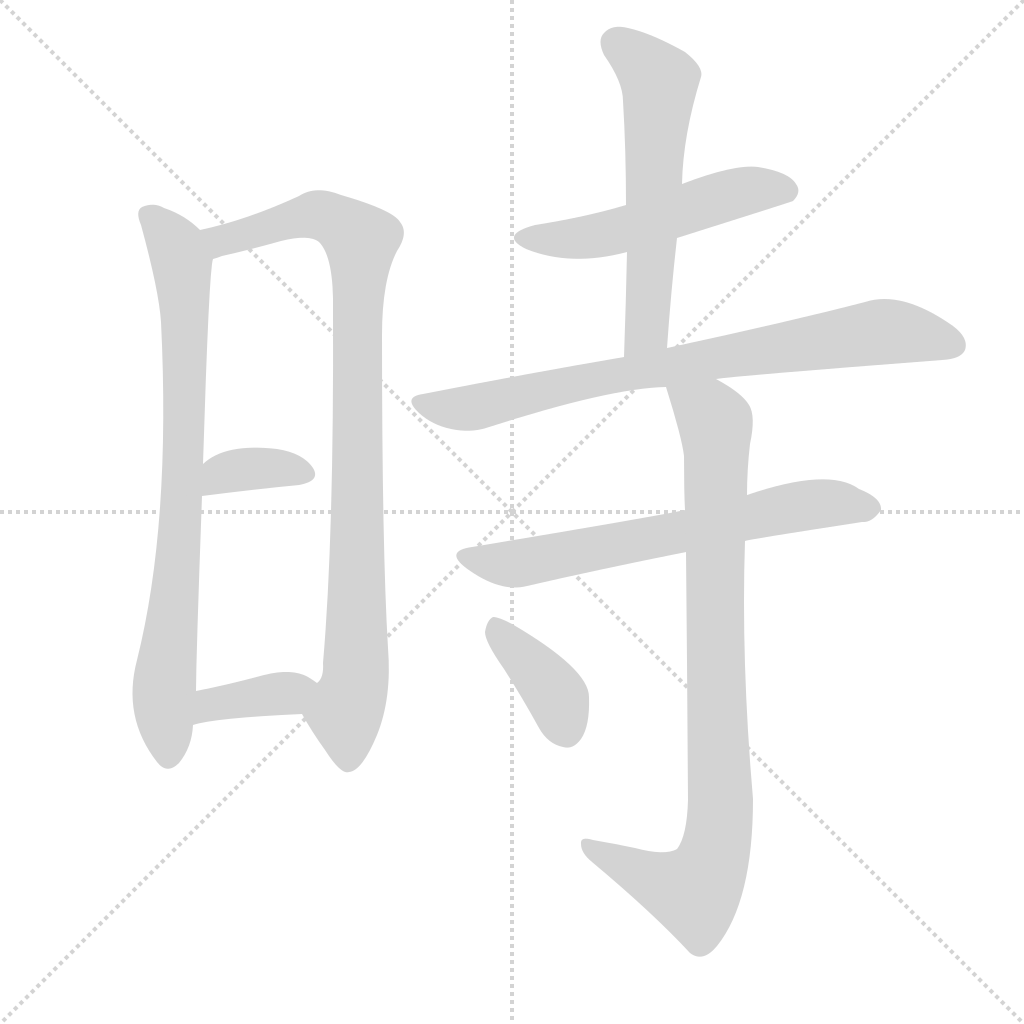
时 (Shí); Kangxi brush strokes: 10; Page 494, Entry 22
Ancient form: 旹
Tang Phonology (Tangyun), Collection Phonology (Jiyun), and Phonology Assembly (Yunhui) define it as pronounced shi. Correct Phonology (Zhengyun) defines it as pronounced shi.
Explanation of Characters (Shuowen): The four seasons.
Definitions of Names (Shiming): The four seasons, each season corresponding to one of the four directions. Time implies a period; the life and death of things follow the appointed periods.
Classic of History (Shujing): Reverently provide the people with the seasons.
Commentary: Reverently record the celestial seasons to provide them to the people.
Also: A period of three hundred and sixty-six days; define the four seasons by intercalary months to complete the year.
Book of Rites (Liji), Confucius in Leisure: Heaven has four seasons: spring, autumn, winter, and summer.
Huainanzi, Treatise on Astronomy: The pure essence of yin and yang forms the four seasons.
Also: Three months make one season.
Also: Phonology Assembly (Yunhui) states it is a period of time, the twelve hours.
Also: Broad Phonology (Guangyun) states it means this or is.
Classic of History (Shujing): The black-haired people were changed, and by this, there was harmony.
Commentary: Time means is or this.
Book of Odes (Shijing): He said stop, he said this, and built a house there.
Zhu Xi Commentary: One may stop here and build a house.
Also: Expanded Elegantia (Boya) states it means to wait for.
Analects (Lunyu): Confucius waited for the time when he was away to go and pay a visit.
Commentary: This means to wait for the time when the master was not at home to go and express gratitude.
Also: Expanded Elegantia (Boya) states it means good.
Broad Phonology (Guangyun) states it means middle or correct.
Also: A place name.
Zuo Commentary (Zuozhuan): Battle at Ganshi.
Note: Ganshi is a place in Qi. The Shi River is in the Le'an territory, and its branches dry up during droughts, hence it is called Ganshi.
Also: A surname.
Broad Phonology (Guangyun): Biography of virtuous officials mentions Shi Miao. The He Family Surname Garden (He Shi Xingyuan) states: Now of Julu.
Also: Same as a roost for chickens.
Book of Odes (Shijing): Chickens roost in the coop.
Explanation of Texts (Shiwen): The coop was originally also written with this character.
Also: Phonology Supplement (Yunbu): Rhymes with pronounced zhi (rising tone).
Wang Can, Seven Explanations: Do not change the path for one's will, do not leave one's time behind. Advance virtue and cultivate accomplishments, in accordance with the world.
Also: Rhymes with pronounced li (falling tone).
Qu Yuan, Li Sao: I am dejected and depressed, I am alone and miserable at this time. (Rhymes with tai, pronounced as ti).