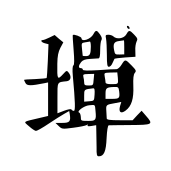
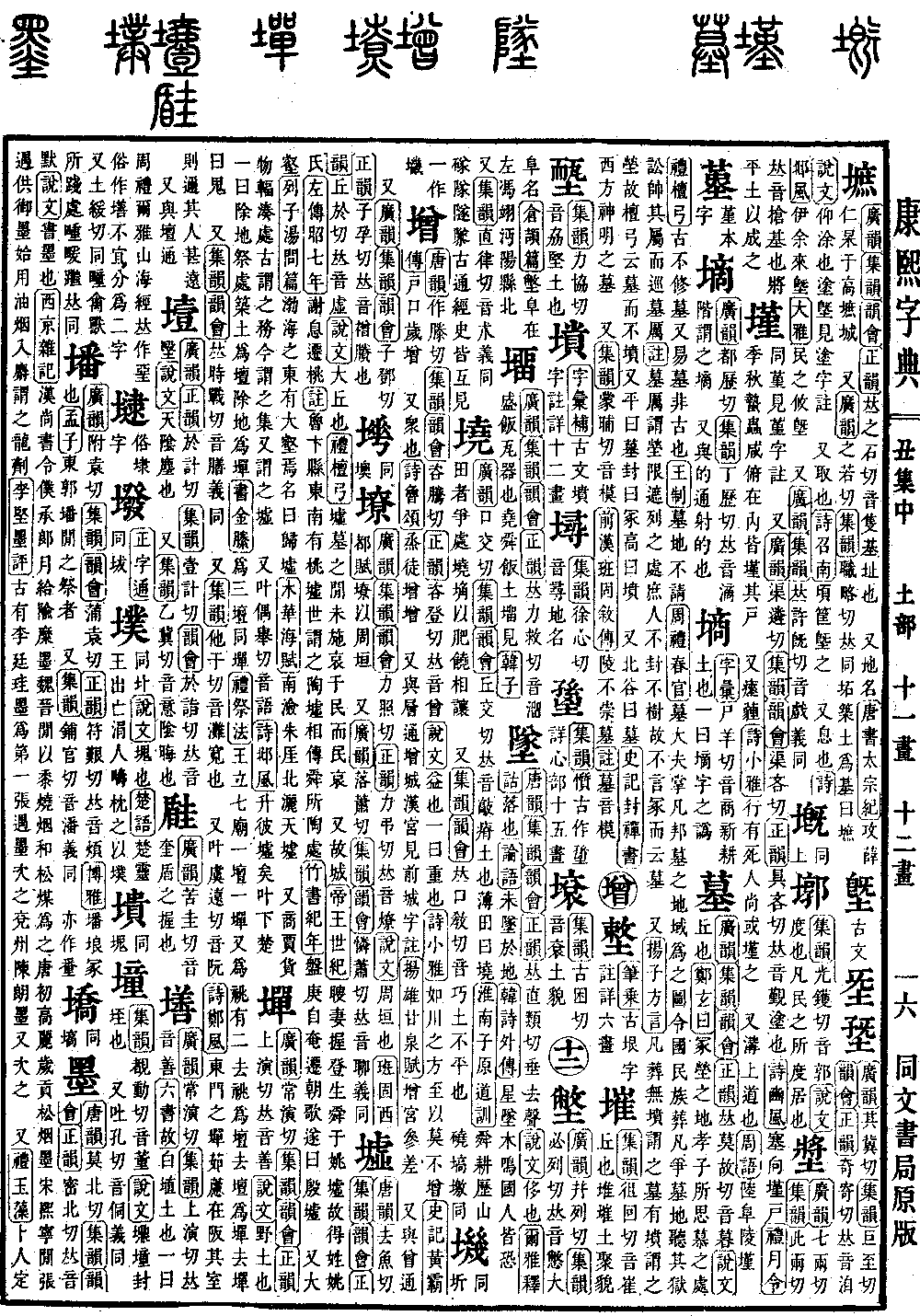
Chou Collection, Middle Volume. Radical: Earth (tǔ). Kangxi strokes: 15. Page 238, Entry 29.
According to the Extensive Rhymes (Guangyun), pronounced shan (falling tone). According to the Collected Rhymes (Jiyun), Rhyme Association (Yunhui), and Correct Rhymes (Zhengyun), pronounced shan (falling tone). As defined in the Explaining Graphs and Analyzing Characters (Shuowen), it refers to wild, uncultivated soil. Another definition states it is a cleared space for sacrificial purposes, where earth is piled to form an altar, or the ground is leveled to form a level space (shan). In the Book of Documents (Shangshu), chapter Metal Bound Coffer (Jinteng), it states: to make three altars within the same cleared space. In the Book of Rites (Liji), chapter Law of Sacrifices (Jifa), it states: the king establishes seven temples, each with an altar and a cleared space. It also refers to ancestral shrines, and when one removes the shrine, one removes the altar, and when one removes the altar, one removes the cleared space, which is called a ghost. Also, according to the Collected Rhymes (Jiyun) and Rhyme Association (Yunhui), pronounced shan (falling tone), with the same meaning. Also, according to the Collected Rhymes (Jiyun), pronounced tan (level tone), meaning wide or broad. Also, rhyming with yuan (rising tone). In the Book of Odes (Shijing), Zheng Odes, it states: At the cleared space by the east gate, madder grows on the slope. The house is nearby, but the person is very far away. Also, it is interchangeable with the term for altar (tan).