Shen Collection, Upper Volume
Radical: Grass (cǎo)
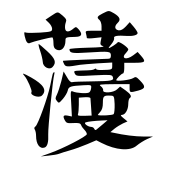
Can; Kangxi strokes: 19
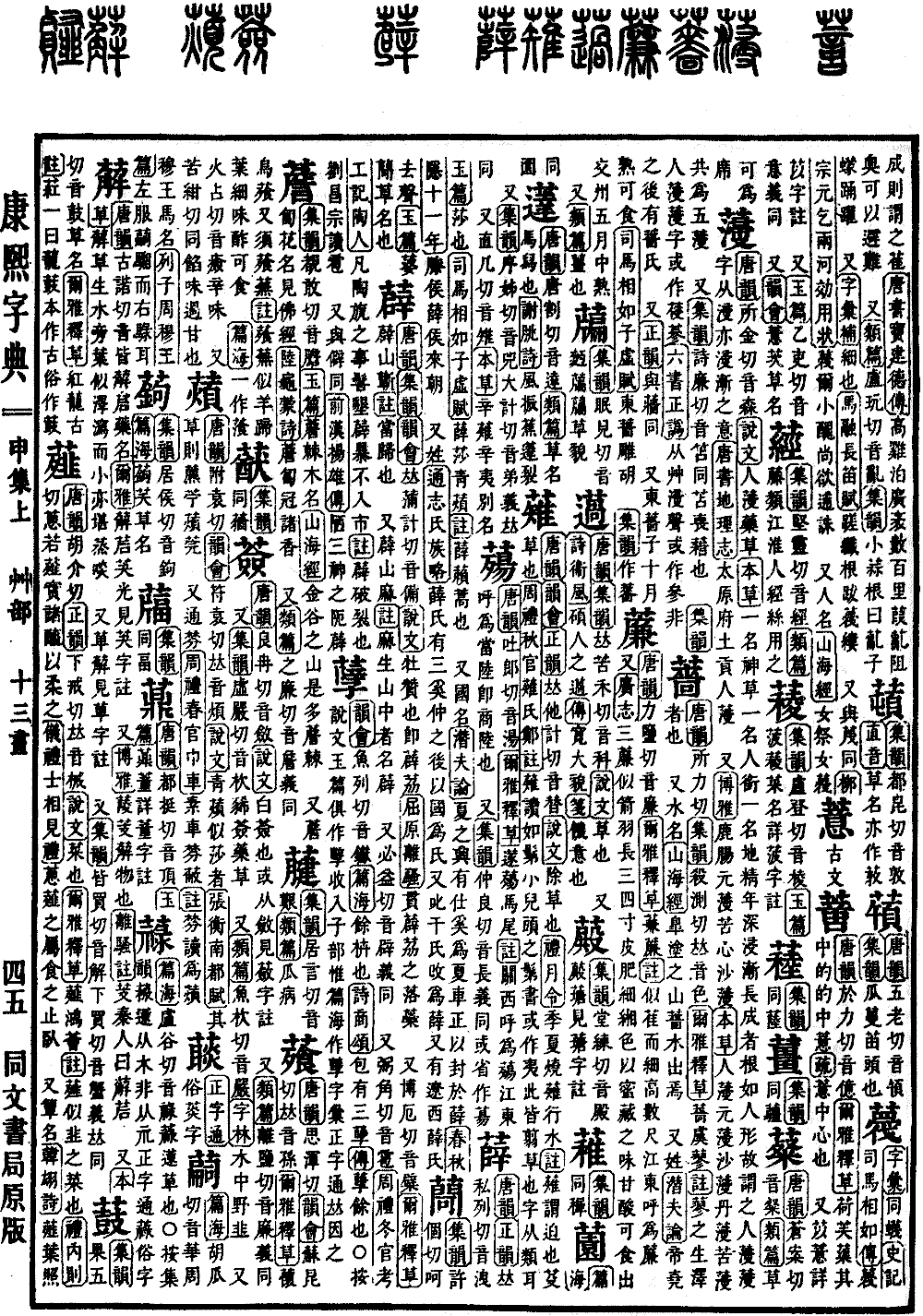
Page 1061, Entry 11
Pronounced sen.
Shuowen Jiezi (Explanation of Simple and Compound Characters): Ren-can is a medicinal herb.
Compendium of Materia Medica (Bencao): Also known as divine herb, human-holding herb, and essence of the earth. When it grows for many years, its root resembles a human shape, hence it is called human-can. The character can follows the meaning of gradually increasing, also signifying the sense of gradual progress.
Book of Tang (Tangshu): Geography Treatise: Taiyuan Prefecture offers human-can as a local tribute.
Also, Guangya (Expanded Elegance): Deer intestine is yuan-can; bitter heart is sha-can.
Compendium of Materia Medica (Bencao): Ren-can, yuan-can, sha-can, dan-can, and ku-can are collectively known as the five cans.
Also, Jiyun (Collected Rhymes): Pronounced shan. Same as the character shan, a mat used during funeral rites.
Jiyun (Collected Rhymes): The character ren-can is sometimes written as can or shen.
Liushu Zheng'e (Rectification of the Six Writings): Follows the grass radical with a phonetic element. Sometimes written as can, which is incorrect.