Wu Collection, Middle Volume
Radical: Eye (mù)
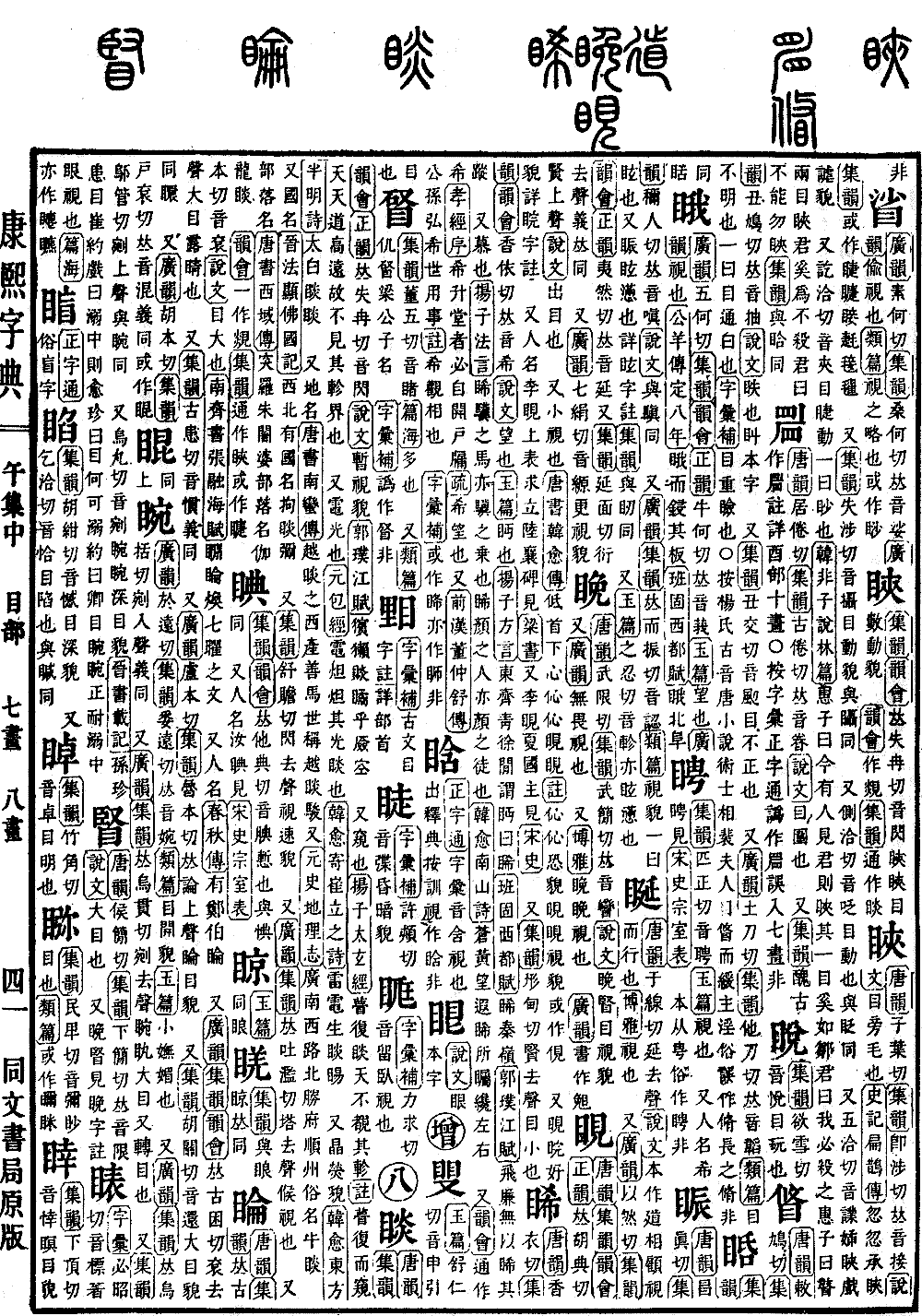
睒
Kangxi Strokes: 13
Page 809, Entry 22
Pronounced shan (falling tone).
According to the Explaining Graphs and Analyzing Characters (Shuowen Jiezi), it describes the appearance of a brief gaze.
From Guo Pu's Rhapsody on the Yangtze (Jiang Fu): The otter peers and glances into the empty abyss.
Also signifies the act of peeping.
From Yang Xiong's Great Mystery (Taixuanjing): Staring dizzily at the sky, one cannot perceive its center.
Commentary: In a state of confusion, one peeps at the sky; the way of heaven is high and distant, thus its boundaries remain unseen.
Also refers to lightning.
From the Yuanbao Jing: The lightning flashes, its light is flickering.
From Han Yu's Poem for Cui Lizhi: Thunder and lightning flash and dart.
Also describes a crystal-clear, twinkling appearance.
From Han Yu's Poem on the Half-Bright East: Venus shines with a twinkling light.
Also a place name.
From the History of the Tang Dynasty (Tangshu), Record of the Southern Barbarians: The west of Yueshan produces fine horses, known as Yueshan steeds.
Also from the History of the Yuan Dynasty (Yuanshi), Treatise on Geography: In the Guangnan Western Circuit, Beisheng Prefecture, Shun Prefecture, commonly known as Niushan.
Also the name of a country.
From A Record of the Buddhistic Kingdoms (Foguo Ji) by Faxian of the Jin: To the northwest lies a country named Kaushambi.
Also pronounced shan (falling tone).
Describes the appearance of a quick look.
Also pronounced ta (falling tone).
Signifies the act of looking.
Also the name of a tribal group.
From the History of the Tang Dynasty (Tangshu), Record of the Western Regions: The Tulu Zhuanpo tribe, called Jialongshan.
According to the Collection of Rhymes (Yunhui), also written as a variant form (zhan).
According to the Collected Rhymes (Jiyun), commonly written as the variant form (shan) or (zhan).