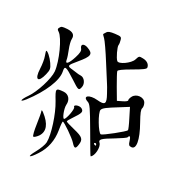
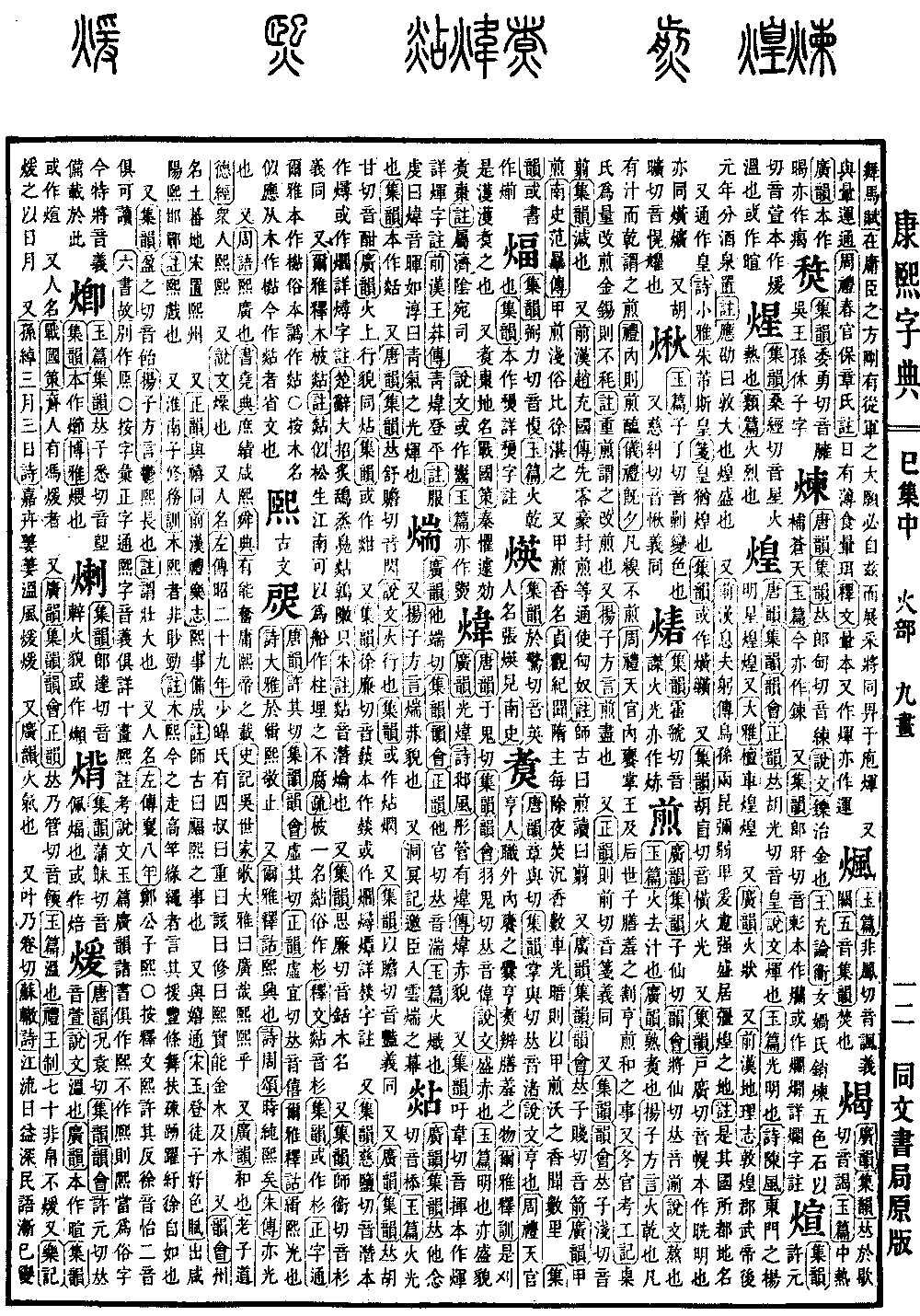
Si Collection, Middle Volume
Radical: Fire (huǒ)
Kangxi Strokes: 13
Page 676, Entry 16
Broad Rhymes (Guangyun) and Collected Rhymes (Jiyun): Pronounced tian.
Jade Chapters (Yupian): The light of fire.
Collected Rhymes (Jiyun): Originally written as a variant form.
Also, Tang Rhymes (Tangyun) and Collected Rhymes (Jiyun): Pronounced shan.
Explaining Graphs and Analyzing Characters (Shuowen): The movement of fire.
Collected Rhymes (Jiyun): Sometimes written as variant forms.
Also, Collected Rhymes (Jiyun): Pronounced yan. Meaning is the same.
Also, Broad Rhymes (Guangyun) and Collected Rhymes (Jiyun): Pronounced han.
Broad Rhymes (Guangyun): The appearance of fire burning upward. Same as a variant form.
Collected Rhymes (Jiyun): Sometimes written as a variant form.
Also, Collected Rhymes (Jiyun): Pronounced lian. Originally written as a variant form. Sometimes written as variant forms. See the detailed notes under the character for that variant.
Also, Collected Rhymes (Jiyun): Pronounced qian. Originally written as a variant form. Sometimes written as a variant form. See the detailed notes under the character for that variant.
Songs of Chu (Chuci), Great Summons (Dazhao): Roasting crows and steaming wild ducks, over a fire of quails arranged in order.
Zhu's Commentary (Zhu zhu): Pronounced qian. Meaning to roast with fire.
Also, Collected Rhymes (Jiyun): Pronounced xian. The name of a type of tree.
Also, Collected Rhymes (Jiyun): Pronounced shan. Meaning is the same.
Also, Literary Expositor (Erya), Explaining Trees (Shim): The pishan tree is a shan tree.
Commentary (Zhu): The shan tree resembles a pine tree, grows in the south of the Yangtze River, and can be used to make pillars for ships; when buried in the ground, it does not rot.
Sub-commentary (Shu): Pishan has another name called shan. It is commonly written as another character.
Explanation of Texts (Shiwen): Pronounced shan.
Collected Rhymes (Jiyun): Sometimes written as another character.
Corrected Meaning (Zhengzitong): The original text of the Literary Expositor (Erya) was written as another character. Popular versions erroneously wrote it as the current character. Note: The name of the tree should seemingly be written with the tree radical. It is now written as the current character, which is a simplified form.