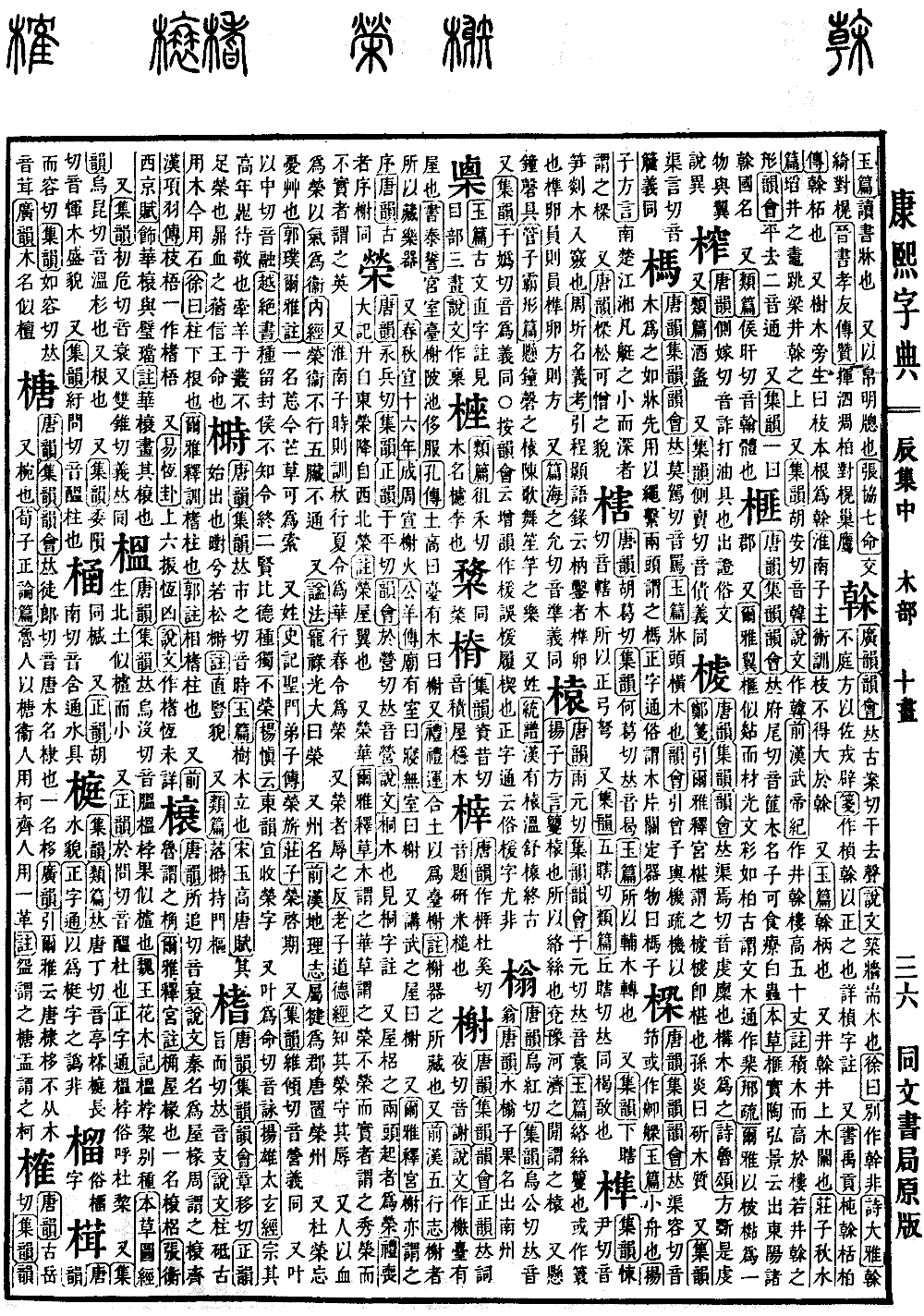
Chen Collection, Middle Volume
Radical: Tree (mù)
Page 544, Entry 01
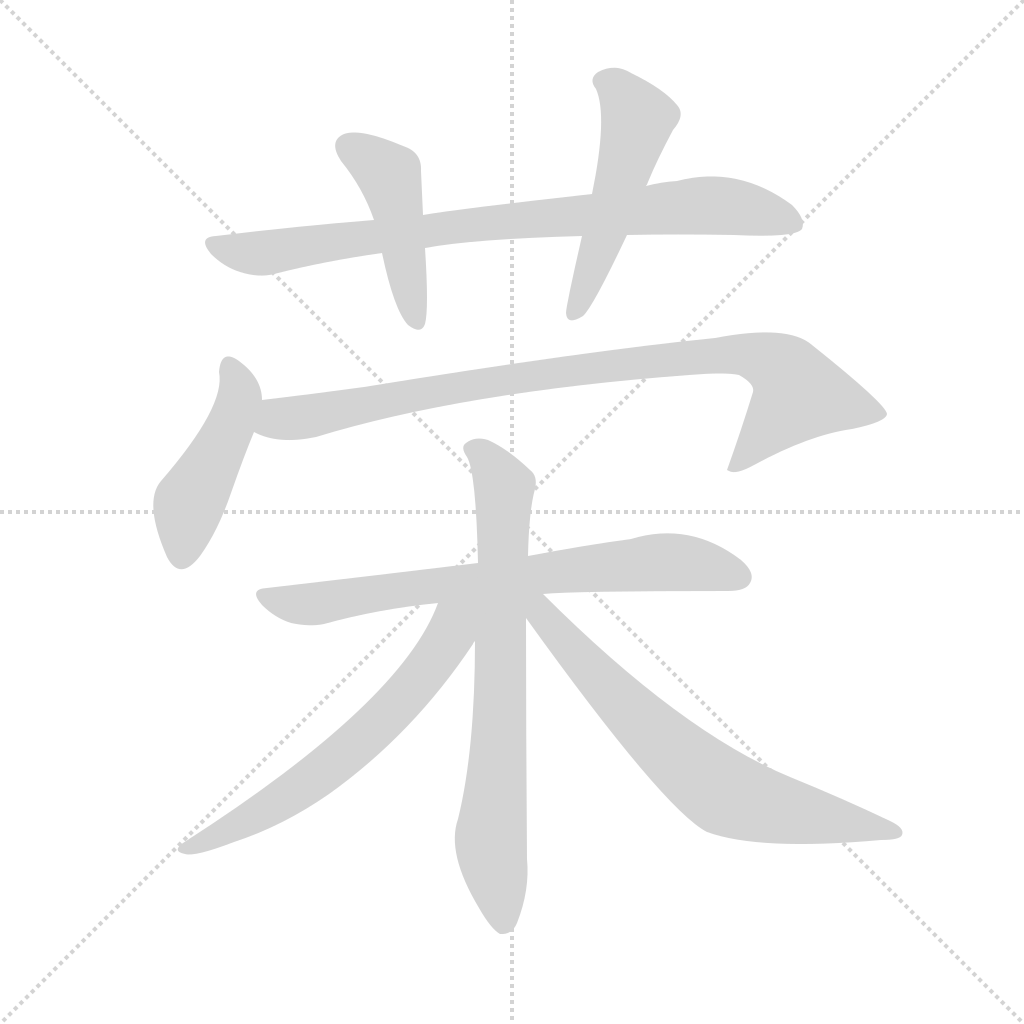
Pronounced ying
According to the Explaining Graphs and Analyzing Characters (Shuowen), this refers to the paulownia tree. See the note under the character for paulownia. It also refers to the curved, upward-turned ends of a roof eave. Book of Rites (Liji), Record of Mourning Ceremonies: Ascend from the curved eave on the east side and descend from the curved eave on the northwest side. The commentary notes that this curved part of the roof is called rong. It also refers to the splendor of flowers. In the Er Ya, Explanation of Plants, it states that when a tree produces flowers, it is called hua, and when a plant produces flowers, it is called rong. When a plant produces fruit without flowering, it is called xiu, and when it produces flowers without fruit, it is called ying. In the Huainanzi, Time and Rule Training (Shize Xun), it states that when summer weather appears in autumn, it is called hua, and when spring weather appears in autumn, it is called rong. Rong is the opposite of shame. Laozi, Classic of the Way and Virtue (Daodejing): Knowing what is glorious, yet keeping oneself in a lowly state. The human body considers blood to be its nourishment (rong) and vital energy (qi) to be its defense (wei). In the Inner Canon (Neijing): If the vital energies of nourishment and defense do not circulate, the five internal organs will not function smoothly. In the Book of Posthumous Titles (Shifa), great favor and generous salary are called rong. It is also the name of a prefecture. In the Former Han, Treatise on Geography (Dili Zhi), it belonged to Jianwei Commandery, and it was established as Rong Prefecture during the Tang dynasty. Du rong is a type of grass. The Er Ya states that wang is du rong. The commentary states that it resembles cogon grass, and its bark can be used to make ropes and straw sandals. It is also a surname. In the Records of the Grand Historian (Shiji), Biography of the Disciples of the Sage, there is Rong Qi. In the Zhuangzi, there is Rong Qiqi. Pronounced ying. The meaning is the same. Pronounced rong. In the Records of the Lost History of Yue (Yuejue Shu): Wen Zhong received the rank of marquis, yet did not know a peaceful end. The two worthies were of equal virtue, yet only Wen Zhong did not attain glory. Yang Shen states that this character should be included in the rhyme group for ying. Pronounced yong. In Yang Xiong, Great Mystery (Taixuan Jing): Venerate those who are aged, and spirits will treat them with respect. Leading a sheep through the brush, it is not worth finding glory. The scent of sacrificial blood in the cauldron is a symbol of adhering to the king's commands.
Correction: Du rong is a type of daylily. Guo Pu, Commentary to the Er Ya, states it is also known as wang, which is modern cogon grass, and can be twisted into rope. Note: Du rong is not a daylily, so it is now amended to: Du rong is a type of grass. The Er Ya states that wang is du rong. The commentary states that it resembles cogon grass, and its bark can be used to make ropes and straw sandals.