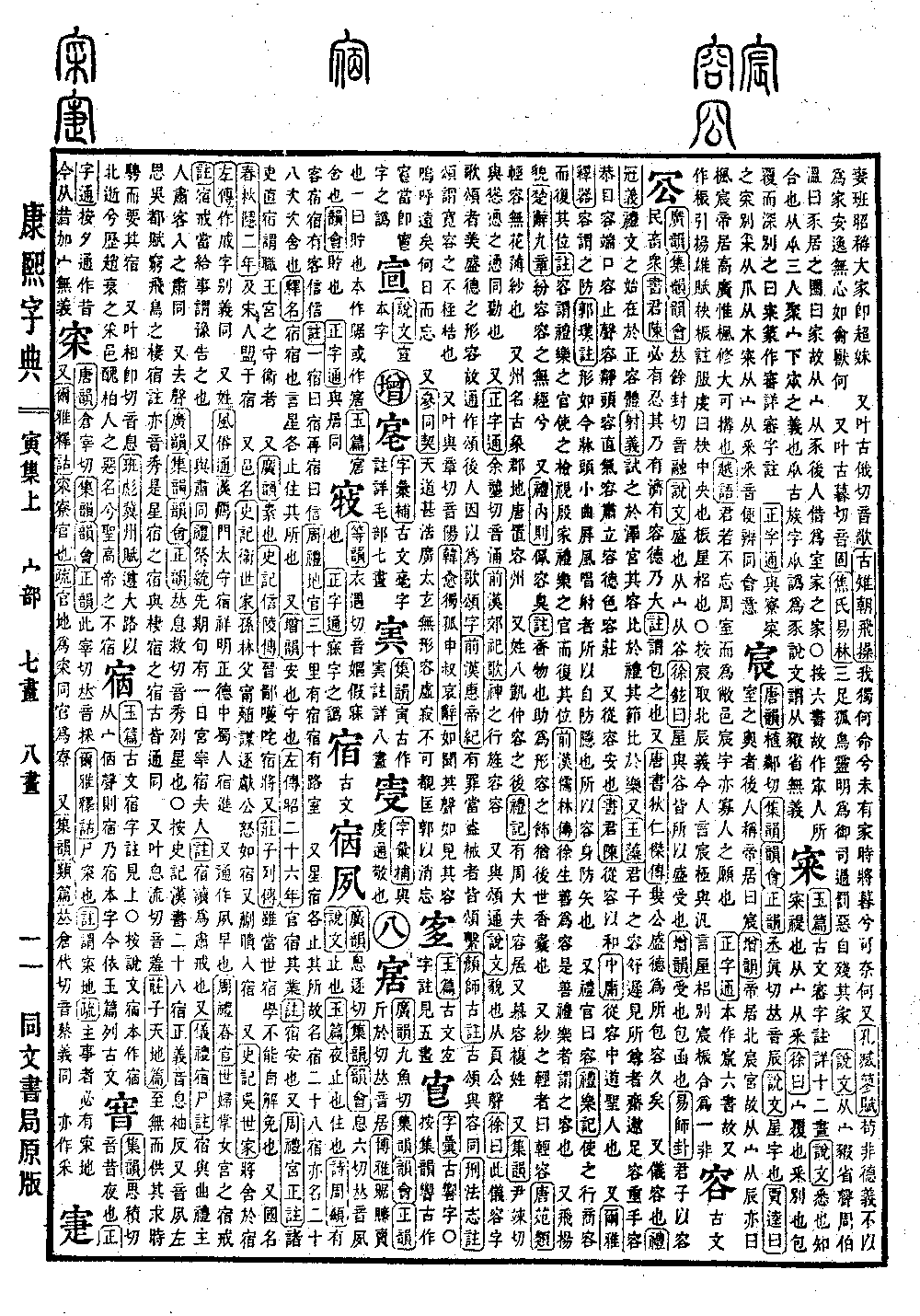
Yin Collection, Upper Volume
Radical: Roof (bù)
Page 287, Entry 03
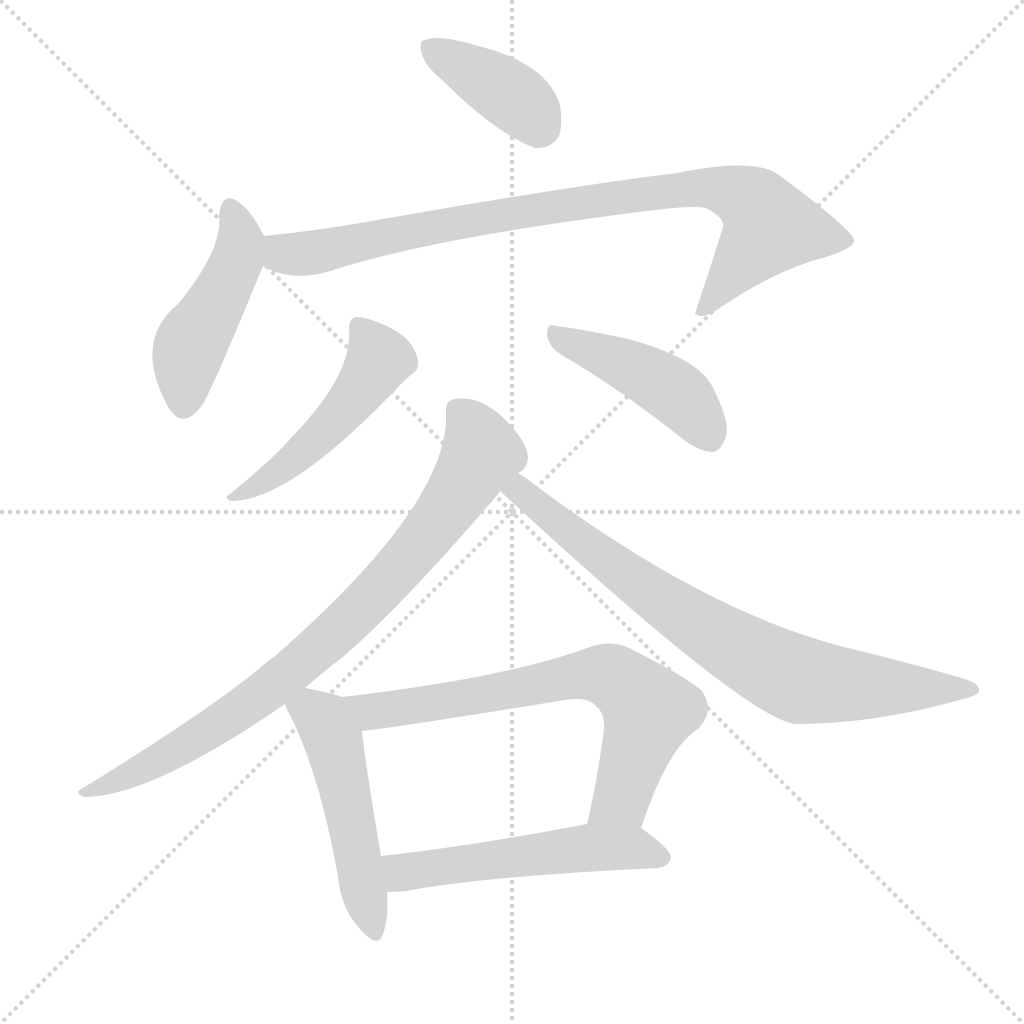
Ancient script. According to the Guangyun (Broad Rhymes) and Jiyun (Collected Rhymes) and Yunhui (Collection of Rhymes), pronounced rong. According to the Shuowen Jiezi (Explaining Single-component Characters and Analyzing Compound Characters), it means to hold or contain. Composed of roof and valley. Xu Xuan commented that houses and valleys are both things that can contain or receive. According to the Zengyun (Expanded Rhymes), it means to accept or include. In the Book of Changes (Yijing), Teacher Hexagram, it states: The superior man uses this to contain the people and nurture the masses. In the Book of Documents (Shujing), Chapter of Jun Chen, it states: One must be able to endure to succeed, and only by containing virtue can one be magnanimous. The commentary states this refers to containment. Also, in the Old Book of Tang (Tangshu), Biography of Di Renjie: Lord Lou’s virtue was great, and he had been containing others for a long time. It also refers to appearance or demeanor. In the Book of Rites (Liji), Meaning of Capping: The beginning of ritual and righteousness lies in rectifying one's appearance and posture. In the Meaning of Archery, it states: Testing him at the archery palace, his demeanor conformed to ritual and his rhythm conformed to music. Also, in the Yuzao: The superior man’s demeanor is relaxed and composed; when seeing a superior, he is respectful and agile; his gait is steady, his gestures respectful, his gaze upright, his mouth calm, his voice quiet, his head and neck straight, his breath solemn, his stance virtuous, and his complexion grave. Also, cong rong means calm and composed. In the Book of Documents (Shujing), Chapter of Jun Chen: Calm and harmonious. In the Doctrine of the Mean (Zhongyong): To be calm and adhere to the middle way is to be a sage. Also, in the Erya, Explaining Vessels, it states: Rong is called a fang. Guo Pu’s commentary states: The shape resembles the small curved screen at the head of a bed today; the person chanting for archery uses it to hide himself and to shelter his body and protect against arrows. Also, a ritual official is called a rong. In the Book of Rites (Liji), Record of Music: Let him search for Shang Rong and restore his position. The commentary states: Rong refers to an official of ritual and music. Let him inspect the ritual and music officials of the Yin dynasty and restore their positions. In the Book of Han (Hanshu), Biographies of Confucian Scholars: Xu Sheng was skilled as a rong. This means those skilled in ritual and music are called rong. Also, the appearance of flying or fluttering. In the Chu Ci (Songs of Chu), Nine Chapters: Fluttering and drifting without discipline. Also, in the Book of Rites (Liji), Inner Chapters: Wear a rong chou. The commentary states: Fragrant items. Used to help adorn one’s appearance and demeanor, similar to the perfume sachets of later generations. Also, thin silk within gauze is called qing rong. According to the Tang Yuan Lei: Qing rong is a thin gauze without patterns. Also, a prefecture name. Located in the area of the ancient Xiang Commandery; established as Rong Prefecture during the Tang dynasty. Also a surname. Descendants of Zhong Rong of the Eight Kais. The Book of Rites (Liji) mentions Rong Ju, a grand officer of the state of Xu. Also, Murong, a double-character surname. According to the Jiyun, pronounced song; the same as the character for instigate or encourage. According to the Zhengzitong (Correction of Character Meanings), pronounced yong. In the Book of Han (Hanshu), Hymns for Suburban Sacrifices: The god travels, and the banners flutter. Also interchangeable with song (to praise). According to the Shuowen Jiezi, it means appearance. From page, with gong as the phonetic. Xu states: This is the character rong for appearance. Song (to praise) is a description that praises grand virtue, so it is often written as song. Later generations therefore used it as a character for song. In the Book of Han (Hanshu), Annals of Emperor Hui: Those who are guilty and should wear shackles are all treated with leniency and restraint. Yan Shigu’s commentary states: In ancient times, song and rong were the same. The commentary to the Treatise on Penal Law states: Song refers to treating with leniency and not wearing the yoke. Also, rhymes with zhang, pronounced yang. In Han Yu’s Elegy for Duguo Shenshu: As if hearing his voice, as if seeing his appearance. Alas, he is gone; when can I ever forget. Also, in the Cantongqi (Triplex Unity): The way of heaven is vast and wide, the great void has no form. Void and silent, it cannot be seen; the outlines are thus dissipated and forgotten.