Wu Collection, Lower Volume
Radical: Grain (hé)
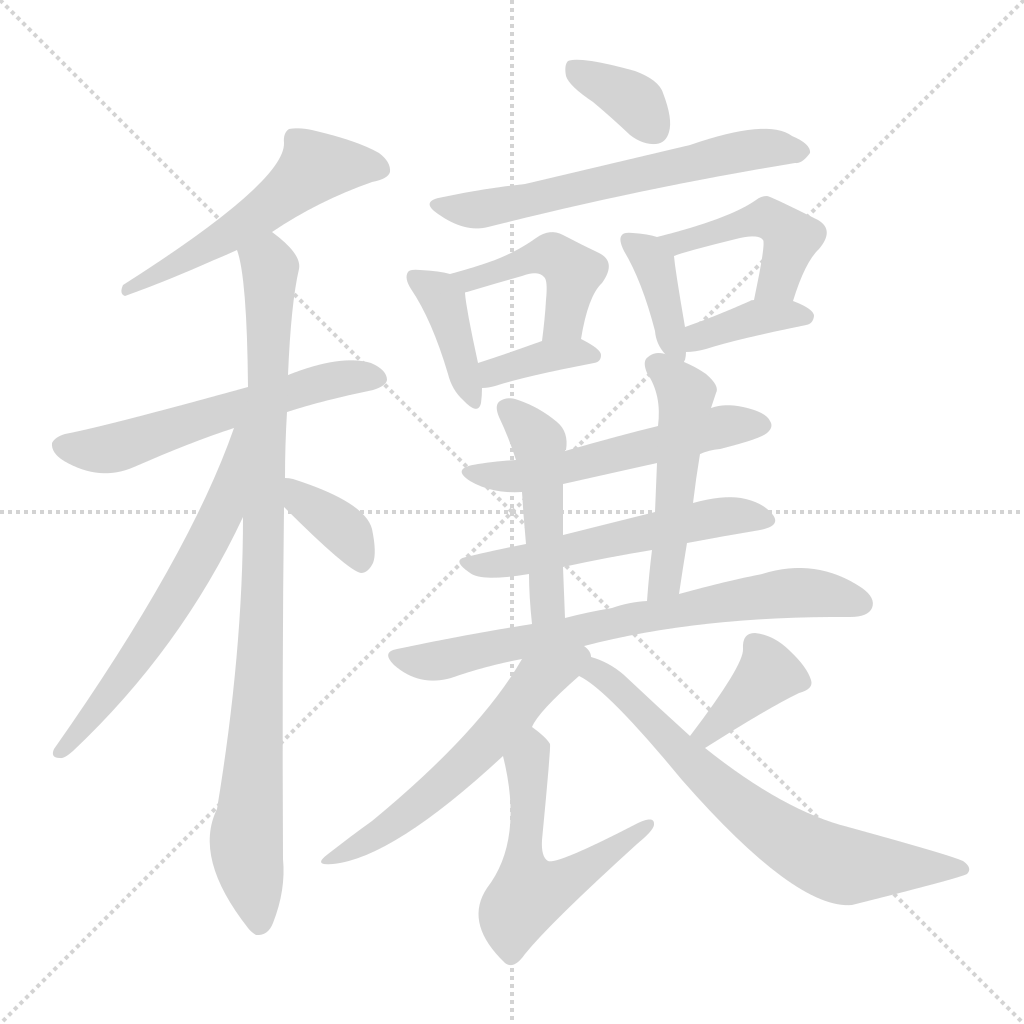
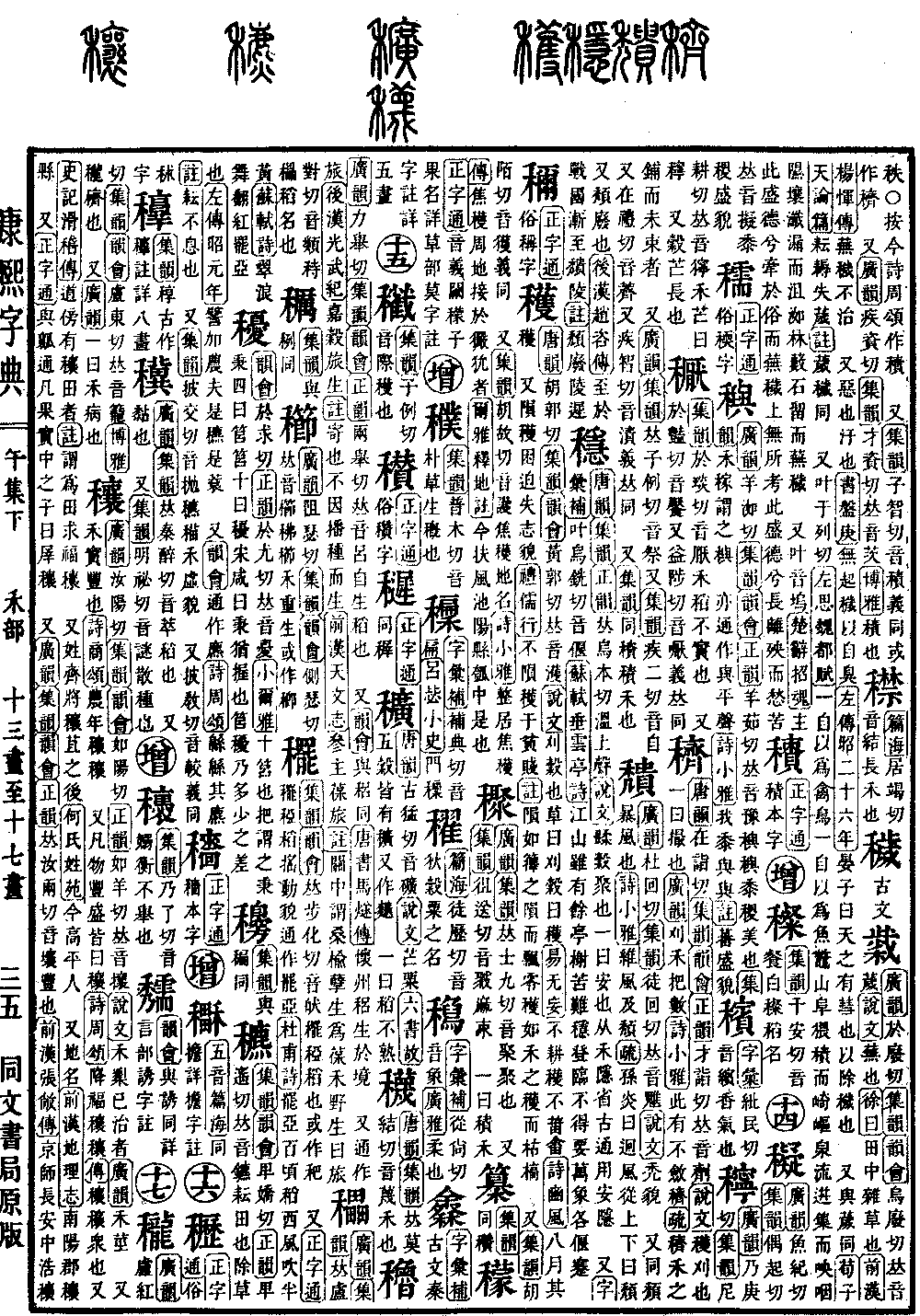
穰
Kangxi stroke count: 22
Page 861, Entry 46
Pronounced rang.
As defined in the Analytical Dictionary of Characters (Shuowen Jiezi), refers to grain that has already been processed. According to the Broad Rhymes (Guangyun), refers to grain stalks. Also refers to a bountiful grain harvest. In the Book of Odes (Shijing), it is written: A bountiful year of plenty. It is also used to describe any object that is abundant or flourishing. In the Book of Odes (Shijing), it is written: Bestowing blessings in abundance. The commentary states that the term indicates a large quantity. According to the Records of the Grand Historian (Shiji), there were those along the road who prayed for a good harvest in the fields. The commentary explains this as seeking blessings for the fields. Also a surname. Descendants of the Qi general Rang Ju. According to the He Family Registry of Surnames (He Shi Xing Yuan), they are currently people of Gaoping. Also a place name. According to the Book of Han (Qian Han Shu), there was a Rang County in Nanyang Commandery. According to the Zhengzitong, it is interchangeable with the character for fruit pulp. Any seeds within a fruit are called pulp.
Pronounced rang (rising tone).
Refers to abundance. According to the Book of Han (Qian Han Shu), the capital city of Chang'an was vast and populous.
Pronounced cheng (level tone).
Refers to the remnants of trampled grain and millet.
Correction: In the citation from the Book of Odes (Shijing), the text was previously given as farming year of plenty; according to the original text, it has been corrected to bountiful year of plenty.