Shen Collection, Lower Volume
Radical: Clothing (yī)
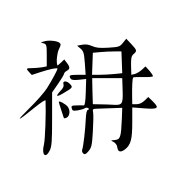
Entry: hu
Kangxi stroke count: 10
Page 1113, Entry 01
Pronounced ran.
Pronounced ran.
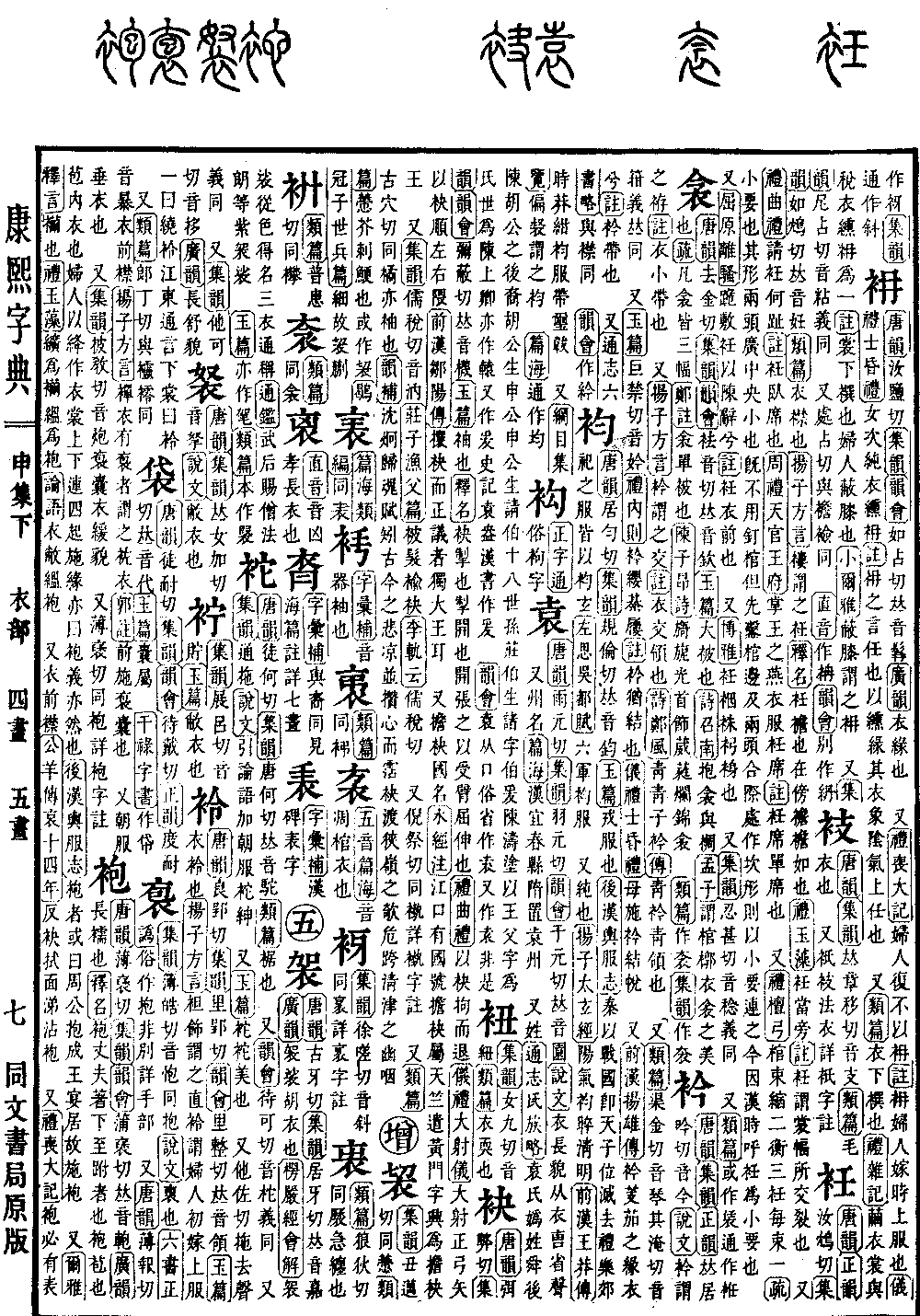
According to the Tang Rhyme (Tangyun), the Broad Rhymes (Guangyun), and the Compendium of Rhymes (Yunhui), the term refers to the hem or edging of a garment.
Also referenced in the Book of Rites (Liji), specifically in the Record of Mourning (Sangdaji): Women do not wear mourning garments with hems. The commentary notes that this refers to the formal upper garment worn by women at the time of their marriage.
In the Book of Etiquette and Ceremonial (Yili), within the Marriage Rites of a Scholar (Shihunli): For a woman, the secondary garment is a plain robe with a crimson hem. The commentary explains that the word for hem (hu) implies the concept of carrying or bearing (ren), indicating that the crimson edge on the garment symbolizes the yin energy rising to bear responsibility.
Additionally, according to the Classified Compendium (Leipian), it refers to the lower hem of a garment.
In the Book of Rites (Liji), in the Miscellaneous Records (Zaji): Silk garments and tax-garments, with crimson hems, are considered one set. The commentary notes that the skirt portion refers to the lower hem, which serves as a woman's knee cover.
The Small Erya (Xiao Erya) defines a knee cover as a hem (hu).
According to the Compendium of Rhymes (Yunhui), pronounced nian. The meaning is the same.
Also pronounced chu. Equivalent to the variant forms chan and lian. In the Direct Pronunciation (Zhiyin), it is written as ran. In the Compendium of Rhymes (Yunhui), it is written separately as a variant form.