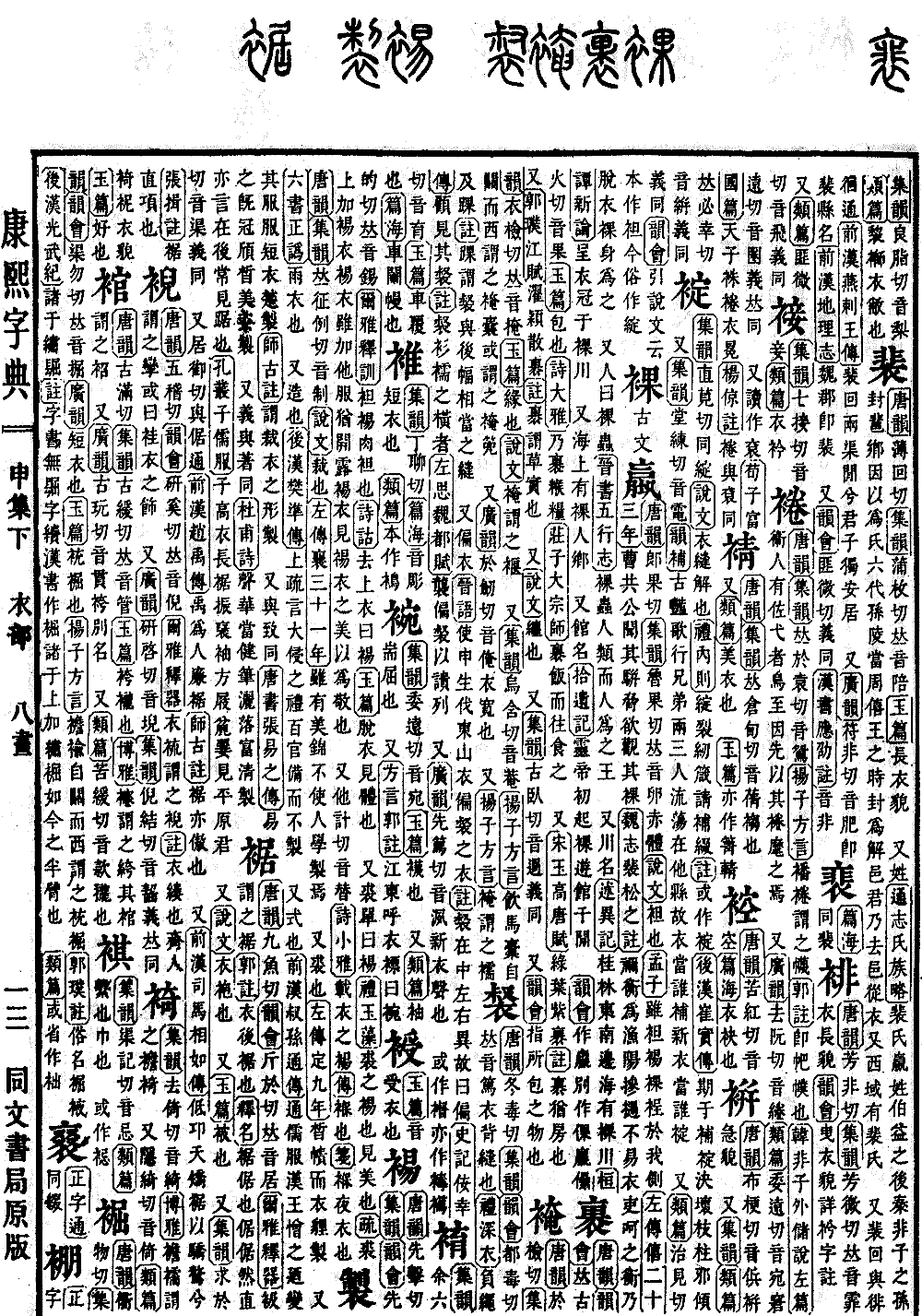
Shen Collection, Lower Volume
Radical: Clothing (yī)
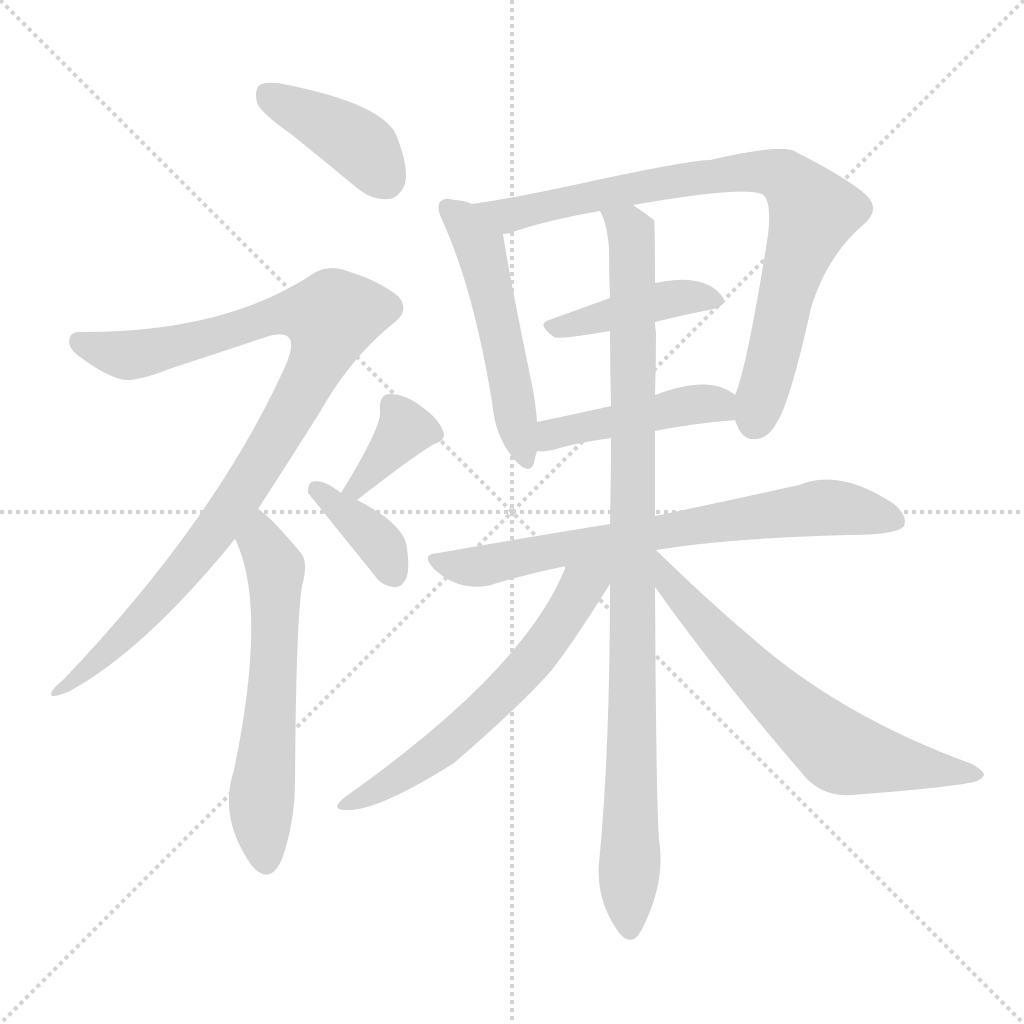
Character: luǒ
Kangxi Strokes: 14
Page 1119, Entry 10
Ancient form: Pronounced luǒ. Naked body. Book of Etymology (Shuowen): To expose. Mencius (Mengzi): Although one may be naked and bare by my side. Commentary on the Zuo Tradition (Zuo Zhuan), twenty-third year of Duke Xi: Duke Gong of Cao heard of his joined ribs and wished to see him naked. Records of the Three Kingdoms (Weizhi), commentary by Pei Songzhi: Mi Heng performed the Yuyang drum beat without changing his clothes; when the official rebuked him, Heng took off his clothes and performed naked.
Also, humans are called naked creatures. Book of Jin (Jinshu), Treatise on the Five Elements: Naked creatures are the human species, and humans are their kings.
Also, a river name. Accounts of Strange Matters (Shuyiji): Southeast of Guilin by the sea, there is the Naked River. New Treatise (Xinlun) by Huan Tan: Displaying robes and caps at the Naked River.
Also, there is a Naked People Village on the sea.
Also, a hall name. Record of Forgotten Matters (Shiyiji): At the beginning of the reign of Emperor Ling, the Naked Wandering Hall with one thousand chambers was constructed.
Dictionary of Rhymes (Yunhui): Written as a variant form, also written as luǒ, luǒ, and léi.