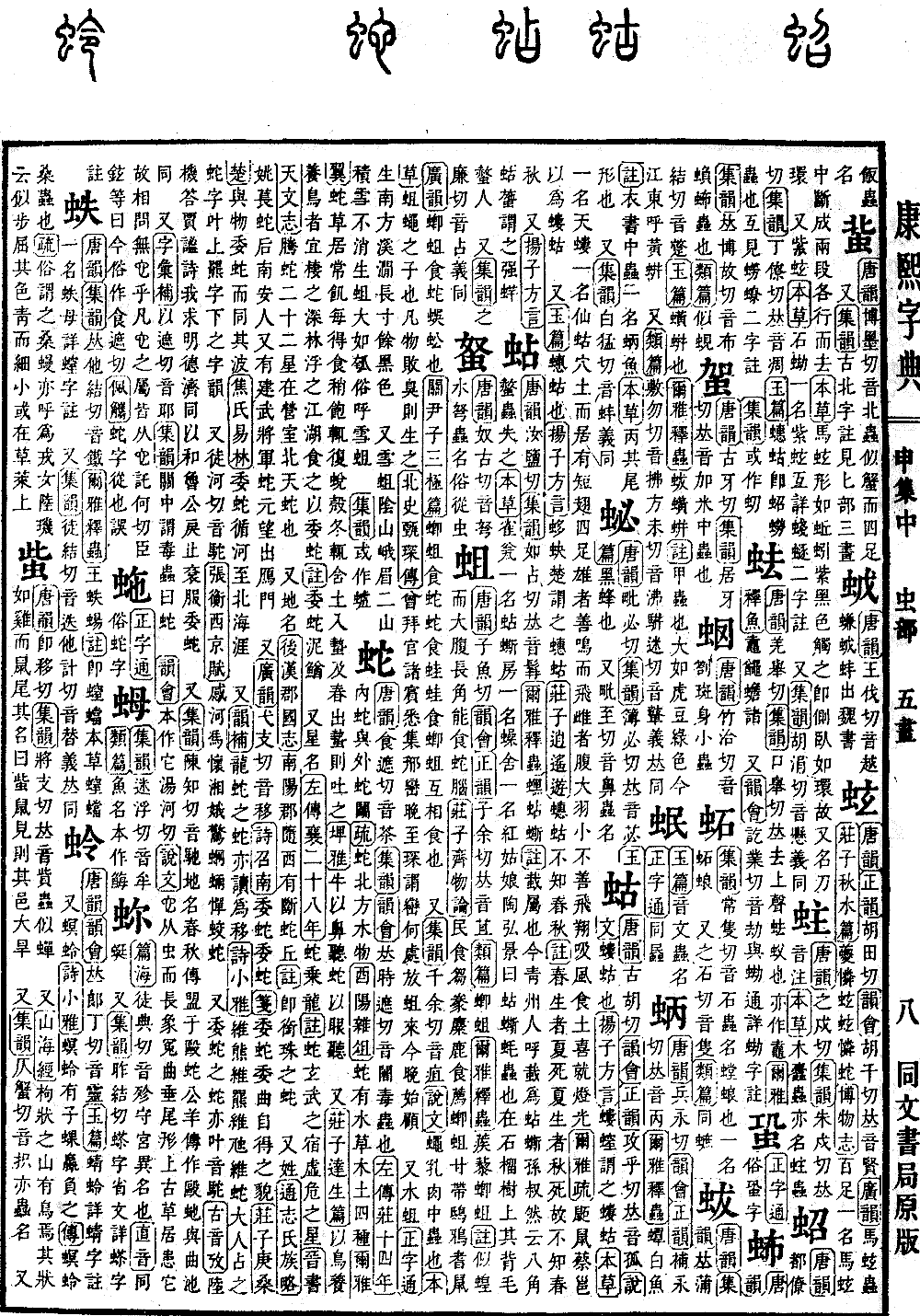
Shen Collection, Middle Volume
Radical: Insect (chóng)
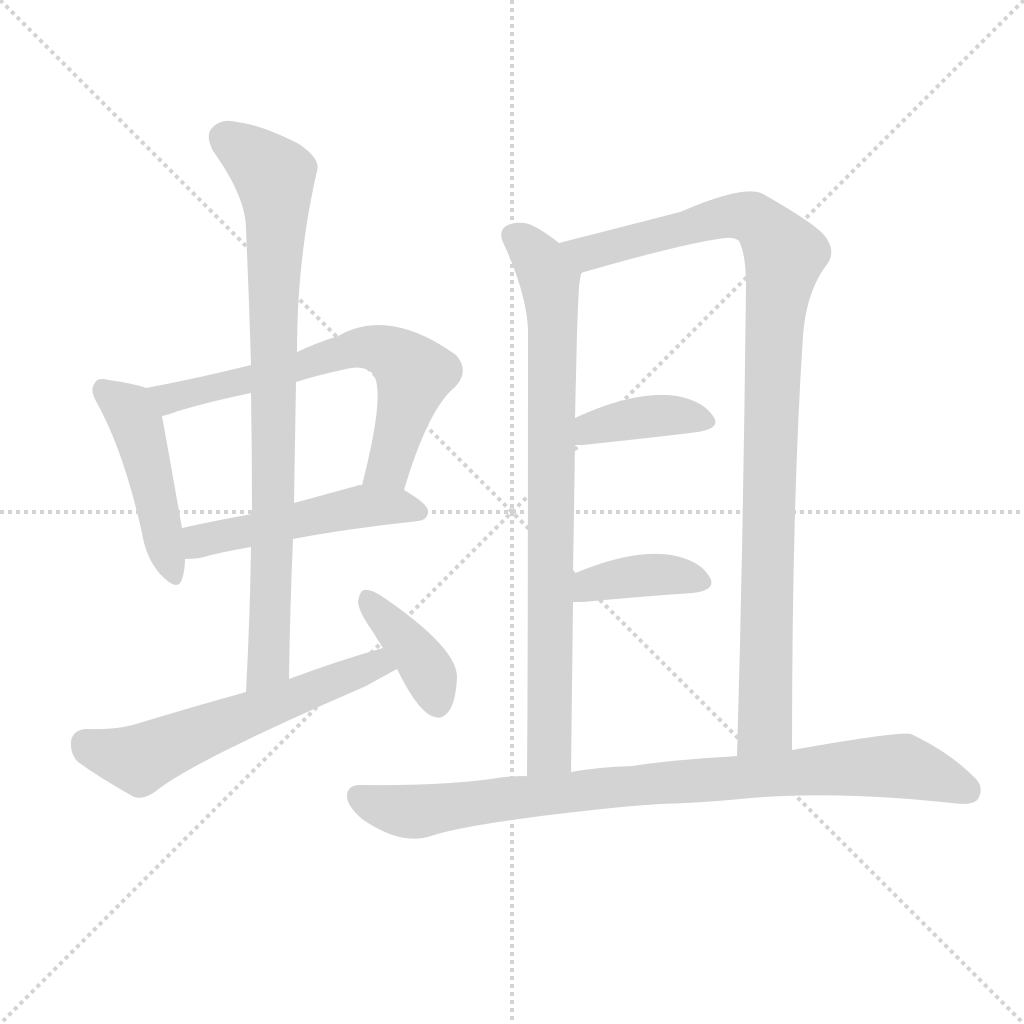
Entry: Maggot (qū)
Kangxi Strokes: 11
Page 1080, Entry 19
Pronounced jū.
In the Classic of Poetry (Shijing) and the Dictionary of Language (Yunhui) and the Corrected Rhymes (Zhengyun), it is defined as the centipede known as the jieju.
In the Erya (Er ya, Explanations on Insects): The jili is the jieju. Commentary: It resembles a locust but has a larger abdomen and long horns; it is capable of eating the brains of snakes.
In the Zhuangzi (Zhuangzi, Discourse on Making All Things Equal): Humans eat livestock, deer eat grass, the jieju loves to eat snakes, and owls and crows love to eat mice.
In the Guangyun (Guangyun): The jieju is a centipede that eats snakes.
In the Guan Yinzi (Guan Yinzi, Three Extremes Chapter): The jieju eats snakes, snakes eat frogs, and frogs eat the jieju; they consume one another.
Also pronounced jū (as cited in Jiyun).
In the Shuowen Jiezi (Shuowen, Origins of Chinese Characters): The eggs laid by blowflies, which become larvae living in flesh.
In the Bencao (Compendium of Materia Medica): The maggot is the larva of the blowfly. Wherever organic matter decays and putrefies, they will be born.
In the History of the Northern Dynasties (Beishi, Biography of Zhen Chen): During an appointment ceremony, the guests had all gathered, but Xing Luan arrived late. Zhen Chen said to Xing Luan: Where did you spawn from like a maggot, arriving so late?
Also water maggot: In the Zhengzitong (Zhengzitong, Correct Character Guide), it is described as growing in southern streams, over an inch long, and black in color.
Also snow maggot: In the Yin Mountains and Mount Emei, where snow does not melt, there exist maggots as large as gourds, commonly referred to as snow maggots.
In the Jiyun (Jiyun), it is sometimes written in a variant form.