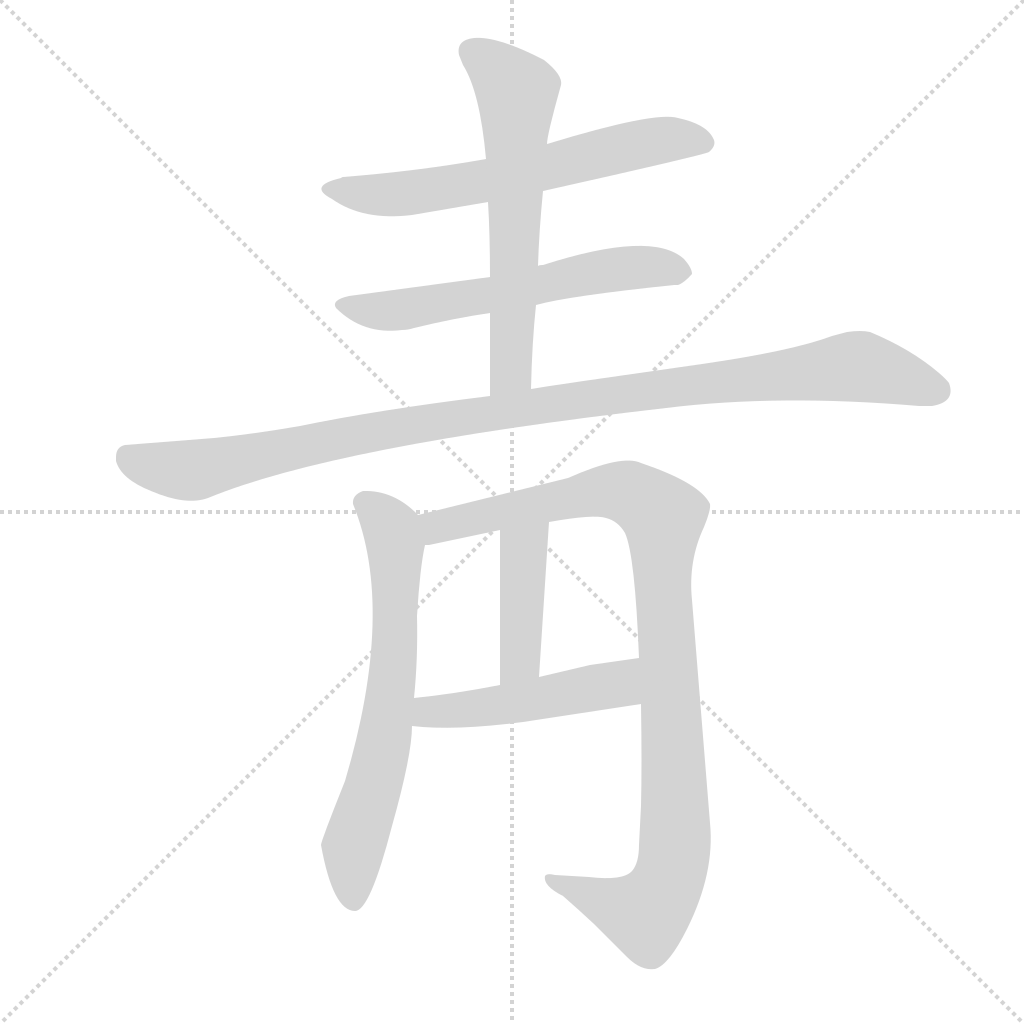
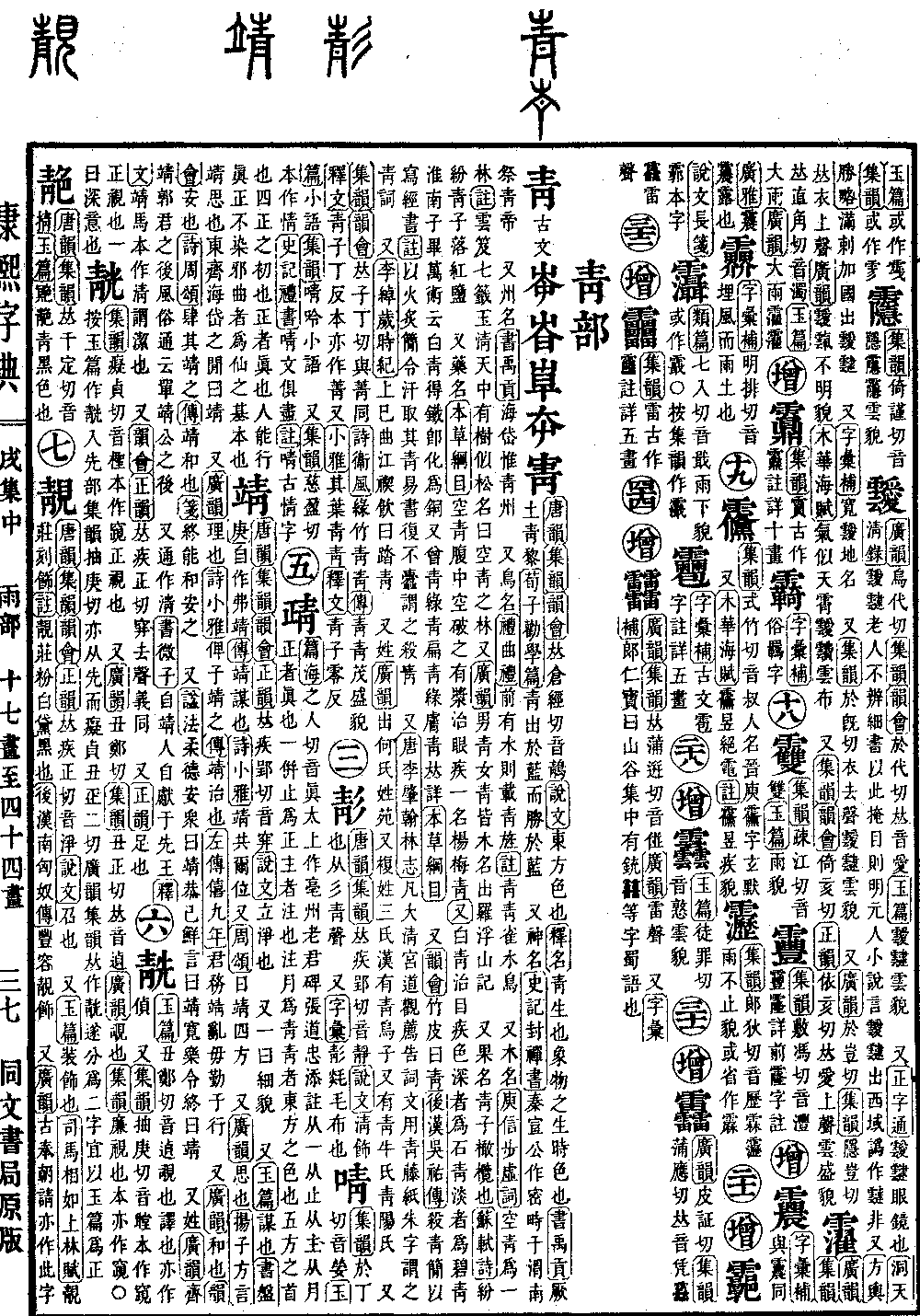
Xu Collection, Middle Volume. Radical: Blue (qīng). Kangxi stroke count: 8. Page 1381, Entry 19.
Ancient form written as qìng.
Tangyun, Jiyun, and Yunhui record its pronunciation as cang; it sounds the same as jīng.
Shuowen Jiezi explains: This is the color of the east.
Shiming explains: Qing means to be born. It symbolizes the color of all things as they grow.
Book of Documents (Shangshu), Tribute of Yu (Yugong) records: The soil there is blue-black.
Xunzi, Exhortation to Learning (Quanxue pian) states: It is extracted from the indigo plant, yet it is bluer than the indigo plant itself.
Also refers to a deity's name.
Records of the Grand Historian (Shiji), Treatise on the Feng and Shan Sacrifices (Fengshan shu) records: Duke Xuan of Qin built the Mi Shrine south of the Wei River to sacrifice to the Blue Emperor.
Also refers to the name of a province.
Book of Documents (Shangshu), Tribute of Yu (Yugong) records: Between the great sea and Mount Tai is Qing Province.
Also refers to a bird's name.
Book of Rites (Liji), Summary of the Rules of Propriety (Qu Li) records: When there is water in front, raise a banner painted with a blue sparrow.
Note: Qing refers to the blue sparrow, a type of water bird.
Also refers to a tree's name.
Yu Xin, Bu Xu Ci writes: Forests of empty-blue trees.
Note: Yunji Qiqian records that in the Heaven of Jade Purity, there is a tree resembling a pine, named the Forest of Empty Blue.
Also, Guangyun records: Male-qing and female-qing are both names of trees. Cited from Records of Mount Luofu (Luofushan ji).
Also refers to a fruit's name. Qingzi refers to the olive.
Su Shi has a line of poetry that reads: Numerous green fruits fall into red salt.
Also refers to a medicinal substance's name.
Compendium of Materia Medica (Bencao Gangmu) records: Kongqing is hollow in the middle, and when broken open, it contains fluid; it can treat eye diseases. Another name is Yangmei Qing.
It also records: Baiqing treats eye diseases; the deep-colored variety is Shiqing, and the light-colored variety is Biqing. Huainanzi, Art of Biwan states: Baiqing, when it encounters iron, can turn into copper.
There are also Zengqing, Lüqing, Bianqing, and Lüfuqing, for which detailed descriptions are found in the Compendium of Materia Medica (Bencao Gangmu).
Also, Yunhui records: The outer layer of bamboo is called qing.
Book of the Later Han (Hou Hanshu), Biography of Wu You records: Shaqing (killing the green) is used for copying classic texts.
Note: Heating bamboo strips over a fire to cause them to sweat (removing moisture) reveals their green layer, which makes writing easier and prevents insect damage; this is called shaqing.
Also, Tang dynasty Li Zhao, Hanshan Zhi records: All sacrificial texts offered by the Taiqing Palace and Daoist temples are written on green rattan paper with red ink; these are called qingci.
Also, Li Chuo, Suishi Ji records: The drinking feast held by the Qu River during the Shangsi Festival is called taqing (treading the green).
Also acts as a surname.
Guangyun records it as originating from He Shi Xingyuan.
There are also three compound surnames; during the Han dynasty, there was Qingwuzi. There are also Qingniushi and Qingyangshi.
Also, Jiyun and Yunhui record the pronunciation as zīng. It is the same as the character jīng.
Book of Odes (Shijing), Odes of Wei (Wei Feng) writes: The green bamboo is lush.
Commentary: Qingqing means the appearance of being lush.
Jingdian Shiwen: Qing is pronounced zīng. Some versions are also written as jīng.
Also, Book of Odes (Shijing), Minor Odes (Xiao Ya) writes: Its leaves are lush.
Jingdian Shiwen: Qing is pronounced líng.
Verification: Xunzi, Exhortation to Learning (Quanxue pian) states: Blue is extracted from the indigo plant, yet it is bluer than the indigo plant. I have corrected the original text to read: Extracted from the indigo plant and bluer than the indigo plant.