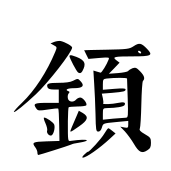
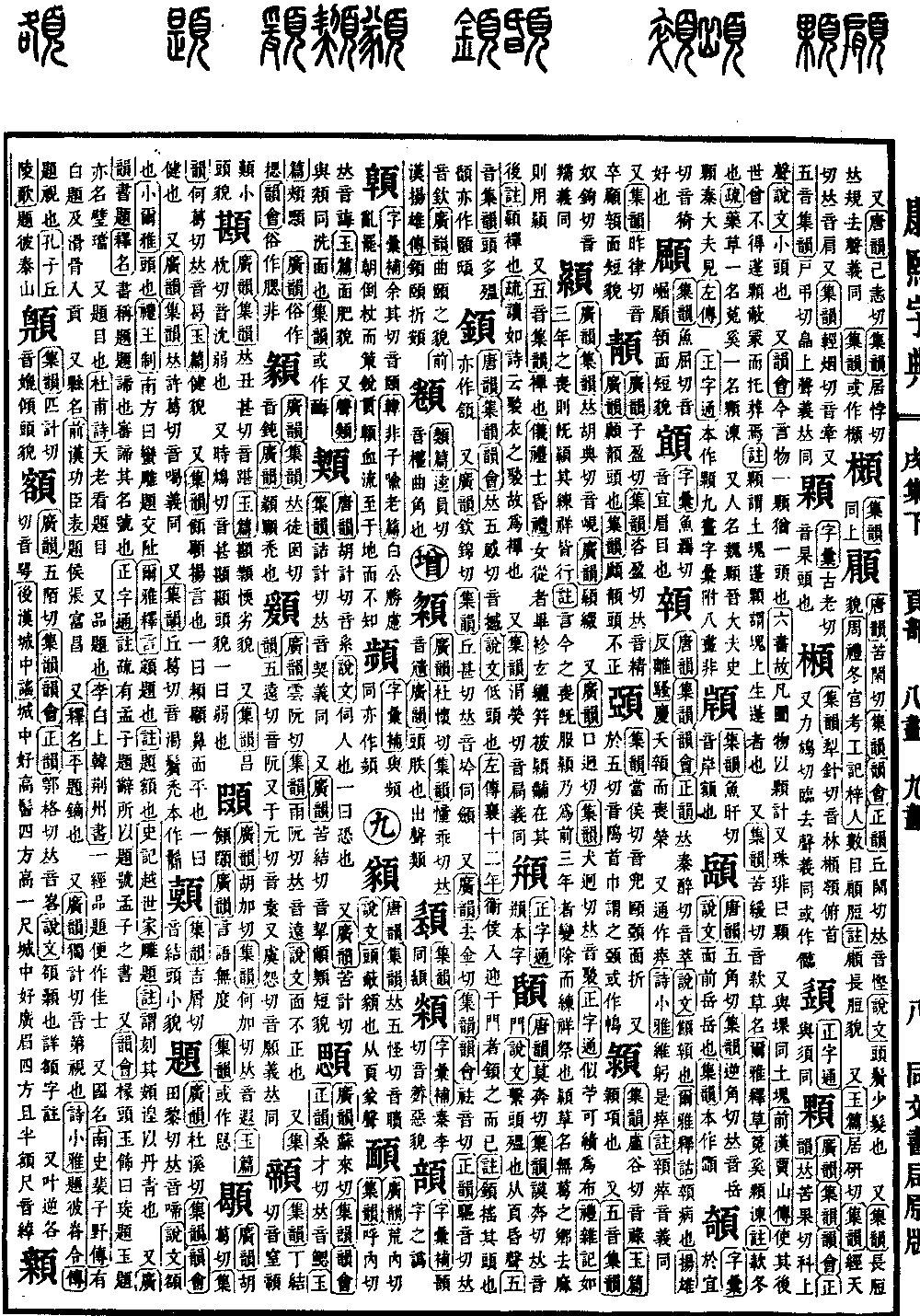
Xu Collection, Lower Volume
Radical: Leaf (yè)
Kangxi Strokes: 17
Page 1406, Entry 19
Pronounced han (falling tone)
Shuowen Jiezi (Explanation of Graphs and Analysis of Characters): The meaning of bowing one's head.
Citation: Zuo Commentary (Zuozhuan), Twenty-Sixth Year of Duke Xiang: When meeting at the gate, one simply bows the head as a sign of acknowledgment. In current editions, this is written as the character for chin (han). The commentary by Du Yu notes: This character means to nod or shake the head.
Also:
Pronounced ken (falling tone)
The same as the variant form (yan).
Also:
Pronounced qin (level tone)
Guangyun (Broad Rhymes): The appearance of a curved chin.
Citation: History of the Former Han (Qian Hanshu), Biography of Yang Xiong: Chin curved and nasal bridge collapsed.
Verification notes:
Regarding the citation from the Zuo Commentary (Zuozhuan), Twelfth Year of Duke Xiang: The person who met the Duke of Wei at the gate simply bowed his head. The commentary states that this character means to shake the head and is also written as the character for chin (han). A careful examination reveals this event occurred in the twenty-sixth year of Duke Xiang; therefore, following the original text of the Shuowen Jiezi (Explanation of Graphs and Analysis of Characters), the citation has been corrected to refer to the Twenty-Sixth Year of Duke Xiang, noting that when meeting at the gate, one simply bows the head as a sign of acknowledgment, and that current editions write this as the character for chin (han), which the commentary by Du Yu defines as shaking the head.