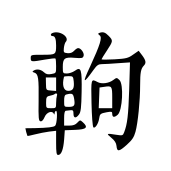
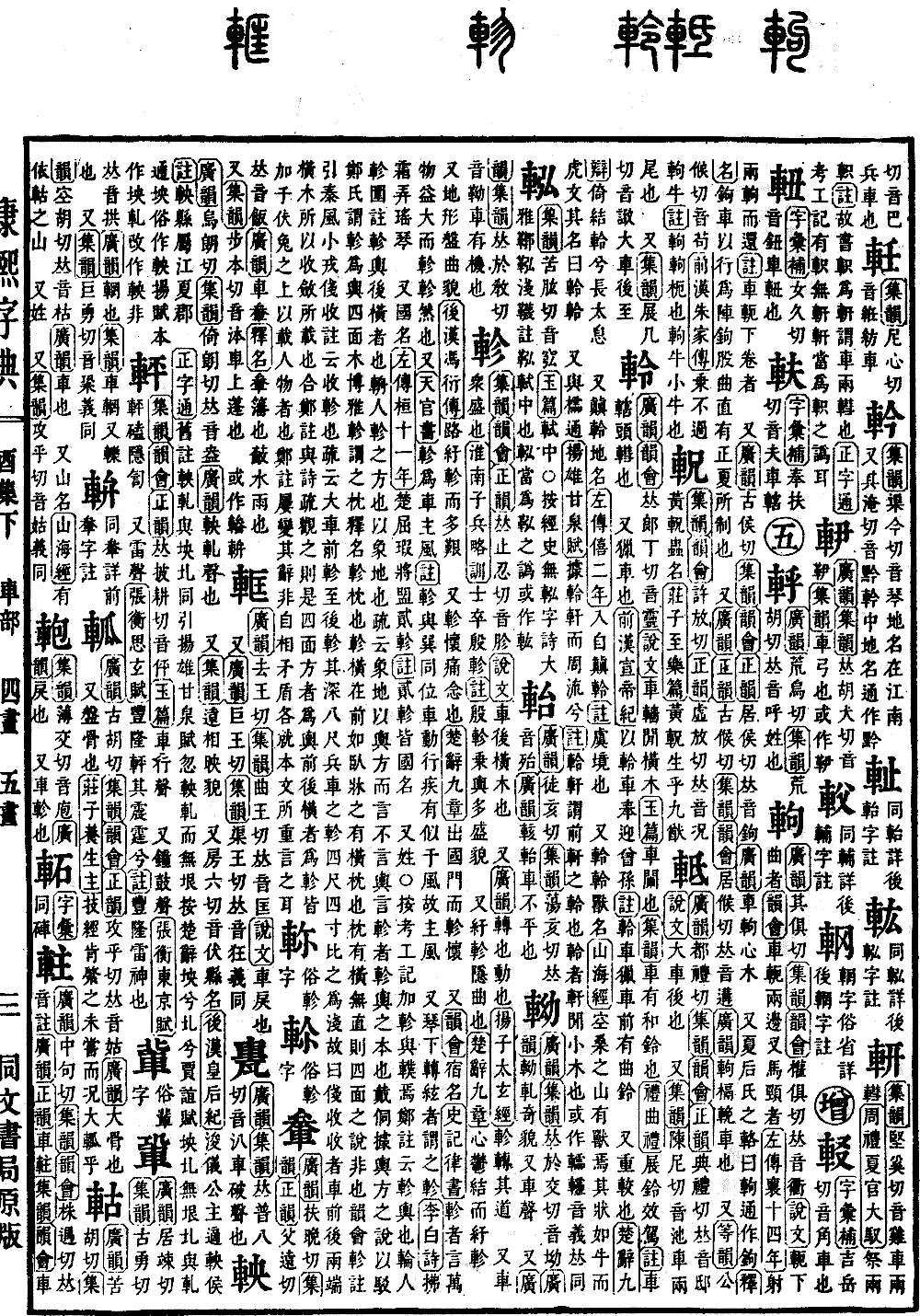
You Collection, Lower Volume
Radical: Carriage (chē)
Kangxi Strokes: 12
Page 1241, Entry 13
Guangyun (Guangyun): Pronounced qu.
Jiyun (Jiyun), Yunhui (Yunhui): Pronounced qu.
Shuowen (Shuowen): The curved part under a yoke.
Yunhui (Yunhui): The parts on both sides of a carriage yoke that fork around a horse's neck.
Zuo Zhuan (Zuozhuan): Shot at the two yokes and returned.
Commentary: The curved part under a carriage yoke.
Guangyun (Guangyun): Pronounced gou.
Jiyun (Jiyun), Yunhui (Yunhui), Zhengyun (Zhengyun): Pronounced gou.
Guangyun (Guangyun): The central wooden piece of a carriage yoke. Also, the ceremonial carriage of the Xia dynasty was called a gou. It is interchangeable with the character gou.
Shiming (Shiming): The hooked carriage was used to form ranks in battle; its hooked and straight parts were correctly balanced, a system established by the Xia dynasty.
Guangyun (Guangyun), Zhengyun (Zhengyun): Pronounced gou.
Jiyun (Jiyun), Yunhui (Yunhui): Pronounced gou.
Guangyun (Guangyun): Gouge, a device for pulling a carriage.
Dengyun (Dengyun): Pronounced gou.
History of the Former Han (Qianhan): Riding in a carriage drawn by no more than a gou bullock.
Commentary: A gou is a yoke-crosspiece. A gou bullock is a small bullock.