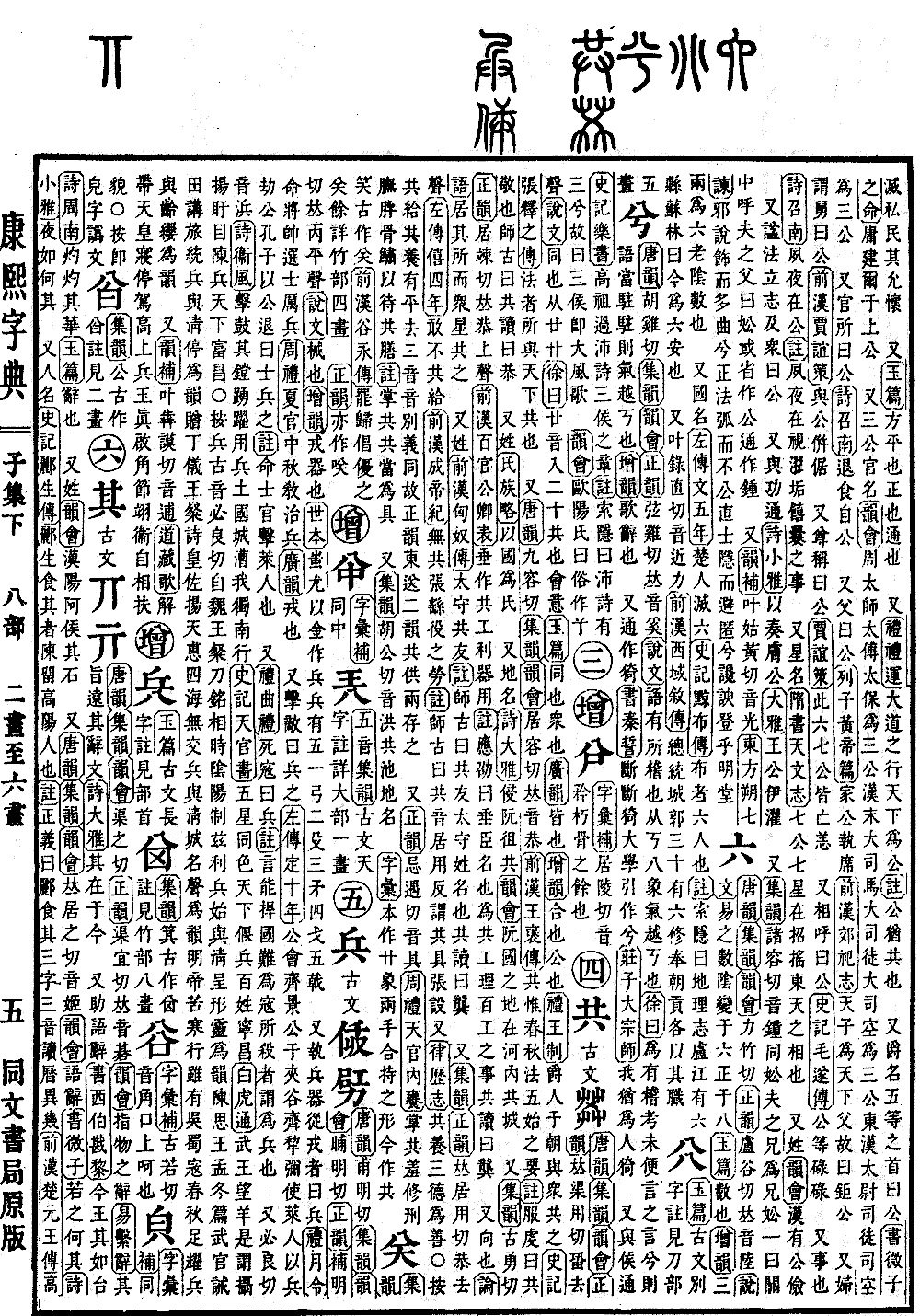
Zi Collection, Page Position: Lower. Radical: Eight (bā). Character: qí. Kangxi Dictionary Stroke Count: 8. Page 127, Column 18.
Ancient forms were written as jī or qí.
Tang Rhymes (Tangyun), Collected Rhymes (Jiyun), and Rhyme Assembly (Yunhui) provide the fanqie pronunciation as qú and zhī. Correct Rhymes (Zhengyun) provides the fanqie as qú and yí. It is pronounced the same as the character for the game of go (qí).
Rhyme Assembly (Yunhui) explains it as a pronoun referring to things. For example, the Classic of Changes (Yijing), Appended Phrases (Xici) states: Its meaning is far-reaching, and its language is elegant. The Book of Odes (Shijing), Greater Odes (Daya) states: It remains so until today.
Also used as a modal particle. For example, the Book of Documents (Shangshu), The Chief of the West's Conquest of Li (Xibo Kan Li) states: Now, what will the King do to me? The Book of Odes (Shijing), Odes of Zhou and the South (Zhounan) states: Brilliant are its flowers. Jade Chapters (Yupian) explains it as a grammatical particle.
Also used as a surname. Rhyme Assembly (Yunhui) records that during the Han dynasty, there was a Marquis of Yang'e named Qi Shi.
Also, Tang Rhymes (Tangyun), Collected Rhymes (Jiyun), and Rhyme Assembly (Yunhui) provide the fanqie pronunciation as jū and zhī, pronounced the same as jī.
Rhyme Assembly (Yunhui) explains it as a grammatical particle. For example, the Book of Documents (Shangshu), Viscount of Wei (Weizi) states: What can be done about it? The Book of Odes (Shijing), Lesser Odes (Xiaoya) states: How is the night passing?
Also used in personal names. The Records of the Grand Historian (Shiji), Biography of Master Li (Lisheng Liezhuan) records: The scholar Li Yiji was a man from Gaoyang. The commentary states that the three characters in the name Li Yiji are pronounced as lì, yì, and jī. The Book of Han (Hanshu), Biography of King Yuan of Chu (Chuyuanwang Zhuan) records: Emperor Gaozu ordered Shen Yiji to remain and attend to the Retired Emperor. The commentary by Yan Shigu states that the character for food (shí) is pronounced as yì, and the character qí is pronounced as jī.
Also used as a mountain name. The Book of Han (Hanshu), Annals of Emperor Wu (Wudi Ji) records: In the fourth month, the Emperor visited Buqi. The commentary states that in this context, the character is pronounced as jī and is the name of a mountain. Expanded Rhymes (Guangyun) records it as being located in Langya.
Also used as a place name. Rhyme Assembly (Yunhui) records that Zhuqi is the same place as Jiagu.
Also, Collected Rhymes (Jiyun) and Rhyme Assembly (Yunhui) provide the fanqie pronunciation as jū and lì. Correct Rhymes (Zhengyun) provides the fanqie as jí and qì. It is pronounced the same as the character for send (jì).
Rhyme Assembly (Yunhui) explains it as a sentence-final modal particle. For example, the Book of Odes (Shijing), Odes of Gui (Guifeng) states: That person there. Used interchangeably with the character pronounced jì. The Record of Rites (Liji), The Record on the Example (Biaoji) quotes the Book of Odes (Shijing) using the character pronounced jì instead. Also used interchangeably with the character pronounced yǐ. The Zuo Commentary (Zuozhuan), Twenty-seventh Year of Duke Xiang, quotes the Book of Odes (Shijing) using the character pronounced jǐ.
Also, Rhyme Assembly (Yunhui) notes it is sometimes written as the character pronounced jì. For example, the Book of Odes (Shijing), Odes of Zheng (Zhengfeng) states: Shu is a good archer.