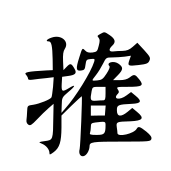
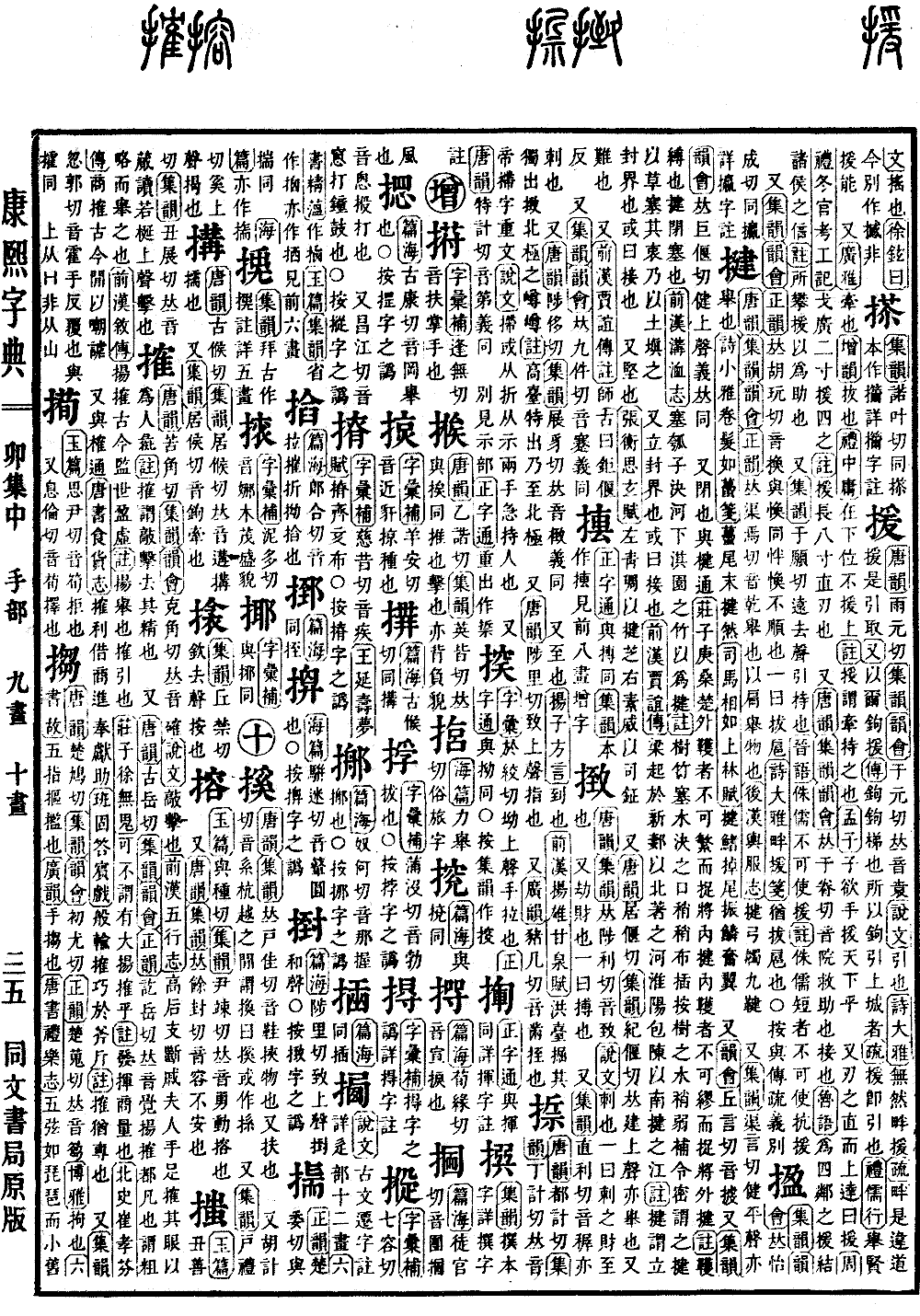
Mao Collection, Middle Volume
Radical: Hand (shǒu)
Kangxi stroke count: 14
Page 445, Entry 40
Pronounced que.
As defined in the Analytical Dictionary of Characters (Shuowen Jiezi), it means to strike or knock.
In the History of the Former Han (Hanshu), in the Record of the Five Elements, it is written: After the Empress Dowager broke the hands and feet of Lady Qi, she struck (que) her eyes and turned her into a human swine. The commentary notes that que refers to striking or knocking out the essence.
Pronounced jue.
Yangque refers to a general summary. It means to mention something broadly or roughly.
In the History of the Former Han (Hanshu), in the Introductory Preface, it is written: Summarizing (yangque) the past and present, observing the rise and fall of generations. The commentary notes: yang means to lift up, and que means to draw out or discuss.
In the Zhuangzi, in the chapter Xu Wugui, it is written: Can this not be called a great summary (yangque)? The commentary notes: It refers to discussing and weighing matters.
In the History of the Northern Dynasties (Beishi), in the Biography of Cui Xiaofen, it is written: Discussing (shangque) the past and present, interspersed with jokes.
Also used interchangeably with the term que (monopoly/levy).
In the History of the Tang (Tangshu), in the Treatise on Food and Money, it is written: Monopolizing (que) profits to exploit merchants, offering contributions as assistance.
In Ban Gu’s Responding to the Guest’s Mockery (Da Bin Xi), it is written: Ban Shu monopolized (que) the skill of the axe and mallet. The commentary notes: que is synonymous with possessing exclusively.
Pronounced huo.
The movement of the hand turning back and forth. Synonymous with the character huo. Note that the top element is written with a cover (mi), not the mountain (shan) radical.