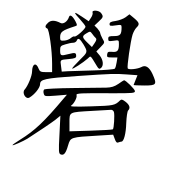
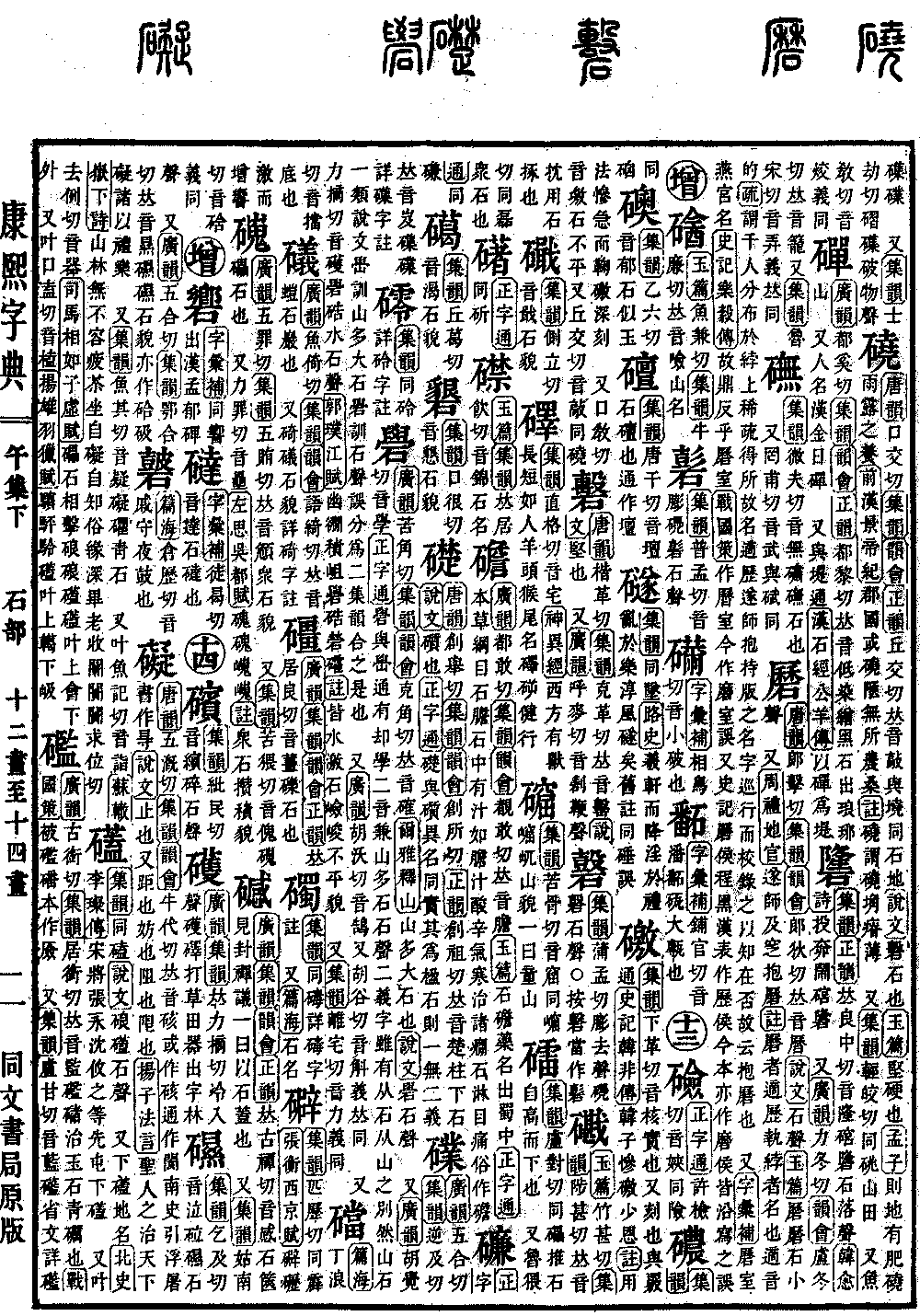
Wu Collection, Lower Volume
Radical: Stone (shí)
Kangxi stroke count: 18
Page 837, Entry 32
Broad Rhymes (Guangyun): Pronounced que. Collected Rhymes (Jiyun) and Rhyme Anthology (Yunhui): Pronounced que. The pronunciation is the same as the character que.
Erya, Explanation of Mountains (Erya Shishan): Refers to a mountain with many large stones.
Analytical Dictionary of Characters (Shuowen Jiezi): The sound of stones colliding.
Also, Broad Rhymes (Guangyun): Pronounced xue. The pronunciation is the same as the character xue.
Authentic Character Guide (Zhengzitong): This character is interchangeable with the character xue. It has two pronunciations, que and xue, and carries both the meanings of a mountain with many stones and the sound of colliding stones. Although the character forms differ in their use of the stone radical and the mountain radical, mountains and stones belong to the same category of things. The Analytical Dictionary of Characters erroneously separates them into two characters, defining one as a mountain with many large stones and the other as the sound of stones. Collected Rhymes (Jiyun) is correct in merging them.
Also, Broad Rhymes (Guangyun): Pronounced hu. Also pronounced hu. The meaning is the same.
Also, pronounced li. Queque is the sound of water and stones colliding.
Guo Pu, River Rhapsody (Jiangfu): Deeply accumulated and craggy, queque and queque. Note: All describe the appearance of water rushing against stones, jagged and uneven.
Also, Collected Rhymes (Jiyun): Pronounced li. The meaning is the same.