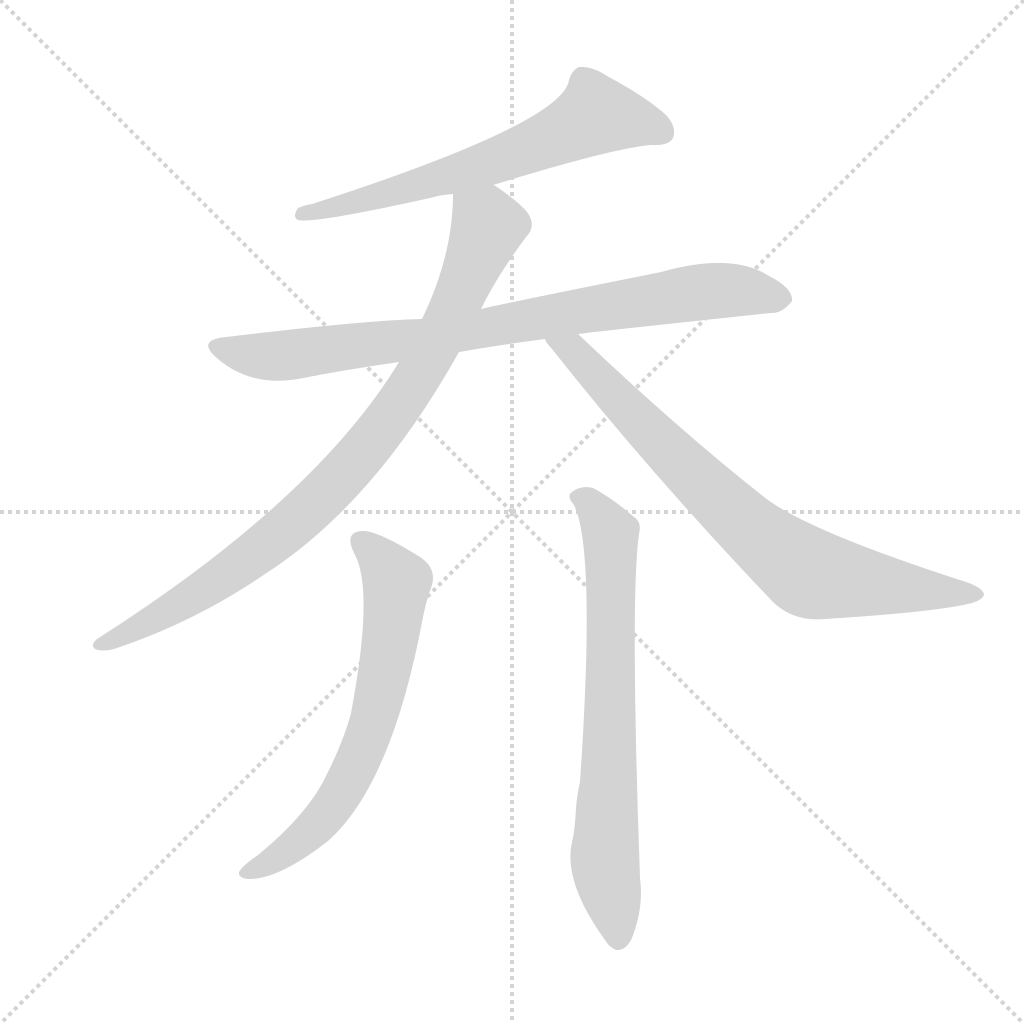
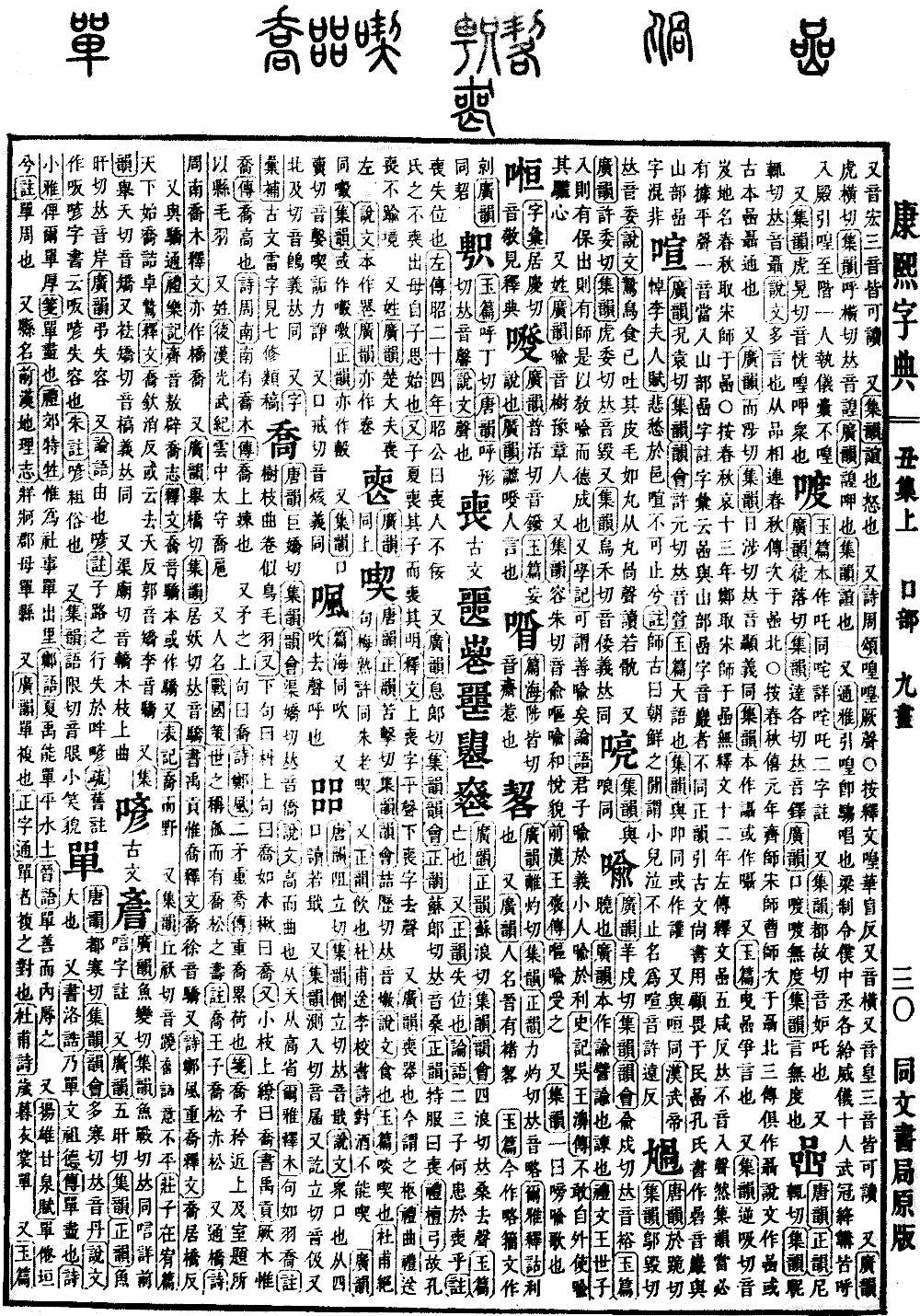
Chou Collection, Upper Volume. Radical: Mouth (kǒu). Character: Qiáo. Kangxi Stroke Count: 12. Page 200. Tang Dynasty Rhyme Dictionary (Tangyun) gives the pronunciation as jù-jiāo. Collected Rhymes (Jiyun) and Rhyme Assembly (Yunhui) give it as qú-jiāo, sounding like qiáo. Explaining Graphs and Analyzing Characters (Shuowen Jiezi) defines it as tall and curved, composed of the character for young (yāo) and an abbreviated form of tall (gāo). Approaching the Correct (Erya), section on trees, states that branches curving like feathers are called qiáo. The commentary notes that the branches curve and wind like bird feathers. It also states that downward curving is called jiū, while upward curving is called qiáo, resembling the catalpa tree. Furthermore, small branches winding upward are called qiáo. The Book of Documents (Shangshu), Tribute of Yu (Yugong), mentions that the trees there are tall. The commentary explains that qiáo means tall. The Book of Odes (Shijing), South of Zhou (Zhounan), mentions that in the south there are tall trees. The commentary explains that qiáo means towering upward. Also, the curved upper part of a spear is called qiáo. The Book of Odes, Odes of Zheng (Zhengfeng), mentions two spears with double curved decorations. The commentary explains that double qiáo refers to layered decorations. The sub-commentary notes that qiáo refers to the shaft of the spear near the top and the spearhead where feathers are hung. It is also a surname. The Book of the Later Han (Houhanshu), Annals of Guangwu, mentions Qiao Hu, the Governor of Yunzhong. It is also a personal name. The Strategies of the Warring States (Zhanguoce) mentions that generations have called themselves the lonely one and enjoyed longevity like Qiao and Song. The commentary notes that Qiao refers to Prince Qiao and Song refers to Chisongzi. It is also interchangeable with the character for bridge, also pronounced qiáo. The Book of Odes, South of Zhou (Zhounan), in its textual explanation for tall trees, notes it is also written as the character for bridge. Broad Rhymes (Guangyun) gives the pronunciation as jǔ-qiáo and Collected Rhymes (Jiyun) gives it as jū-yāo, sounding like jiāo. The Book of Documents, Tribute of Yu (Yugong), in its textual explanation, notes that Xu Miao reads qiáo as jiāo. The Book of Odes, Odes of Zheng (Zhengfeng), in its textual explanation, notes that qiáo is read as jū-qiáo. It is also interchangeable with the character for arrogant, also pronounced jiāo. The Book of Rites (Liji), Record of Music (Yueji), states that the music of Qi is arrogant and biased, and the mind is proud and unrestrained. The textual explanation notes that qiáo is read as jiāo, and some versions write it as the character for arrogant. The Record of Examples (Biaoji) uses it to mean proud and coarse. Collected Rhymes (Jiyun) gives the pronunciation as qiū-yāo, sounding like qiāo. The term qiáojié means feeling indignant or unfair. Zhuangzi, Letting Be (Zaiyou), states that the world began to experience injustice and violence. The textual explanation notes that qiáo is read as qīn-xiāo or qù-yāo; Guo Xiang reads it as jiǎo, and Li Gui reads it as jiāo. Collected Rhymes (Jiyun) also gives the pronunciation as jǔ-yāo, sounding like jiǎo. Another pronunciation is qū-jiǎo, sounding like gǎo, with the same meaning. It is also pronounced qú-miào, sounding like jiào, meaning branches curving upward. Textual Verification: In the Strategies of the Warring States (Zhanguoce), the phrase referring to generations calling themselves the lonely one and having the longevity of Qiao and Song is corrected by changing the world's (shìzhī) to generations (shìshì) according to the original text.