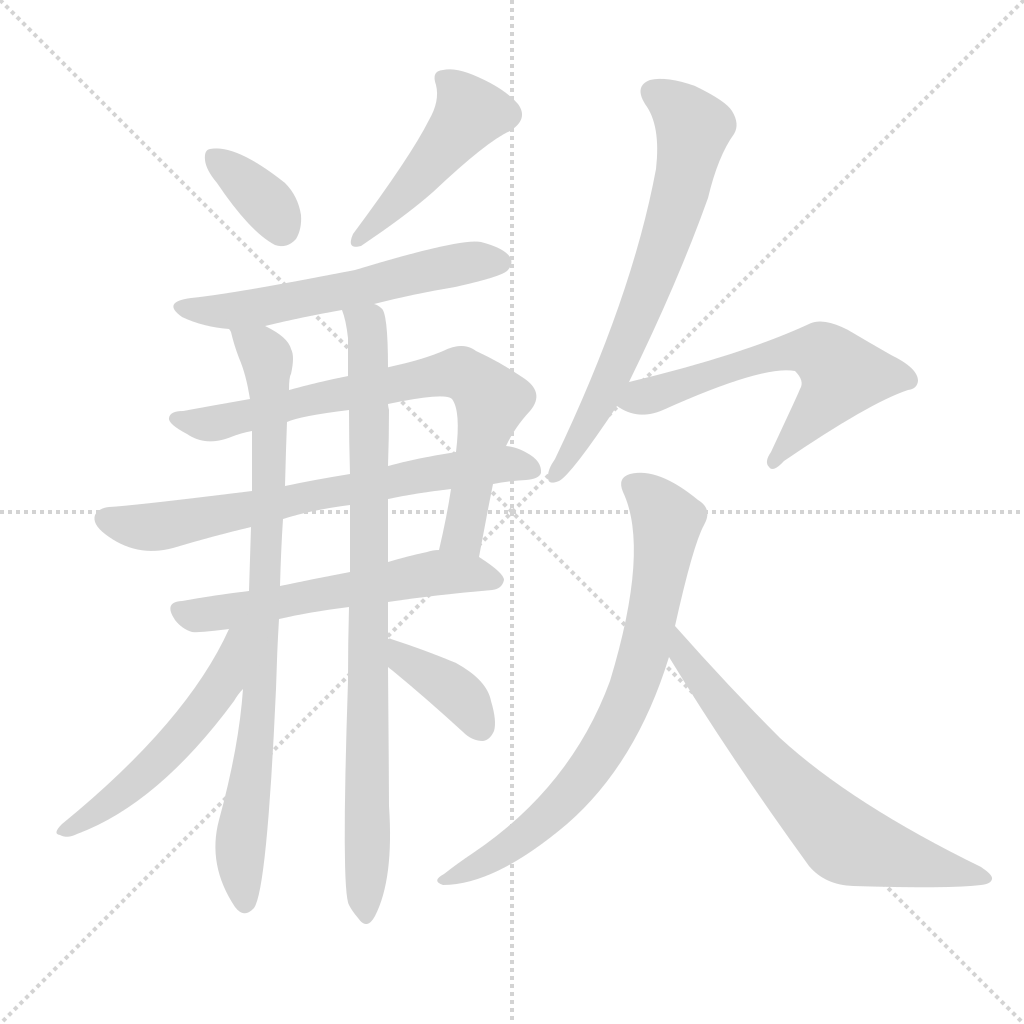
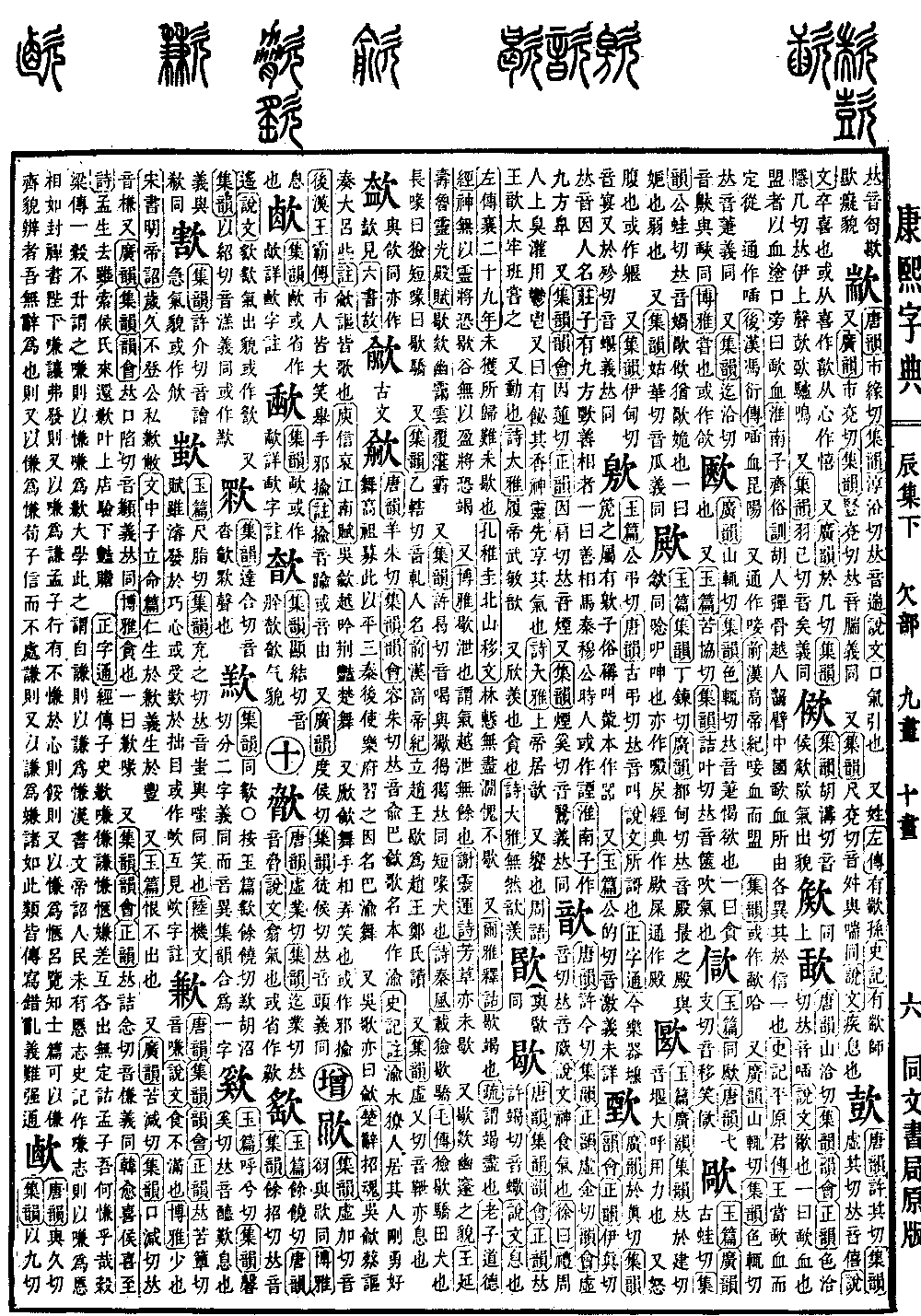
Chen Collection, Lower Volume
Radical: Lack (qiàn)
Kangxi Strokes: 14
Page 570, Entry 30
Pronounced qiǎn.
According to the Explaining Graphs and Analyzing Characters (Shuowen Jiezi), it means to eat but not be satisfied.
According to the Guangya, it means few or lacking.
According to the Book of Song (Songshu), Edict of Emperor Ming: Years have passed without a bountiful harvest, leaving both public and private resources impoverished and exhausted.
According to the Master Wenzhong (Wenzhongzi), On Establishing Fate: Benevolence arises from insufficiency, while righteousness arises from abundance.
Also, according to the Jade Chapters (Yupian), it refers to regrets that one cannot express.
Pronounced jiǎn.
Pronounced xiàn. The meaning is the same as the above. According to the Guangya, it refers to greed. One theory states it refers to a greedy mouth.
Pronounced qiàn. The meaning is the same as the above.
According to the poem by Han Yu, Pleased at the Arrival of Hou Xi: Although Master Meng has left and is isolated, the arrival of the Hou family still brings a sense of lack. Rhymes with the characters for shop and verify, and below with the characters for beauty and provide.
According to the Orthodox Lexicon (Zhengzitong), in the classics, commentaries, philosophical works, and histories, the characters for lack, dissatisfied, satisfied, humble, satisfied, satisfied, and dislike are often used interchangeably, yet each has a distinct origin and no fixed explanation. In the Mencius, it says why would I be dissatisfied? In the Guliang Commentary, it says one grain not rising is called dissatisfied, which uses the characters for satisfied and dissatisfied in place of the character for lack. In the Great Learning (Daxue), it says this is called being self-humble, which uses the character for humble in place of the character for satisfied. In the Book of Han (Hanshu), Edict of Emperor Wen, it says the people are not yet focused; in the Records of the Grand Historian (Shiji), it is written as dissatisfied, which uses the character for dissatisfied in place of the character for satisfied. In the Records of the Grand Historian, Biography of Sima Xiangru, it says the Emperor is humble and does not reveal it, which uses the character for dissatisfied in place of the character for humble. In the Mencius, it says if one's actions do not satisfy the heart, one will feel weak, which uses the character for satisfied in place of the character for pleasant. In the Lu's Springs and Autumns (Lushi Chunqiu), Chapter on Knowing Gentlemen, it says those who can satisfy Qi Maobian, I have no excuse to refuse, which uses the character for satisfied in place of the character for satisfied. In the Xunzi, it says to be trustworthy but not dwell on humility, which uses the character for humble in place of the character for dislike. Cases like these are all errors caused by transcription and copying, and their meanings are difficult to reconcile consistently.