Mao Collection, Upper Volume
Radical: Heart (xīn)
Kangxi strokes: 14
Page 398, Entry 02
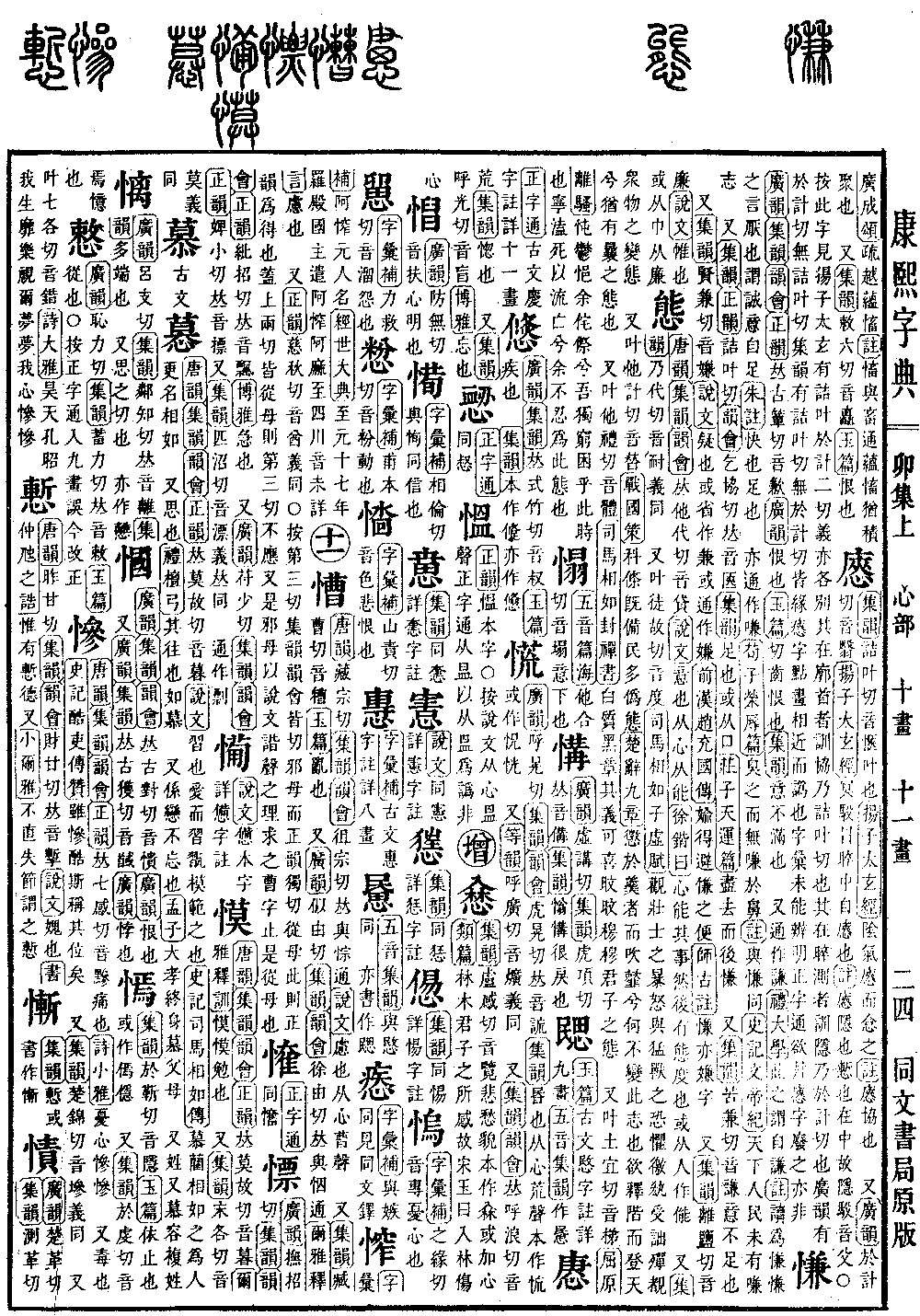
According to the Extensive Rhymes (Guangyun), Collected Rhymes (Jiyun), Rhyme Compendium (Yunhui), and Orthodox Rhymes (Zhengyun), the pronunciation is qian (falling tone).
In Extensive Rhymes (Guangyun), it means hatred.
In the Jade Chapters (Yupian), it means gnashing one's teeth in hatred.
In the Collected Rhymes (Jiyun), it means a heart not satisfied.
It is also used interchangeably with qian. In the Book of Rites (Liji), Great Learning (Daxue), it is written as this is called self-satisfaction. The commentary notes that it is read as qian. Qian means satisfaction, referring to the heart being truly fulfilled. The commentary by Zhu Xi defines it as being delighted and satisfied.
It is also used interchangeably with qian. In the Xunzi, chapter on Glory and Shame (Rongru), it speaks of hearing something but not having it satisfy the nose. The commentary notes it is the same as qian. In the Records of the Grand Historian (Shiji), Annals of Emperor Wen (Wendi Ji), it refers to the people under heaven not yet having a feeling of satisfaction.
Also, according to the Collected Rhymes (Jiyun) and Orthodox Rhymes (Zhengyun), pronunciation is qie. In the Collected Rhymes (Jiyun), it means to satisfy. Some write it with the mouth radical. In the Zhuangzi, chapter on Heavenly Revolutions (Tianyun), it refers to discarding everything completely and then being satisfied.
According to the Collected Rhymes (Jiyun), pronunciation is qian. It means the heart is not fulfilled.
According to the Collected Rhymes (Jiyun), pronunciation is xian. In the Explaining Graphs and Analyzing Characters (Shuowen), it means to suspect. Some omit the heart radical and write it as jian. Some are used interchangeably with xian. In the History of the Former Han (Qian Hanshu), Biography of Zhao Chongguo, it refers to obtaining the convenience of avoiding suspicion. The commentary by Shigu notes that qian is the same as the character for suspicion.
According to the Collected Rhymes (Jiyun), pronunciation is lian. In the Explaining Graphs and Analyzing Characters (Shuowen), it means a curtain or tent. Some write it with the cloth radical or as lian.