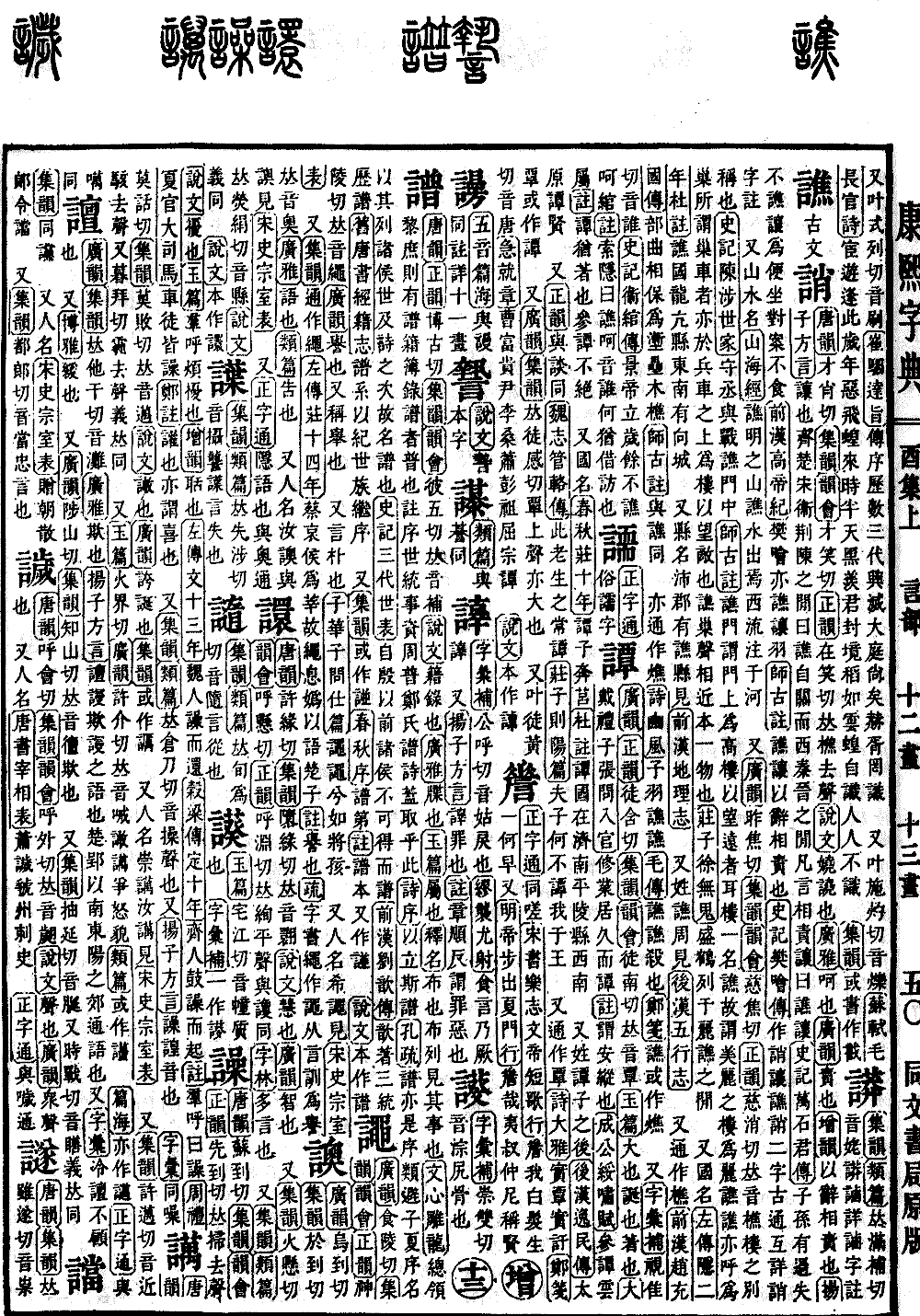
You Collection, Upper Volume
Radical: Speech (yán)
Kangxi Strokes: 19
Page 1182, Entry 03
Ancient form: qiao.
Pronounced qiao (falling tone).
Pronounced qiao (falling tone).
Pronounced qiao (falling tone).
According to the Explaining Graphs and Analyzing Characters (Shuowen Jiezi), it means to blame or scold. According to the Guangya, it means to chide. According to the Guangyun, it means to reproach. According to the Zengyun, it means to rebuke one another with words. According to the Fangyan by Yang Xiong, it means to admonish. In the regions of Qi, Chu, Song, Wei, and Jing, it is called qiao. From the pass to the west, in the regions of Qin and Jin, any instance of mutual reproach or admonishment is called qiao rang. In the Records of the Grand Historian (Shiji), Biography of Lord Wanshi, when children and grandchildren had faults, he would not scold or rebuke them but would sit facing the desk and refuse to eat. In the History of the Former Han (Qian Hanshu), Annals of Emperor Gao, Fan Kuai also scolded and rebuked Yu. The commentary by Yan Shigu states that qiao rang means to reproach one another with words. In the Records of the Grand Historian (Shiji), Biography of Fan Kuai, it is written as qiao rang. The two characters qiao and qiao were used interchangeably in ancient times. See the entry for the character qiao for further details.
Also the name of a mountain and a river. According to the Classic of Mountains and Seas (Shanhaijing), on Qiaoming Mountain, the Qiao River originates and flows west into the Yellow River.
Pronounced qiao. A specific term for a tower. In the Records of the Grand Historian (Shiji), Biography of Chen She, the garrison commander fought with him in the qiao gate. The commentary by Yan Shigu states that a qiao gate refers to a gate with a high tower built above it for observing distances. The tower is also known as a qiao; thus, a beautiful tower is called a li qiao. A qiao is also referred to as a chao (nest). The so-called chao che (nest chariot) also refers to a chariot with a tower built on top for observing the enemy. The sounds of qiao and chao are similar; they were originally the same object. In the Zhuangzi, Chapter Xu Wugui, flourishing cranes are lined up between the li qiao towers.
Also a name of a state. According to the Commentary of Zuo (Zuozhuan), Year 2 of Duke Yin, the Du commentary states that the state of Qiao had Xiangcheng southeast of Longkang County.
Also a county name. Pei Commandery had a Qiao County. See the Geography Treatise of the History of the Former Han (Qian Hanshu).
Also a surname. Qiao Zhou. See the Five Elements Treatise of the History of the Later Han (Hou Hanshu).
Also written in the variant form qiao. In the History of the Former Han (Qian Hanshu), Biography of Zhao Chongguo, the troops protected each other by digging trenches and building wooden qiao fortifications. The commentary by Yan Shigu states that this is the same as qiao.
Also written in the variant form jiao. In the Book of Odes (Shijing), Binfeng, it is written: My feathers are worn and tattered. The Mao commentary states that qiao qiao means tattered or worn out. The Zheng commentary states that qiao is sometimes written as jiao.
Pronounced shui (rising tone). In the Records of the Grand Historian (Shiji), Biography of Wei Wan, a year after Emperor Jing ascended the throne, he did not question or interrogate Wan. The commentary, quoting the Suoyin, states that qiao he is pronounced shui he, meaning to question or inquire.