Wu Collection, Upper Volume
Radical: Tile (wǎ)
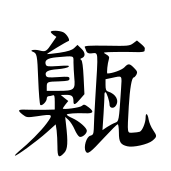
Character: 甈
Kangxi strokes: 15
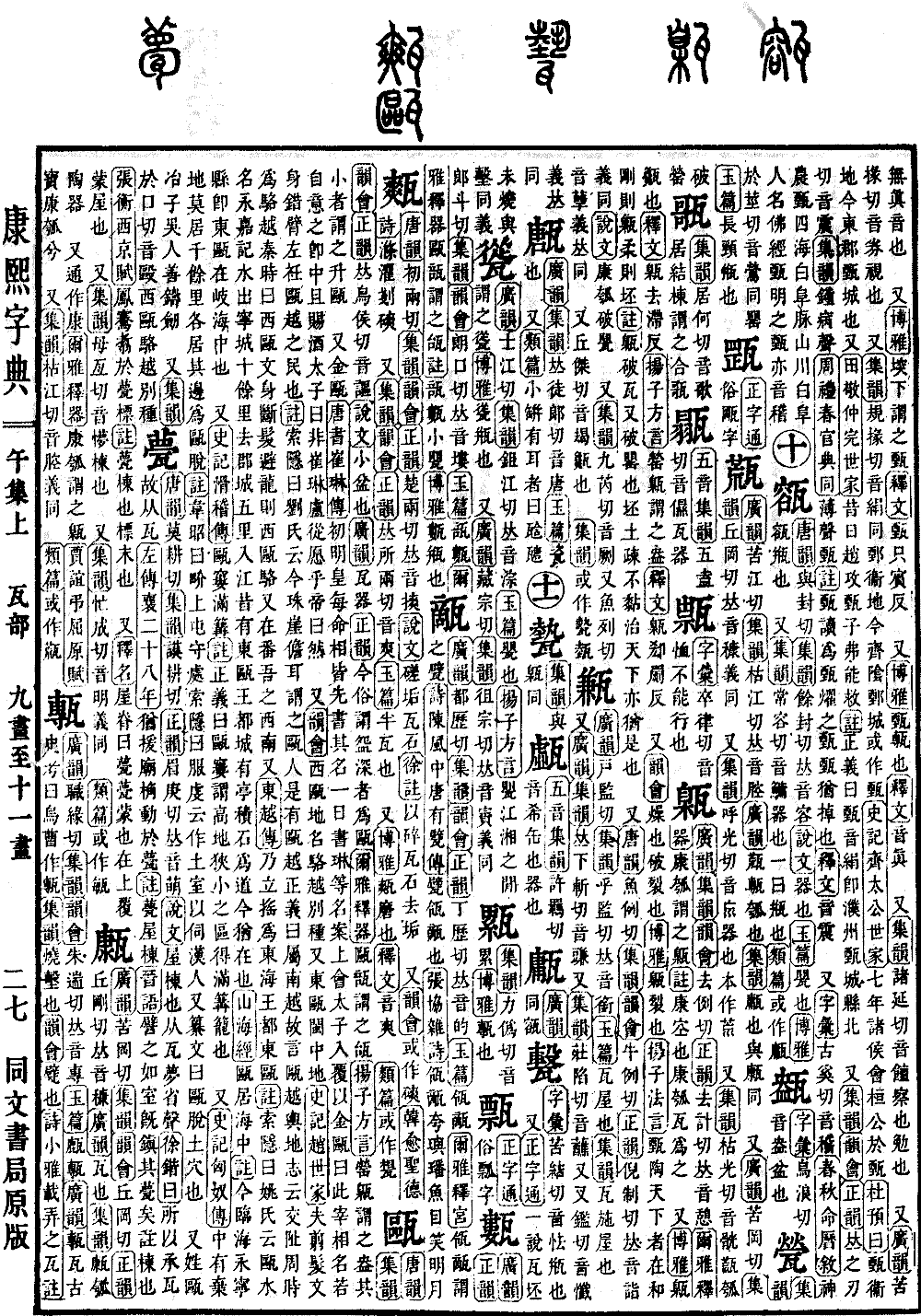
Page 751, Entry 09
Pronounced qi (falling tone).
Book of Rituals (Erya), section on implements: A hollow pot is called a qi. Commentary: Kang means empty. A hollow pot is made of tile.
Also, Broad Reference (Guangya): Qi means to crack.
Explication of Texts (Shuowen): Qi, pronounced ji (falling tone).
Dictionary of Local Expressions (Fangyan): A type of vessel is called a qi.
Explication of Texts (Shuowen): Qi, pronounced ji (falling tone).
Also, Dictionary of Rhymes (Yunhui): To be dry, or to crack and split.
Broad Reference (Guangya): Qi means to crack.
Model Sayings (Fayan) by Yang Xiong: Those who mold and fire the world rely on harmony. If it is too rigid, it will crack; if it is too soft, it will crumble. Commentary: Qi means a broken tile. Also means a broken earthen jar. If the clay is loose and not adhesive, governing the world is just like this.
Also, Tang Dictionary (Tangyun): Pronounced yi (falling tone). Dictionary of Rhymes (Yunhui): Pronounced yi (falling tone). Correct Rhymes (Zhengyun): Pronounced yi (falling tone). Meaning is the same.
Explication of Characters (Shuowen): A hollow pot or broken jar.
Also, Collective Rhymes (Jiyun): Pronounced jue (rising tone).
Also, Pronounced nie (falling tone). Meaning is the same.
Also, Pronounced qie (falling tone). Meaning is to crack.
Collective Rhymes (Jiyun): Sometimes written in a variant form.