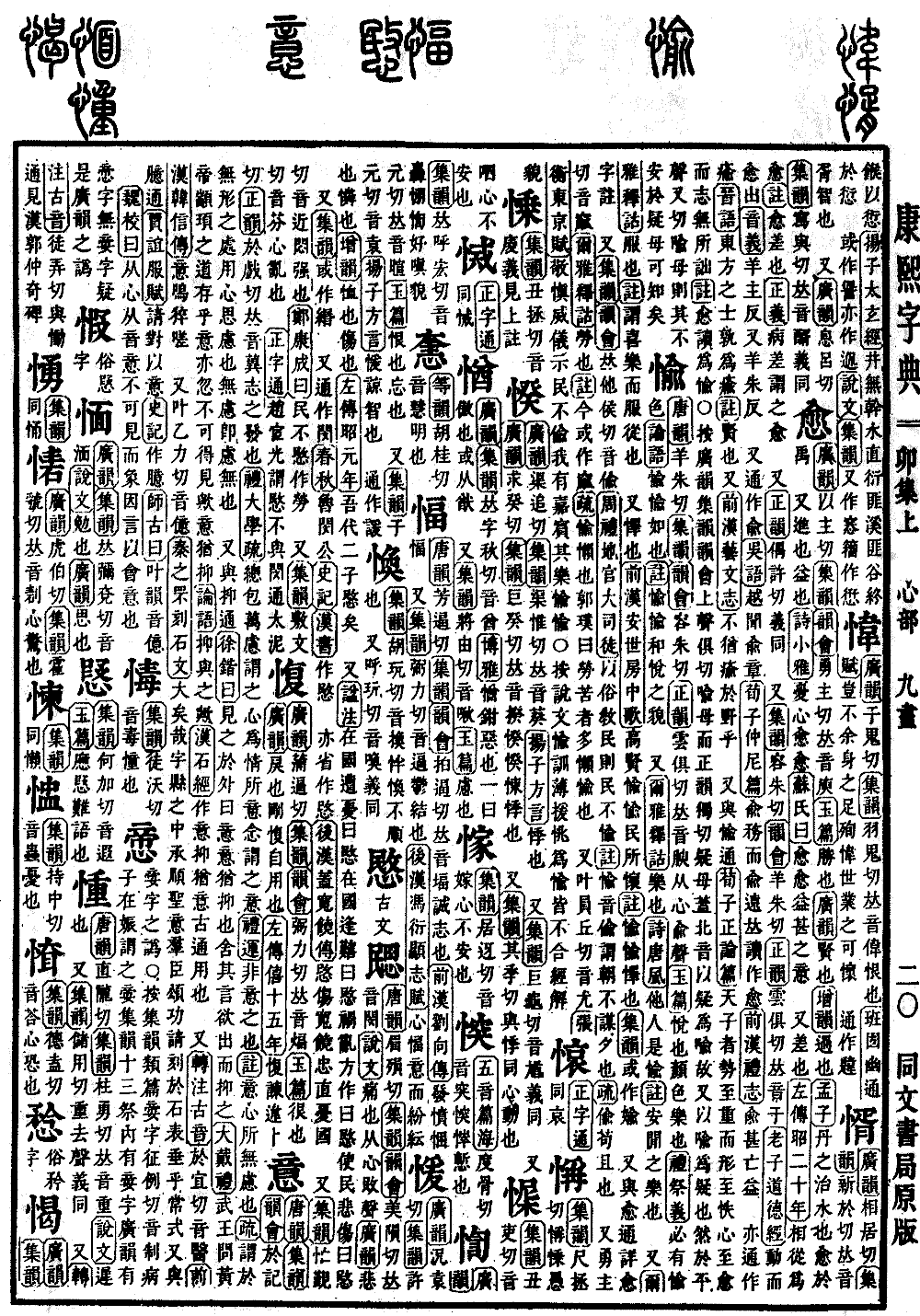
Mao Collection, Upper Volume
Radical: Heart (xīn)
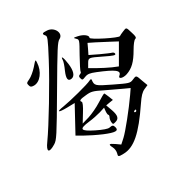
Character: Qi
Kangxi Stroke Count: 13
Page 394, Entry 35
Pronounced qi.
According to the Analytical Dictionary of Chinese Characters (Shuowen Jiezi), it means to rest. It is composed of the radical for heart and the phonetic element he.
In the Book of Odes (Shijing), Xiaoya, it is written: Does one not wish to rest there?
In the Book of Odes (Shijing), Daya, it is written: It is hoped that one may rest for a little while.
The commentaries state that both instances are interpreted as meaning to rest.
Also, it is sometimes written in a variant form (ji).
In the Ganquan Rhapsody (Ganquan Fu) by Yang Xiong, it is written: Crossing the mountain ridges and passing the flowering pear trees.
The commentary by Shigu states that this character should be read as qi.
Also, pronounced ke.
Meaning: to be greedy.
In the Zuo Commentary (Zuo Zhuan), first year of Duke Zhao, it is written: To indulge the years and be greedy for days. The commentary notes that both words mean greedy.
Also means: hurried.
In the Spring and Autumn Annals (Chunqiu), third year of Duke Yin, it records the burial of Duke Mu of Song. The Broad Rhymes (Guangyun) cites the Gongyang Commentary (Gongyang Zhuan): To perform a burial not at the proper time is called qi. Qi means hurried. In the current edition, it is written as ke.
Also, pronounced kai. The meaning is the same.
Also, pronounced he. Meaning: to be fearful or intimidated. It is sometimes written as he. It is also used interchangeably with the variant form (ji).
Also, pronounced qie.
Originally written as qi. Due to corrupted forms, it was written as xi, which eventually evolved into the character qi.
Textual research:
The Gongyang Commentary (Gongyang Zhuan) states: Not being timely and performing a burial is called qi. The commentary notes: it means hurried. It is sometimes written as ke, and sometimes as yi.
Correction: The current edition of the Gongyang Commentary (Gongyang Zhuan) uses the character ke. However, the Broad Rhymes (Guangyun) cites the Gongyang Commentary (Gongyang Zhuan) using the character qi. I have revised the entry to read: The Broad Rhymes (Guangyun) cites the Gongyang Commentary (Gongyang Zhuan): To perform a burial not at the proper time is called qi. Qi means hurried. In the current edition, it is written as ke.