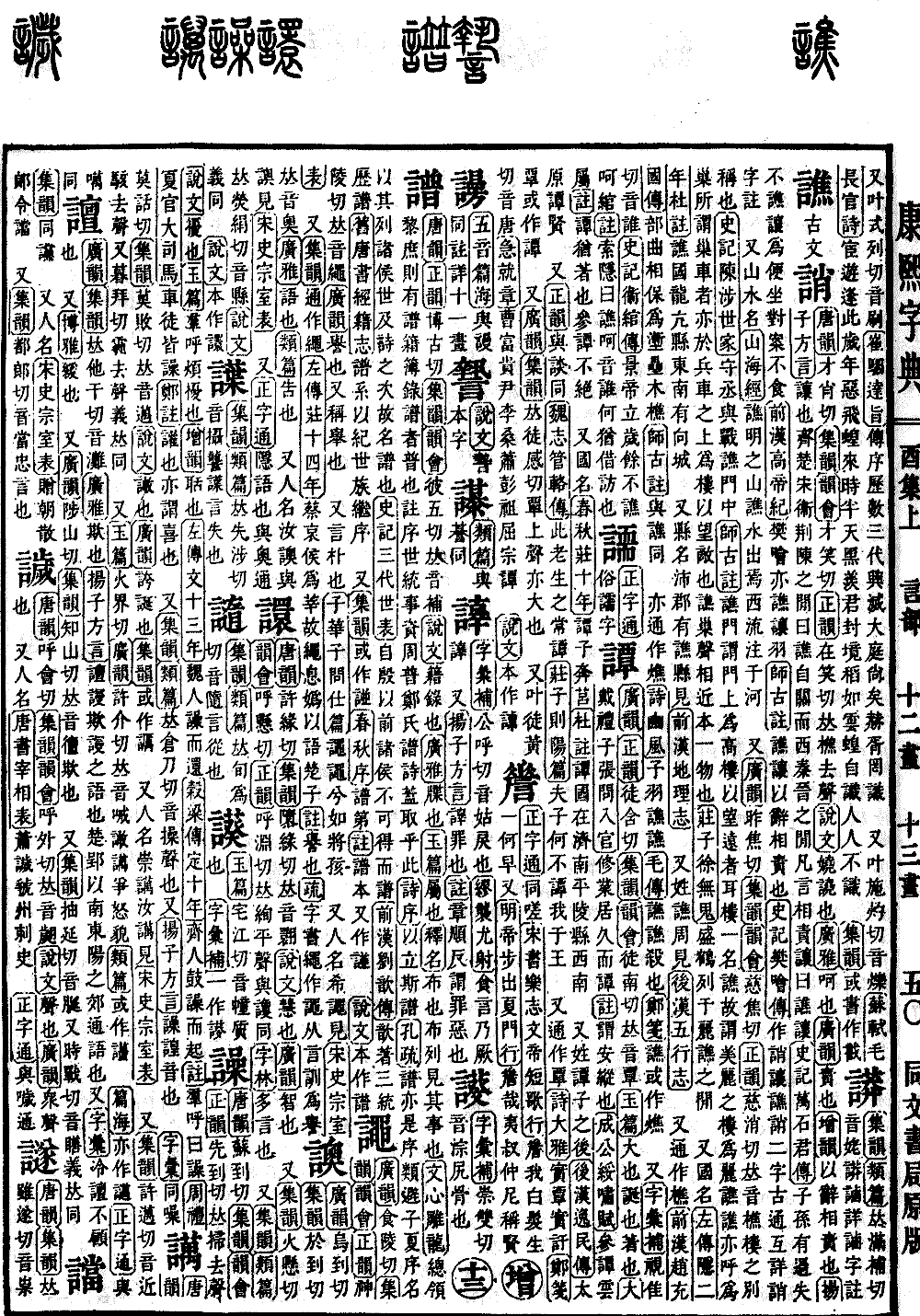
You Collection, Upper Volume
Radical: Speech (yán)
Kangxi Strokes: 20
Page 1182, Entry 12
Pronounced bu.
Shuowen Jiezi (Explaining Simple and Analyzing Compound Characters): To register or record.
Guangya (Expanded Dictionary): A register or list.
Yupian (Jade Chapters): To belong to or be related.
Shiming (Explanation of Names): To spread out, to spread out and display events for examination.
The Literary Mind and the Carving of Dragons (Wenxin Diaolong): When overseeing the populace, there are registries and record books. A register is universal. It summarizes lineages and events, serving to be comprehensive. The commentaries of Master Zheng on the Book of Odes (Shijing) draw upon this.
Preface to the Book of Odes: To establish this register.
Commentary by Kong (Kongshu): The register is also a type of preface. To avoid using the same name as the preface by Zixia, and because it lists the successions of feudal lords and the order of the poems, it is called a register.
Records of the Grand Historian (Shiji): From the Shang dynasty and before, the feudal lords cannot be put into a register.
History of the Former Han Dynasty (Qian Hanshu): Liu Xin wrote the Three Systems Calendar Register.
Old Book of Tang (Jiu Tangshu): Registers and lineages are used to record the succession of clans.
Also written in a variant form (pu).
Spring and Autumn Annals Preface (Chunqiu Xu): Registers and sequences. Commentary: The register was originally also written as a variant form. The original form was written as the radical for speech combined with the character for speech.