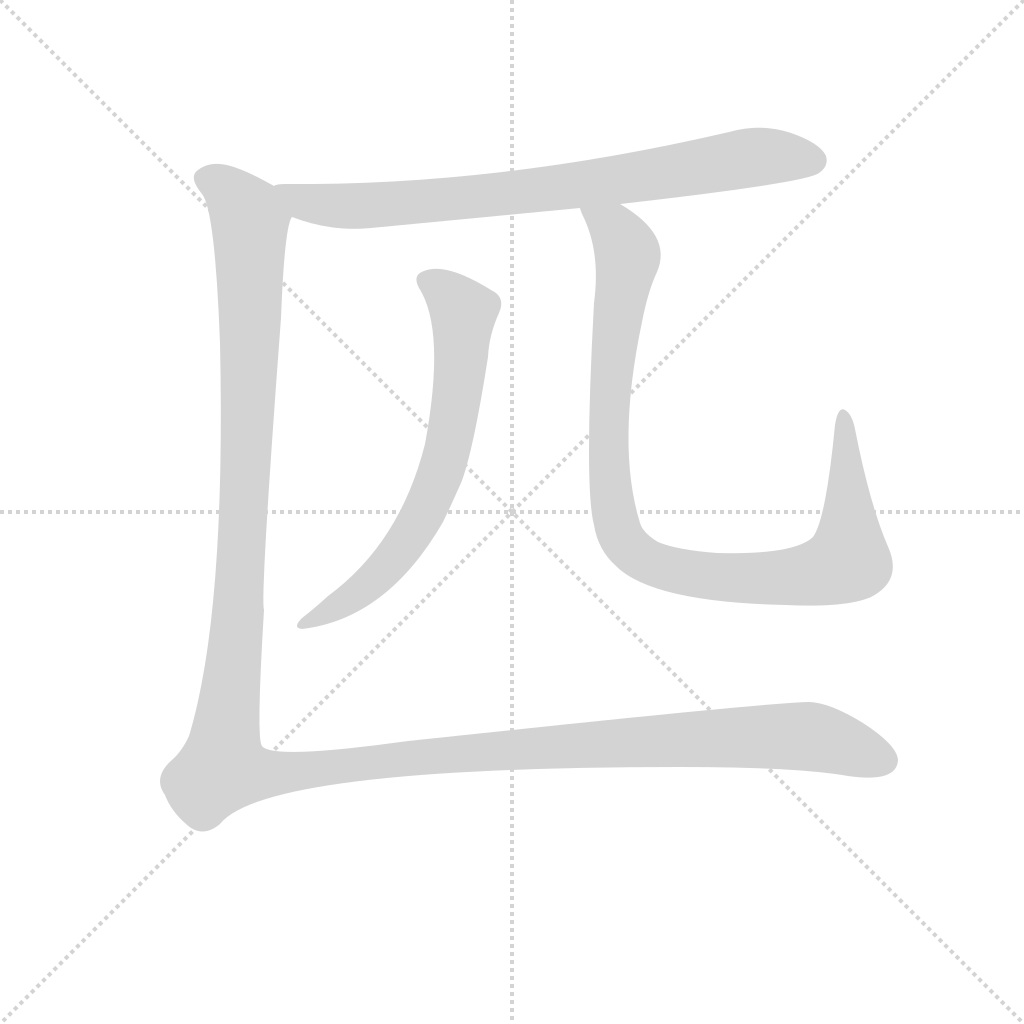
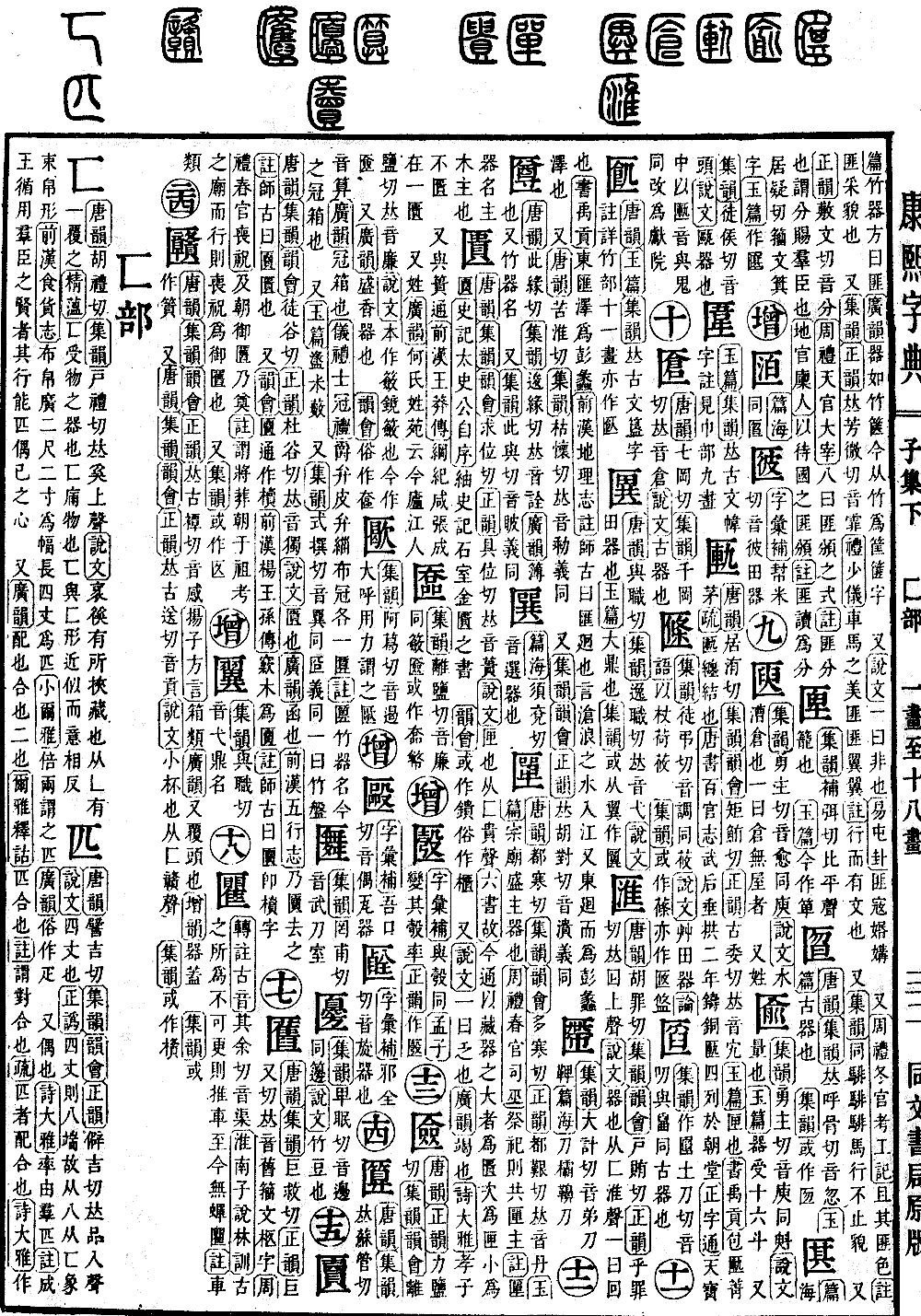
Zi Collection, Page Position: Lower. Radical: Enclosure (xi). The character pi. Kangxi Dictionary strokes: 4. Page 154, Entry 36.
Tang Rhymes (Tangyun): Pronounced as a combination of the sounds pi and ji. Collected Rhymes (Jiyun), Rhyme Meetings (Yunhui), and Correct Rhymes (Zhengyun): Pronounced as a combination of the sounds pi and ji. The pronunciation is similar to the entering tone of the word pin.
Shuowen Jiezi (Shuowen Jiezi) explains it as four zhang, which is a unit of length. Correcting Errors (Zheng-e) adds: Four zhang is equivalent to eight duan, an ancient unit for cloth, which is why the character form includes the component for eight; it also includes the enclosure component xi, resembling the shape of bundled cloth. Book of Han (Hanshu), Treatise on Food and Money records: Cloth with a width of two chi and two cun is called a fu, and a length of four zhang is called a pi. Little Erya (Xiao Erya) says: Twice the amount of a unit called a liang is called a pi. Expanding Rhymes (Guangyun) mentions it is commonly written in a variant form pronounced shu.
It also represents a spouse or a pair. Book of Odes (Shijing), Major Odes: Following the lead of the various peers. The commentary states: King Cheng of Zhou followed the practice of employing worthy officials among his ministers whose talents and conduct matched his own intentions.
Expanding Rhymes (Guangyun) also explains it as to match, to combine, or to form a pair. Erya (Erya), Explaining Words says pi means to join. The commentary notes this refers to two things matching as a pair, and the sub-commentary says pi means to coordinate. Book of Odes (Shijing) contains the line: He built the capital at Feng to match him. Also, the Book of Rites (Liji), Black Robes: Only the superior man can love his equals. The commentary notes pi refers to intimate friends.
It also refers to marriage or a spouse. The political memorial by Kuang Heng of the Han dynasty states: The occasion of marriage and consorting is the beginning of the people's reproduction. Also, the Commentary of Zuo (Zuozhuan), tenth year of Duke Huan: A common man is without guilt. The commentary explains: Commoner couples joined in marriage are called pi. Once the term was established, even a single individual could be called pi; thus, they are commonly called pi fu pi fu, meaning an ordinary man and woman.
It is also used as a classifier for horses. Rites of Zhou (Zhouli), Summer Offices: The commentary states that four horses constitute one chariot. Collection of Literature and Art (Yiwen Leiju) explains: Because a horse's shadow appears to be about one pi or four zhang in length, horses are also referred to by this term. Correcting Errors (Zheng-e) says: The horse's shadow is four zhang long, and thus the word pi was borrowed; it is also written as the variant shu.
It is also used as a phonetic loan for the word for duck, wu, pronounced here as mu. Book of Rites (Liji), Summary of Ceremonies states: The gift of introduction for a commoner is a duck.