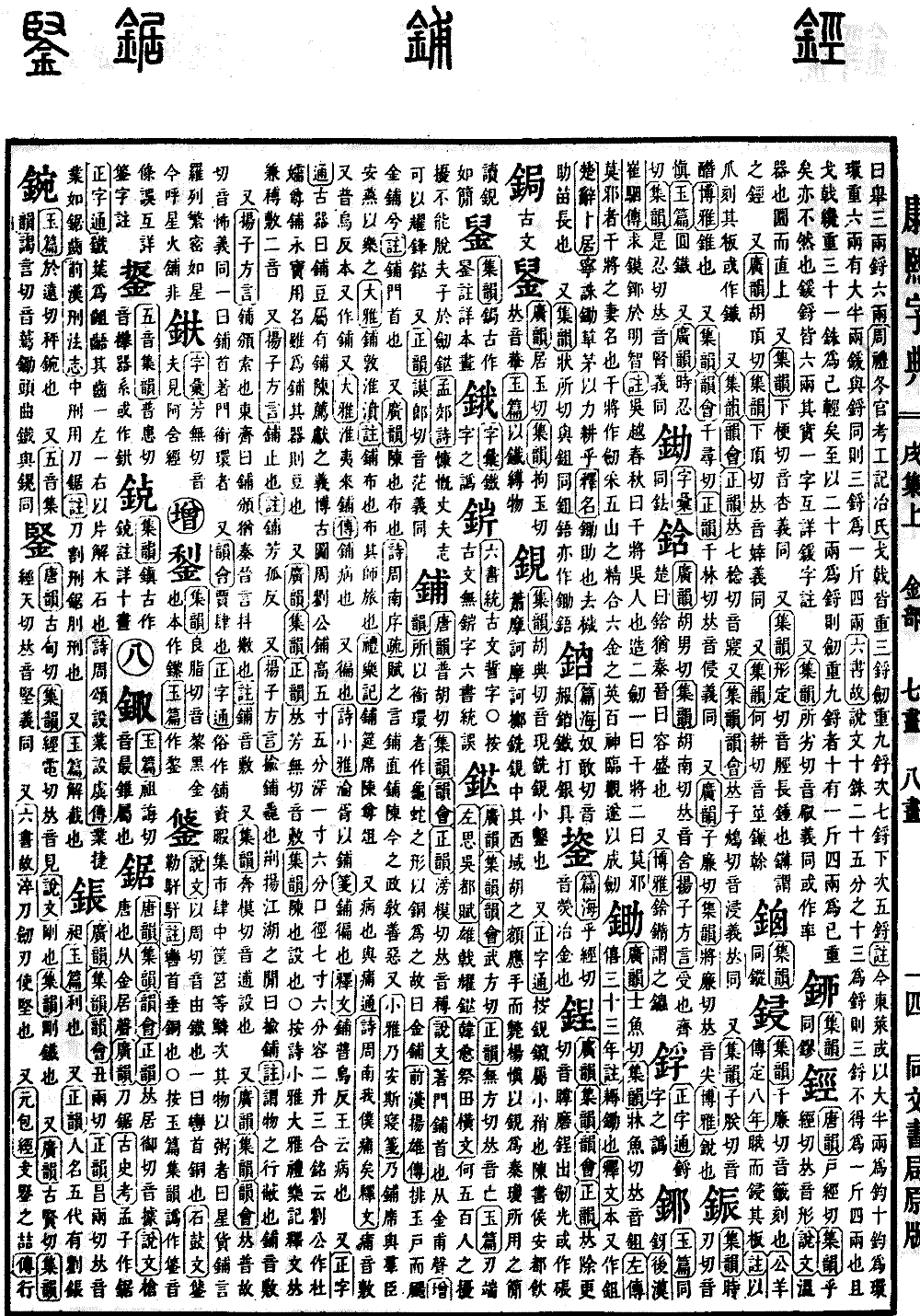
Xu Collection, Upper Volume
Radical: Metal (jīn)
Page 1308, Entry 15
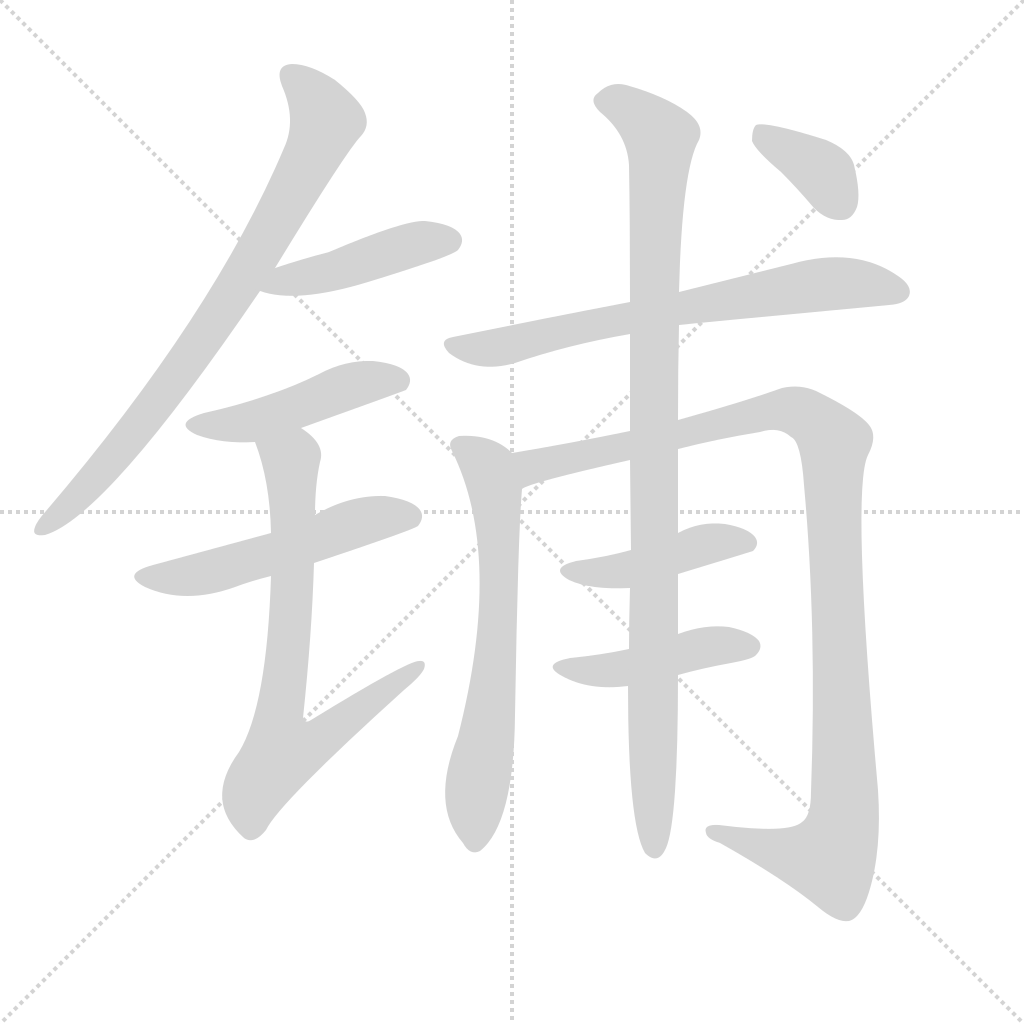
According to the Tang Dynasty Rimes (Tangyun), the pronunciation is pu (level tone). According to the Collection of Rimes (Jiyun), the Rime Treasury (Yunhui), and the Corrected Rimes (Zhengyun), the pronunciation is pang (level tone). In the Explaining Graphs and Analyzing Characters (Shuowen Jiezi), it is defined as the metal fixture installed on a gate to hold a door ring, derived from metal with the phonetic component pu. According to the Additions to the Rimes (Zengyun), it is an object used to hold a door ring, shaped like a tortoise or snake and made of copper, hence the name golden pu. In the Biography of Yang Xiong in the History of the Former Han (Qianhan Shu), it refers to pushing open the jade gate, causing the metal fixtures to sway in the wind. The commentary notes that pu is the base of a door ring.
According to the Broad Rimes (Guangyun), it means to spread out or arrange. The Commentary on the Preface to the Zhou South section of the Book of Odes (Shijing) states that the term fu (exposition) means to spread out, referring to the direct expression of the merits or faults of political education. In the Small Odes (Xiaoya) of the same text, the commentary notes it means spreading out mats for officials to sit, feast, and enjoy themselves. In the Greater Odes (Daya), it refers to deploying troops along the Huai River, with the commentary noting that it means to arrange. In the Book of Rites (Liji), it refers to laying out mats and setting up vessels for wine and food.
It also refers to illness. It is interchangeable with the character pu (suffering). In the explanation of the Zhou South section of the Book of Odes (Shijing), it is noted that pu is pronounced fu (level tone), though some sources also read it as pu (level tone). Some versions are written as the variant form pu. In the Greater Odes (Daya), it refers to the Huai Yi tribes coming to bring suffering. The tradition notes that it means to cause pain.
It also means universal or all-encompassing. In the Small Odes (Xiaoya) of the Book of Odes (Shijing), it refers to all suffering in succession. The commentary states it means universally. The textual notes state it is pronounced pu (level tone), and one scholar notes it signifies suffering.
According to the Correct Dictionary (Zhengzitong), in ancient times there was a vessel called a pu, belonging to the dou (a type of sacrificial vessel) category, carrying the meaning of offering or presentation. The Illustrations of Antiquities (Bogu Tu) records the Liu Gong Pu from the Zhou Dynasty, measuring five inches and five fen in height, one inch and six fen in depth, with a mouth diameter of seven inches and six fen, and a capacity of two sheng and three ge. The inscription states that Liu Gong made this precious pu for Du Ru for eternal use. Although named a pu, this object is essentially a dou.
According to the Broad Rimes (Guangyun), the Collection of Rimes (Jiyun), and the Corrected Rimes (Zhengyun), it is pronounced fu (level tone). The Collection of Rimes states it means to arrange or display. Note: The commentaries on the Small Odes and Greater Odes of the Book of Odes (Shijing) and the Book of Rites (Liji) provide pronunciations for both fu and pu.
According to the Regional Dialects (Fangyan) by Yang Xiong, it means to stop. The commentary notes it is pronounced fu (level tone). Also in the Regional Dialects, the term yu pu refers to the fine hair of birds and beasts. In the regions of Jingzhou, Yangzhou, and along the Yangtze River and Dongting Lake, this is called yu pu. The commentary notes that this refers to an item surface becoming fuzzy. Here, pu is pronounced fu (level tone). Also in the Regional Dialects, the term pu ban refers to shaking out or searching. In the eastern Qi region, this is called pu ban, which is equivalent to the term dou sou (to shake off/exert oneself) used in the Qin and Jin regions. The commentary notes it is pronounced fu (level tone).
According to the Collection of Rimes (Jiyun), it is pronounced bu (level tone) and means to arrange. According to the Broad Rimes (Guangyun), the Collection of Rimes (Jiyun), and the Rime Treasury (Yunhui), it is pronounced bu (falling tone) and shares the same meaning. One interpretation suggests the pu fixture is specifically the metal object on a gate that holds a ring.
According to the Rime Treasury (Yunhui), it refers to a shop or store. The Corrected Rimes (Zhengyun) notes that the common variant form is written as pu. The Collection of Leisurely Observations (Zixia Ji) records that in markets, where goods such as baskets and hampers are densely arranged for sale, they are called star-goods shops, meaning they are as numerous and dense as stars. The current name star-fire shop is incorrect.