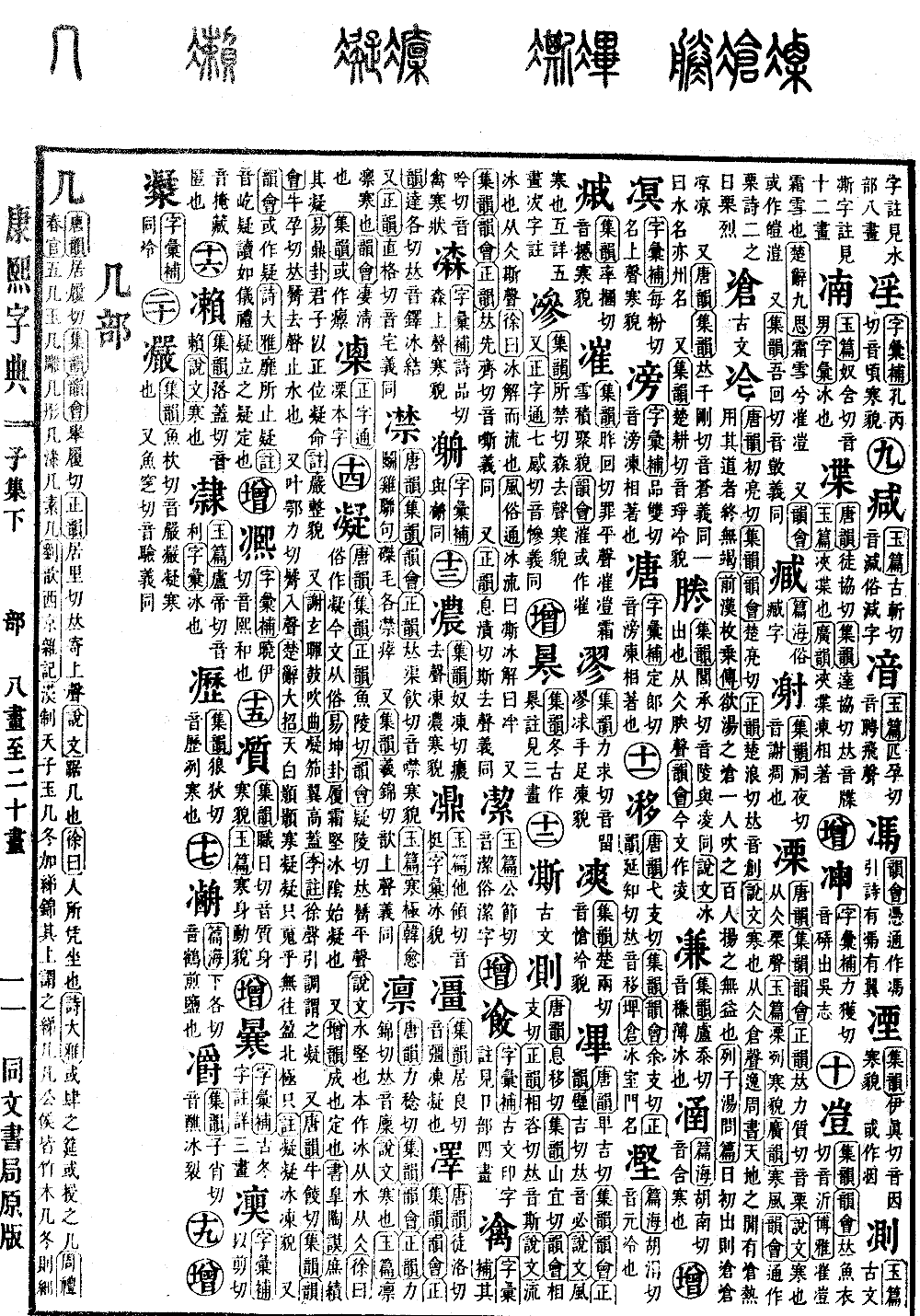
Zi Collection, Page Position: Lower
Radical: Ice (bing)
Strokes: 16
Page 133, Entry 45
In the Tangyun, Jiyun, and Zhengyun, the fanqie pronunciation is given as yu and ling. In the Yunhui, the fanqie pronunciation is given as yi and ling. It is pronounced like the level tone of the character yi.
The Explaining Graphs and Analyzing Characters (Shuowen Jiezi) explains it as water freezing into hard ice. The original character was written as bing, composed of the elements for water (shui) and ice (bing).
Xu Xuan states that the common form is written as ning, and the current standard script follows this common form.
In the Book of Changes (Yijing), Hexagram Kun: When one treads upon hoarfrost, hard ice will follow; the yin energy has begun to congeal.
Furthermore, the Zengyun explains it as to form or to stabilize. In the Book of Documents (Shangshu), The Counsels of Gao Yao: The various achievements are thus consolidated.
In the Book of Changes, Hexagram Ding: The superior man rectifies his position and consolidates his mandate. The commentary notes this describes a solemn and orderly appearance.
Also, in the Songs for Wind and Percussion (Guchuiqu) by Xie Tiao: The slow sounds of the reed pipe accompany the high carriage canopy. Li Shan's commentary states that when musical sounds are slow and drawn out, it is called ning.
Also, in the Tangyun, the fanqie pronunciation is niu and [cut]. In the Jiyun and Yunhui, the fanqie pronunciation is niu and yun, sounding like the departing tone of the character yi. It refers to stagnant water.
Also, there is a rhyming pronunciation of e and li, similar to the entering tone of yi.
In the Songs of the South (Chuci), The Great Summons: The sky is vast and white, the cold congeals into ice. O soul, do not go there, for the North Pole is filled with ice and snow. The commentary states that ningning describes a frozen appearance.
Furthermore, the Yunhui states it is sometimes written as yi. In the Classic of Poetry (Shijing), Greater Odes: There is no place to settle and find stability. The commentary gives the pronunciation as yi. Here, yi is read as the word yi in the phrase standing firmly from the Book of Rites and Ceremonies (Yili), meaning stable.