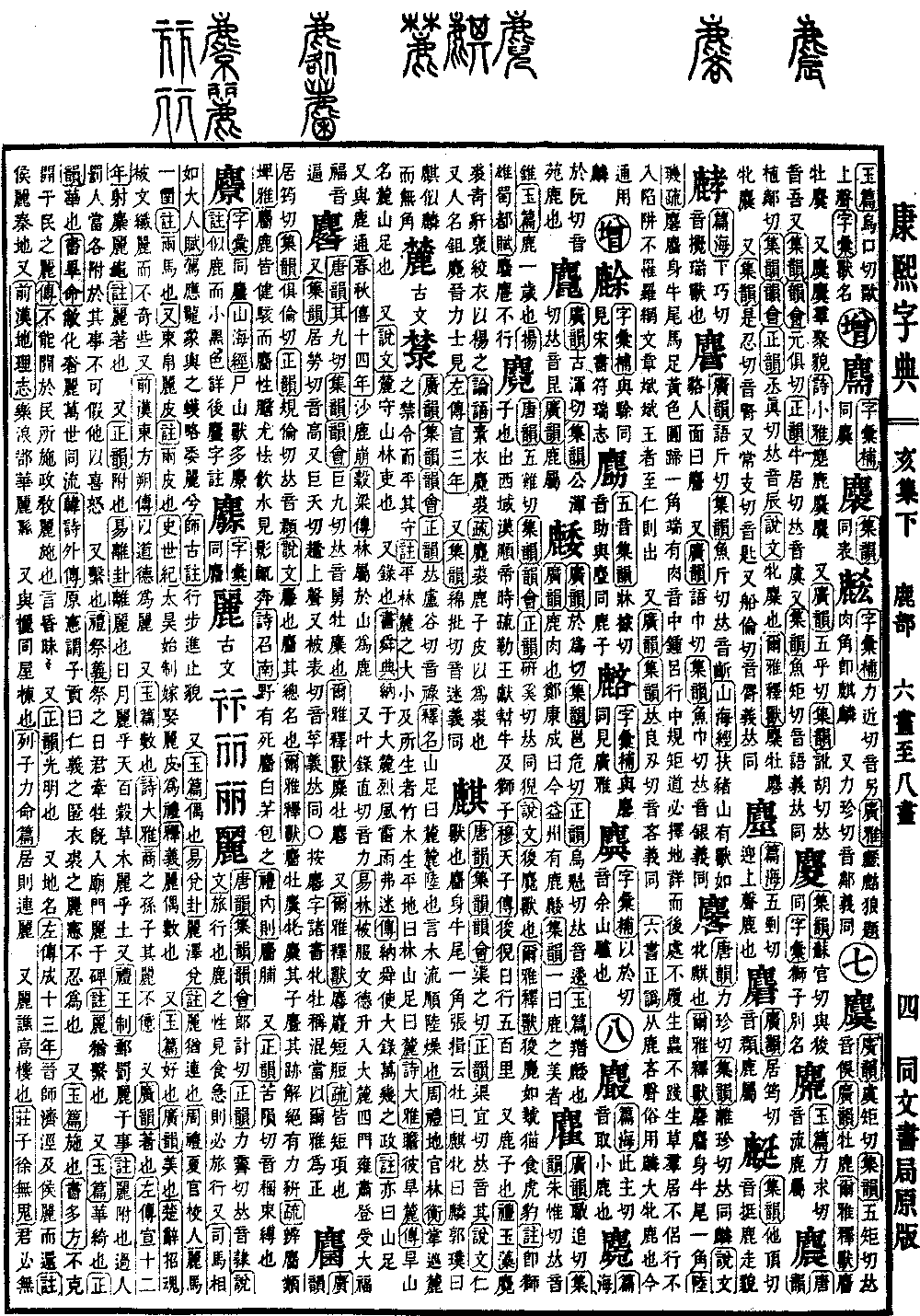
Hai Collection, Lower Volume
Radical: Deer (lù)
Kangxi Strokes: 19
Page 1510, Entry 23
Pronounced ni. The same as the term for a lion (ni).
Shuowen Jiezi states: Suanni is a type of beast.
Erya, Explanation of Beasts states: The suanni resembles a small striped cat and eats tigers and leopards.
Commentary states: This is the lion. It comes from the Western Regions. During the reign of Emperor Shun of Han, the King of Shule offered a zebu and a lion as tribute.
The Chronicle of King Mu (Mu Tianzi Zhuan) states: The suanni travels five hundred li in a single day.
Also refers to a fawn.
Book of Rites (Liji), Jade Pattern section states: A fawn-fur robe with black fox cuffs, worn with an unlined garment over it.
Analects (Lunyu) states: A plain white garment and a fawn-fur robe.
Commentary states: A fawn-fur robe is a garment made from the hide of a fawn.
Also a name of a person. Chu Ni was a warrior of the State of Jin. See Zuo Commentary (Zuozhuan), Year 2 of Duke Xuan.
Also, according to the Collected Rhymes (Jiyun), pronounced mi. The meaning is the same.
Textual Research: In the Chronicle of King Mu (Mu Tianzi Zhuan), the text reads the suanni travels five hundred li. Following the original text, the character for walks has been corrected to travels. In the Zuo Commentary (Zuozhuan), the text refers to Year 2 of Duke Xuan. Following the original text, the reference to Year 3 has been corrected to Year 2.