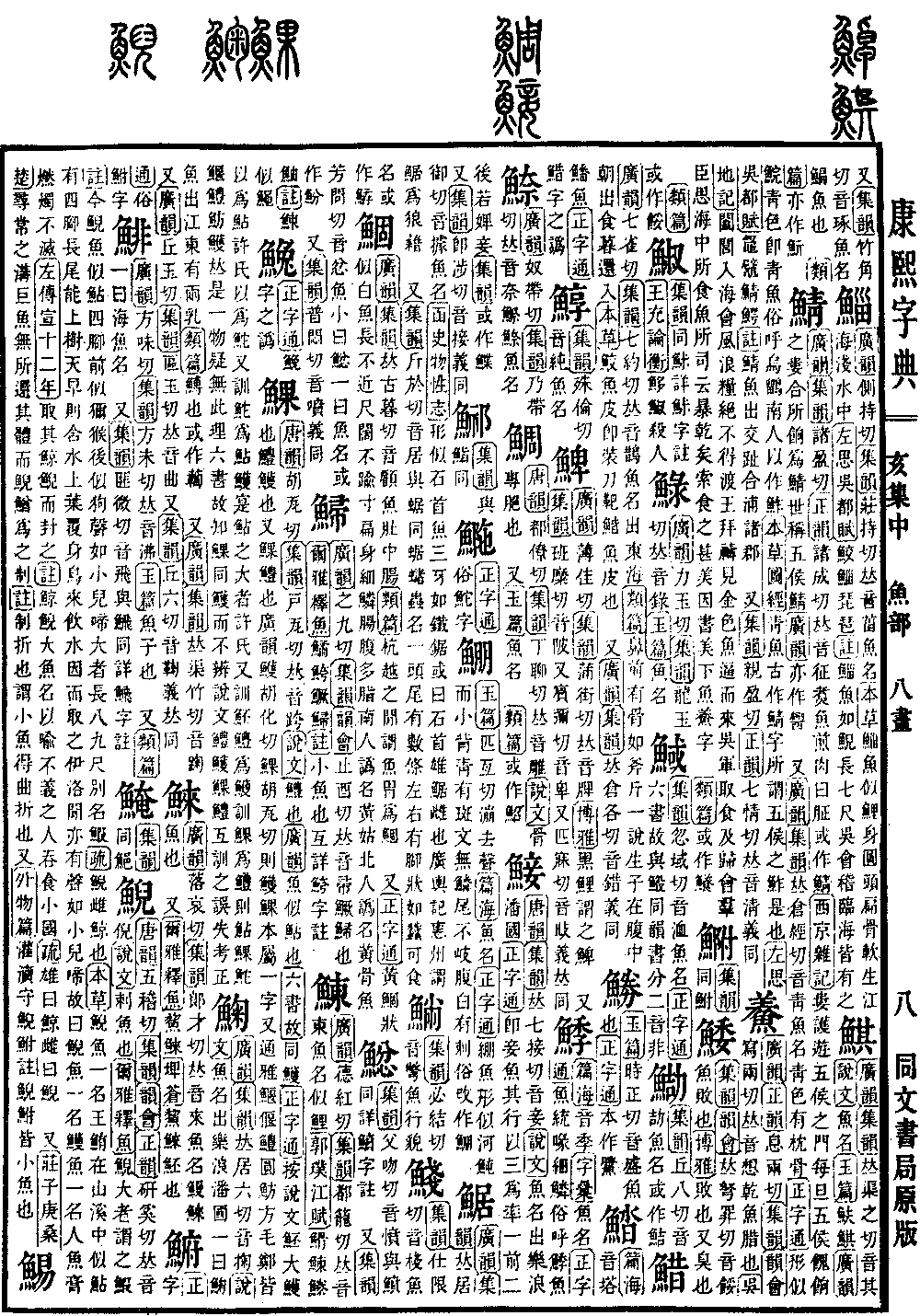
Hai Collection, Middle Volume
Radical: Fish (yú)
Character: Ni
Kangxi stroke count: 19
Page 1472, Entry 01
Pronounced ni (level tone)
Shuowen Jiezi (Dictionary of Explaining Graphs and Analyzing Compound Characters): A fish with a barb.
Erya (Approaching Elegance), Explaining Fishes: The large ones are called xia. Commentary: The current giant salamander looks like a catfish, has four legs; the front resembles a macaque and the back a dog; its sound is like a small child crying; large ones reach eight or nine feet in length; another name is xia.
Subcommentary: Ni is the female whale.
Bencao (Compendium of Materia Medica): The giant salamander is also called wangwei; it lives in mountain streams, looks like a catfish, has four legs and a long tail, and is able to climb trees. During droughts, it holds water in its mouth to douse its body and leaves; when birds come to drink, it catches them. It is found in the Yi and Luo river regions; its sound is like a small child crying, hence it is called ni fish. Other names include hu fish and ren fish; its fat burns in candles without extinguishing.
Zuo Zhuan (Chronicle of Zuo), 12th Year of Duke Xuan: To take their jing and ni and seal them. Commentary: Jing and ni are names of large fish. Used as a metaphor for unrighteous people swallowing up small states. Subcommentary: The male is called jing and the female is called ni.
Zhuangzi, Geng Sang Chu: In a ditch of eight feet, a giant fish has no room to turn its body, but the ni and qiu fish can control it. Commentary: Control means to bend or fold; it means the small fish are able to move in curves.
Zhuangzi, Outer Chapters: Irrigating ditches guarded by ni and fu. Commentary: Ni and fu are both small fish.