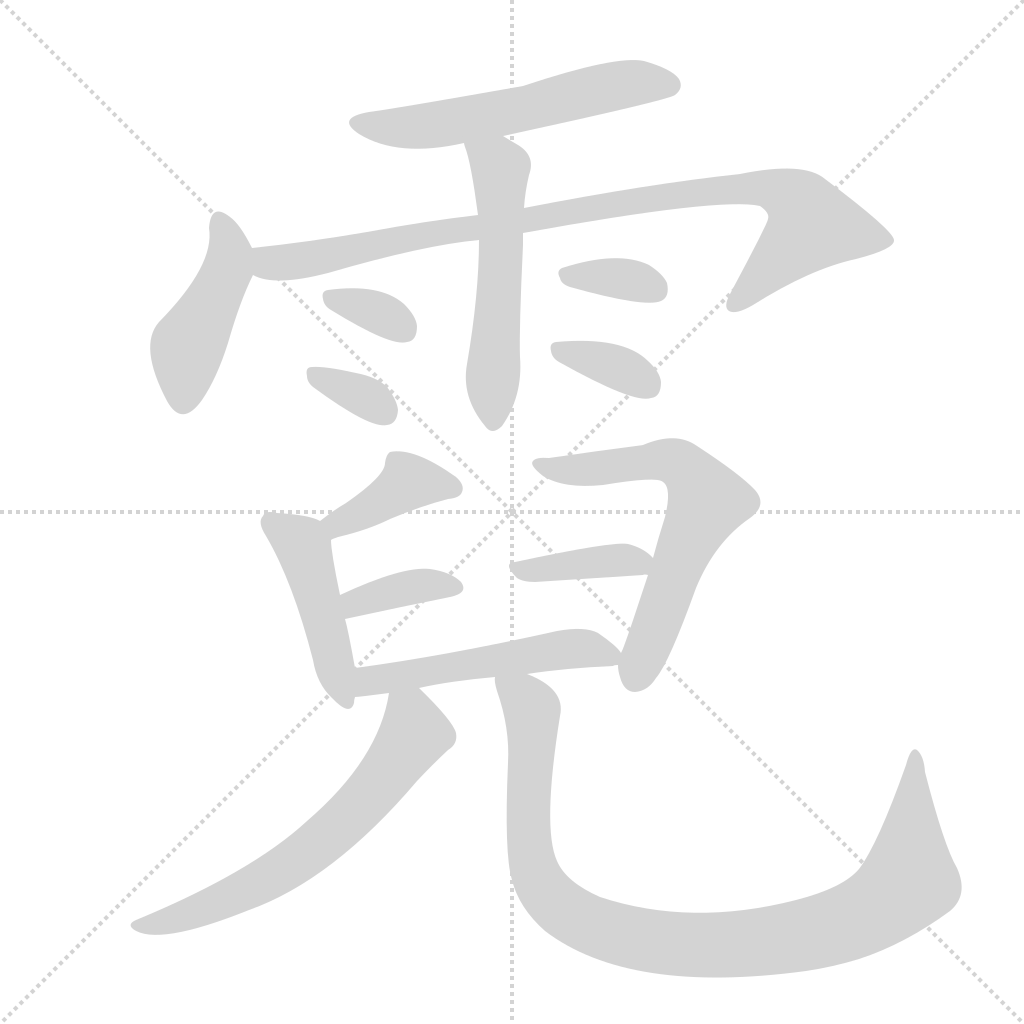
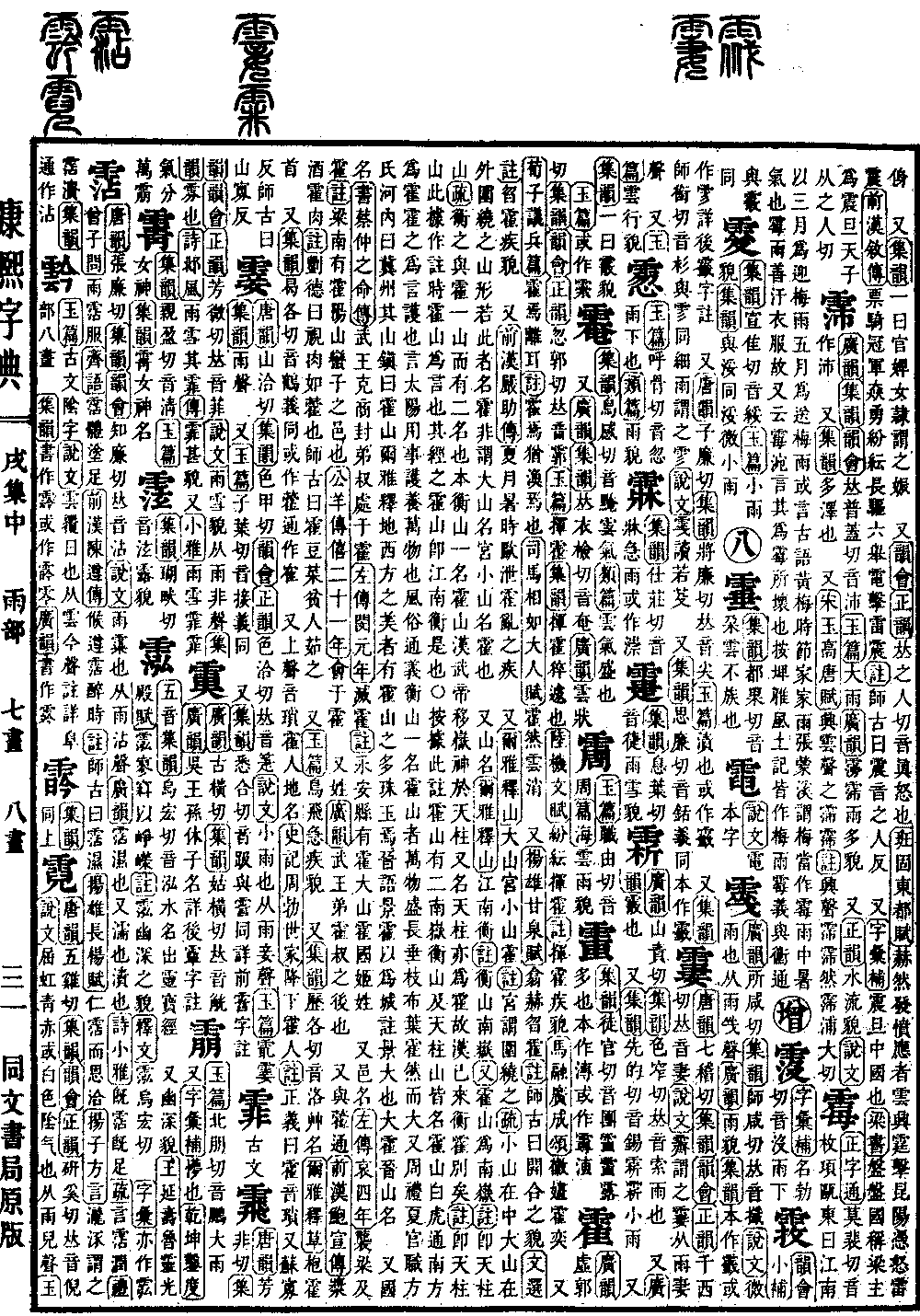
Xu Collection, Middle Volume
Radical: Rain (yǔ)
Ni; Kangxi stroke count: 16
Page 1375, Entry 29
Pronounced ni.
According to the Explaining and Analyzing Characters (Shuowen Jiezi), it refers to a curved rainbow of blue and red colors. It may also refer to a white-colored atmospheric phenomenon. It is composed of the radical for rain and the sound of the character er.
According to the Jade Chapters (Yupian), it refers to cloud colors resembling a dragon.
According to the Encyclopedia of Pi (Piya), the male is called hong and the female is called ni. Traditionally, it was said that rainbows appeared in pairs; the one with bright and strong colors was the male, while the one with faint colors was the female. Another theory states that the red and white one is called hong, while the blue and white one is called ni.
The Book of Erya (Erya), section on heaven, states that ni is a splitting in two.
The Huainan Masters (Huainanzi), section on mountain teachings, states that heaven possesses two types of vapors that form a rainbow, which is the meaning here.
The Book of Mencius (Mengzi) compares it to longing for clouds and ni during a great drought.
In the Collected Rhymes (Jiyun), it is used interchangeably with the character ni (variant form).
Also, the Book of Erya (Erya), section on heaven, states that rapid thunder is called tingni. The commentary explains that swift and fierce thunder is called peili.
Pronounced yi (falling tone). The meaning is the same.
In the Eastern Capital Rhapsody (Dongjing Fu) by Zhang Heng, it is written that dragon carriages fill the palace, and cloud flags flutter like ni. On the morning of the first day of the first month of the Xia calendar, torches in the courtyard shine brightly.
Pronounced nie (entering tone). The meaning is the same.
According to the Explanation of Names (Shiming), ni means to gnaw. Its form is intermittent, appearing at times it should not, which is a sign of disaster. It harms all things as if something is gnawing at them.
According to the History of the Southern Dynasties (Nan Shi), biography of Wang Jun, when Shen Yue wrote the Suburban Dwelling Rhapsody (Jiaoju Fu), he showed the draft to Wang Jun. When Wang Jun read the phrase female ni coiling, Shen Yue clapped his hands and said happily: I have always feared others would read ni with a level tone. Note: The ni in female ni is read with a falling tone. The ni in cloud ni is read with a level tone. The Study Grove (Xuelin) states: When Fan Zhen was summoned to the Academy for an examination, he used the ni in colorful ni with a level tone. The examiners believed Fan Zhen had violated the rhyme, and the scholars of the time were indignant and troubled by this. Sima Guang remarked: Shen Yue’s rhapsody simply selects a reading with beautiful rhythm; it is not that the character ni cannot be read with a level tone.
Also in the Western Capital Rhapsody (Xijing Fu) by Zhang Heng, it refers to standing straight and tall. The commentary explains that che-ni describes a lofty appearance.
Pronounced yi.
In the Collected Rhymes (Jiyun), it refers to a female ni.
In the Collected Rhymes (Jiyun), the original form is written as ni. It is also written as ni (variant form).