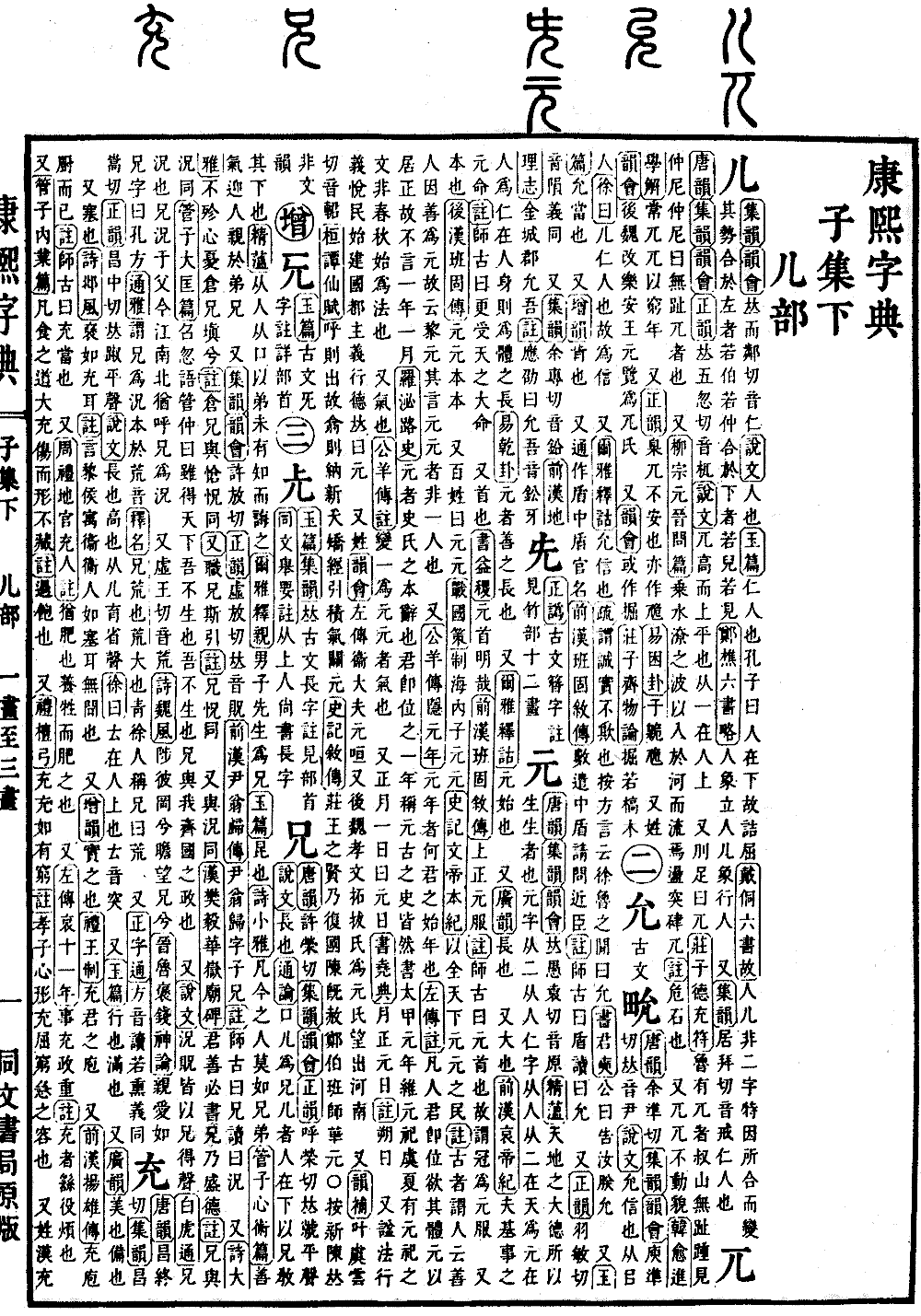
Zi Collection, Page Position: Lower. Radical: Legs (ér). Kangxi Dictionary Stroke Count: 8. Page 123. Tang Dynasty Rhymes (Tangyun): Pronounced with the initial of rǔ and the final of yí. Collected Rhymes (Jiyun), Rhyme Rhymes (Yunhui), and Correct Rhymes (Zhengyun): Pronounced with the initial of rú and the final of zhī. The pronunciation is similar to the level tone of ěr. "A young child (rúzǐ)" — Explaining Graphs and Analyzing Characters (Shuowen Jiezi). The character form resembles the shape of an infant. The fontanelle (xìn) on top of a young child's head has not yet closed. "A male child is called ér, while a female child is called yīng" — Rhyme Rhymes (Yunhui). "It carries the meaning of an inkling (duān ní), referring to the initial state of a human, just as trees have sprouts and beginnings" — Rhyme Rhymes. "It means soft and weak, referring to the delicate appearance of an infant, representing a young and fragile state" — Cangjie Chapter (Cangjiepian). "This is a surname; in the Han Dynasty, there was a person named Er Kuan" — Rhyme Rhymes. Additionally, the Tang Dynasty Rhymes gives the pronunciation for the surname as the initial of wǔ and the final of jī. The Collected Rhymes and Rhyme Rhymes give it as the initial of yán and the final of xī. The Correct Rhymes gives it as the initial of wǔ and the final of lí. The sound is similar to ní. This is used as a surname. "There is a chapter titled Er Liang" — Book of the Former Han (Qianhan Shu), Treatise on Literature and Art (Yiwen Zhi). Yan Shigu states that Er Liang was a person from the Warring States period. "Er Kuan was from the region of Qiancheng" — Biography of Er Kuan (Er Kuan Zhuan). "It means small and weak and is used interchangeably with the character ní; it appears in the phrase 'returning their elderly and young'" — Mencius (Mengzi). Verification: In Explaining Graphs and Analyzing Characters, the text originally stated child (háizi), but has been corrected to young child (rúzǐ) according to the source. The term for head fontanelle was corrected from tóu cōng to tóu xìn. In the Mencius, the phrase for elderly and young was corrected from mào ní to máo ní according to the original text.