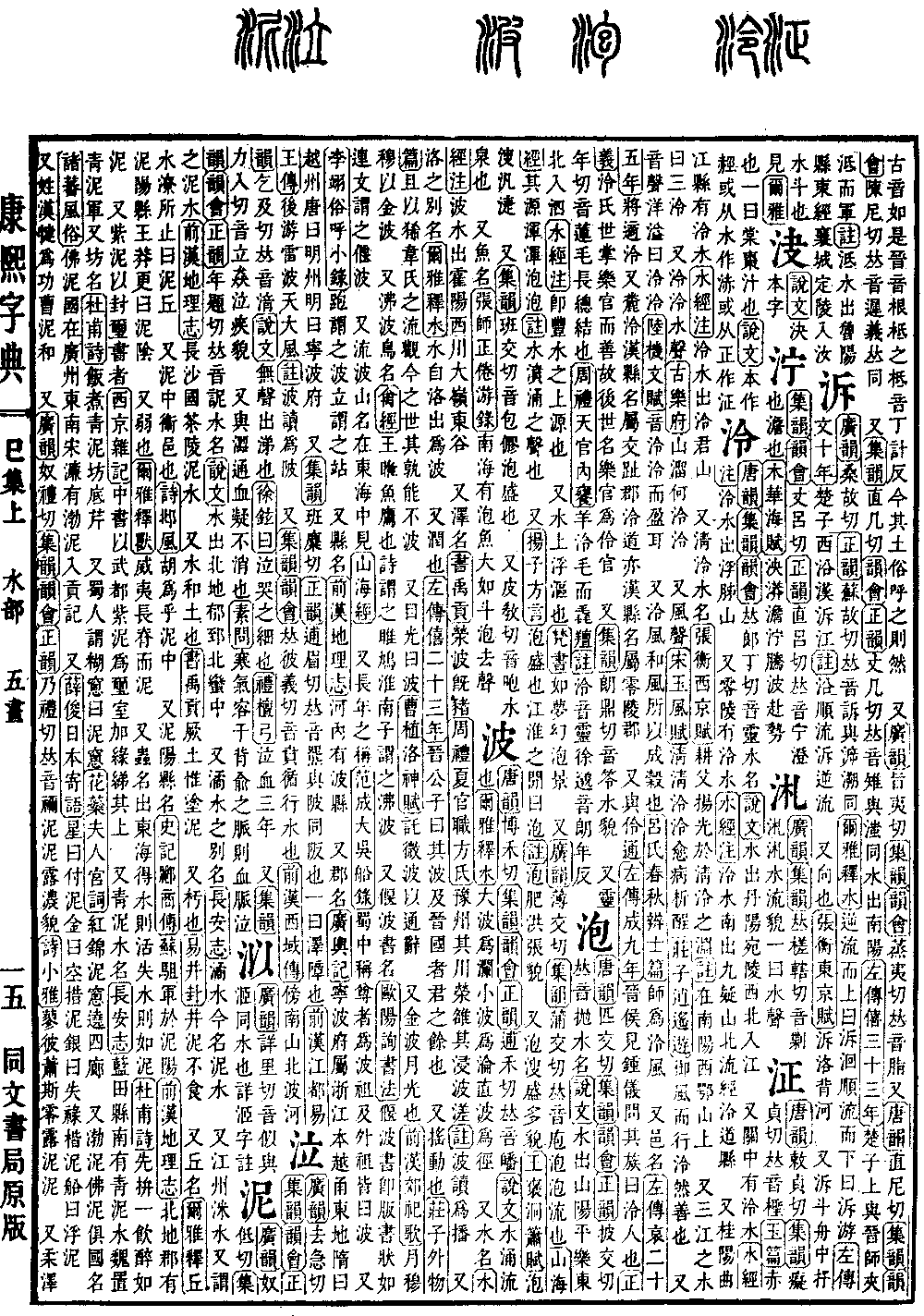
Si Collection, Upper Volume. Radical: Water (shuǐ). Kangxi stroke count: 9. Page 617, Entry 11.
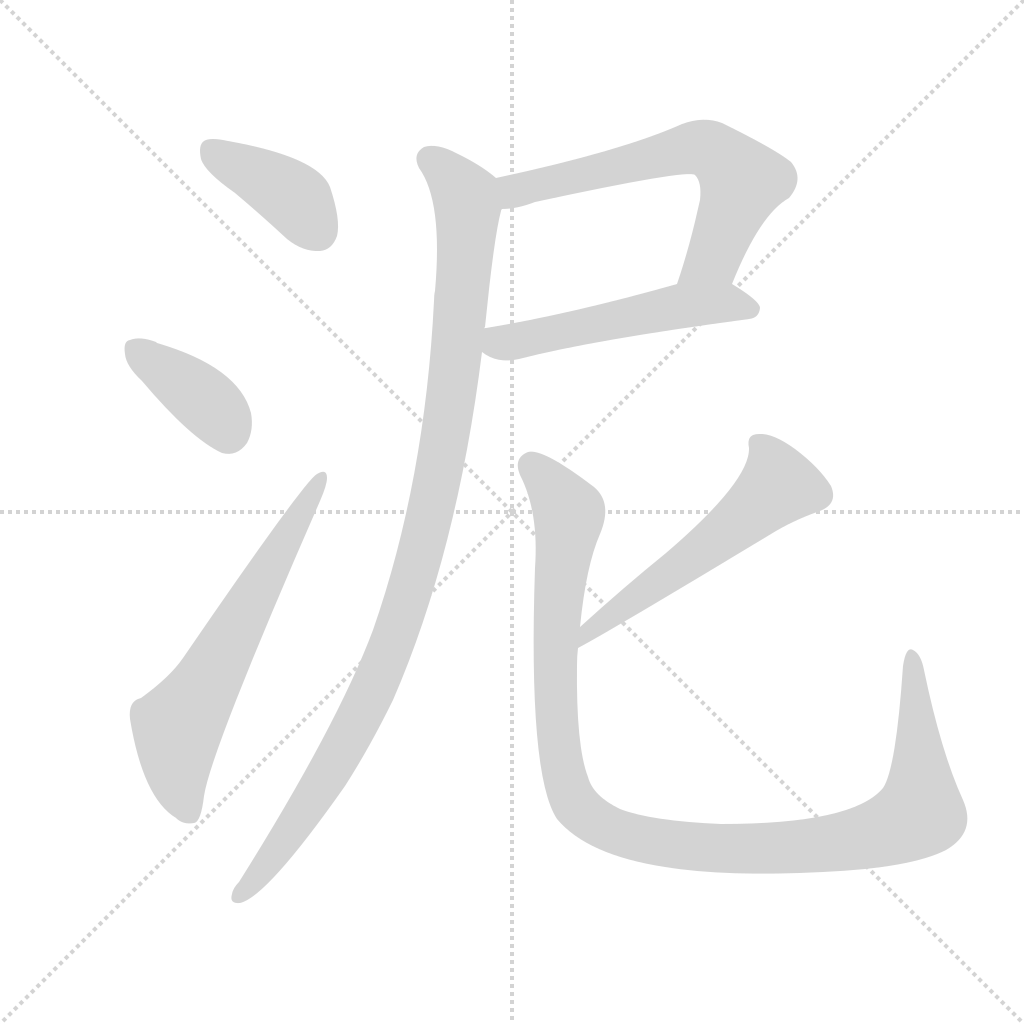
Pronounced ni. It is the name of a river.
Shuowen Jiezi states: This water originates in the barbarian regions north of Yuzhi County, Beidi Commandery.
It is also an alternative name for the Ju River. The Record of Chang'an (Chang'an Zhi) states: The Ju River is currently called the Ni River.
Furthermore, the Mi River in Jiangzhou is also referred to as the Ni River. The Book of Han (Qian Hanshu), Geographic Treatise, records: Chaling County in the State of Changsha has a Ni River.
It also refers to a mixture of water and soil. The Book of Documents (Shangshu), Tribute of Yu (Yu Gong), records: The soil there is low-lying and marshy.
It also refers to filth. The Book of Changes (Yijing), Well hexagram (Jing gua), states: If there is silt in the bottom of a well, it cannot be consumed.
It is also the name of a mound. The Erya, Explanation of Mounds (Shi qiu), states: A place where rainwater collects and stagnates is called a Ni mound.
Nizhong is a city in the State of Wei. The Book of Odes (Shijing), Odes of Bei (Beifeng), states: Why are you in Nizhong?
Niyang is the name of a county. The Records of the Grand Historian (Shiji), Biography of Li Shang, records: Su Zang stationed troops in Niyang. The Book of Han, Geographic Treatise, records: Beidi Commandery had Niyang County, which was renamed Ni-yin during the time of Wang Mang.
It also refers to being weak or soft. The Erya, Explanation of Beasts (Shi shou), states: The weiyi beast has a long, soft back.
It is also the name of an insect that lives in the East Sea; it lives when it touches water and becomes like mud when it loses water. Du Fu's poetry states: I will be drunk first, drunk as soft mud.
Zini (purple mud) is a material used to seal imperial edicts. The Miscellaneous Records of the Western Capital (Xijing Zaji) records: The Central Secretariat used purple mud from Wudu to create boxes for the imperial seal, covering them externally with green silk.
Qingni (green mud) is the name of a river. The Record of Chang'an records: South of Lantian County is the Qingni River, where the State of Wei once established the Qingni Army.
It is also the name of a neighborhood. Du Fu's poetry states: The rice is cooked with celery produced in the Qingni neighborhood.
People in the Shu region call papering windows ni. The Palace Poems of Lady Huarui (Huarui Furen Gongci) state: Red brocade-decorated ni-windows surround the four corridors.
Boni and Foni are both names of countries. Record of Foreign Customs (Zhufan Fengsu) records: Foni country is southeast of Guangzhou; Song Lian wrote the Record of Tribute from Boni.
Additionally, Xue Jun's Notes on Japanese Language (Riben Jiyu) records: Stars are called funi, gold is called kongcuoni, silver is called shilukaini, and ships are called funi.
It is also a surname. During the Han dynasty, there was an official named Ni He in Jianwei Commandery.
Pronounced ni. Ni-ni describes the appearance of heavy dew. The Book of Odes, Odes of Xiao Ya (Xiaoya), states: That tall mugwort, the fallen dew is wet and glistening.
It also describes a soft and glossy appearance. The Book of Odes, Odes of Da Ya (Daya), states: Just budding, just growing, its leaves are soft and glossy. It is also written in a variant form (ni).
Pronounced ni. It refers to being obstinate or obstructed. The Analects (Lunyu) states: Focusing on distant goals may lead to being obstinate and lacking flexibility.
Pronounced ning. Nimu is the name of a place.
It is also the name of a pavilion. The Commentary to the Zuo Tradition (Zuozhuan Zhu) states: East of Gaoping and Fang counties, there is the Nimu Pavilion, pronounced like ning.
It is also used interchangeably with nie. The Records of the Grand Historian, Biography of Qu Yuan, states: The appearance of purity, dyed in black mud and not turning black. The commentary notes: Ni is pronounced the same as nie.
Textual research: Refers to filth. The Book of Changes, Well hexagram. Record: The silt in the well cannot be consumed. Note: Cheng Yi's commentary explains that the well water cannot be consumed due to contamination by filth. Changed the character meaning "trowel" to the character meaning "filth".