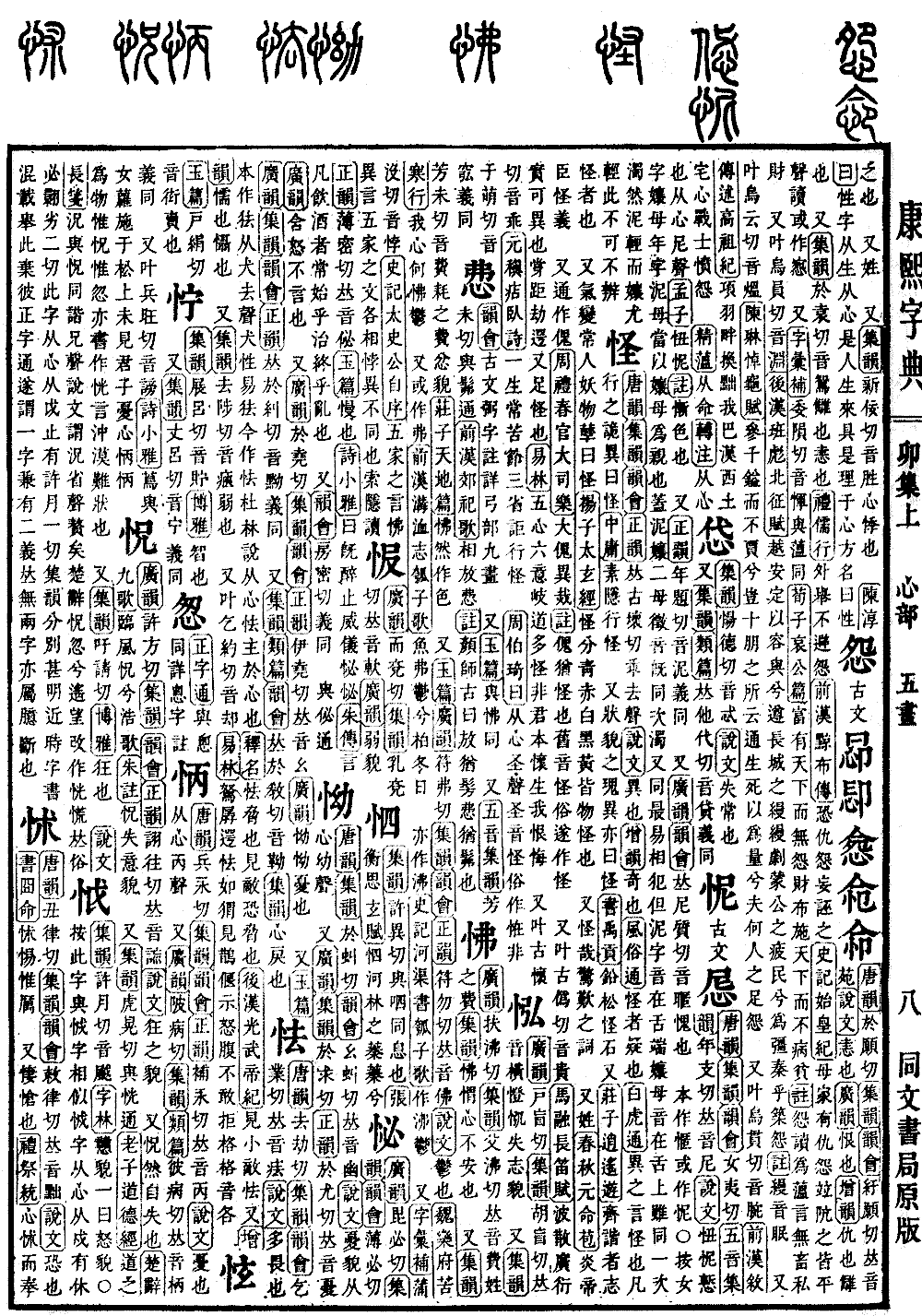
Mao Collection, Upper Volume
Radical: Heart (xīn)
Ni
Kangxi stroke count: 9
Page 382, Entry 08
Ancient citations:
According to Tang Rhymes (Tangyun), Collected Rhymes (Jiyun), and Rhyme Compendium (Yunhui), pronounced ni. According to Five Sounds Collected Rhymes (Wuyin Jiyun), pronounced ni, which is the same as the pronunciation for ni. The Analytical Dictionary of Characters (Shuowen Jiezi) defines it as niu-ni, meaning to be ashamed. The character structure consists of the Heart radical with ni as the phonetic component. It appears in the Mencius (Mengzi). The commentary defines it as the appearance of shame.
According to Correct Rhymes (Zhengyun), pronounced ni, which is the same as the pronunciation for ni. The meaning is the same. According to Broad Rhymes (Guangyun) and Rhyme Compendium (Yunhui), pronounced ni, which is the same as the pronunciation for ni (close or intimate), meaning to be ashamed. It was originally written as a variant form. Sometimes also written as ni.
Note: The character ni belongs to the niang initial, and the character ni belongs to the ni initial; the niang initial pronunciation is more accurate. Because the ni initial and the niang initial share the same zhi tone category and both belong to the secondary voiced initials, they are easily confused. However, the ni initial is pronounced at the front of the tongue tip, while the niang initial is pronounced at the top of the tongue surface. Although both are secondary voiced, the ni sound is lighter, and the niang sound is even lighter; this distinction must be observed.