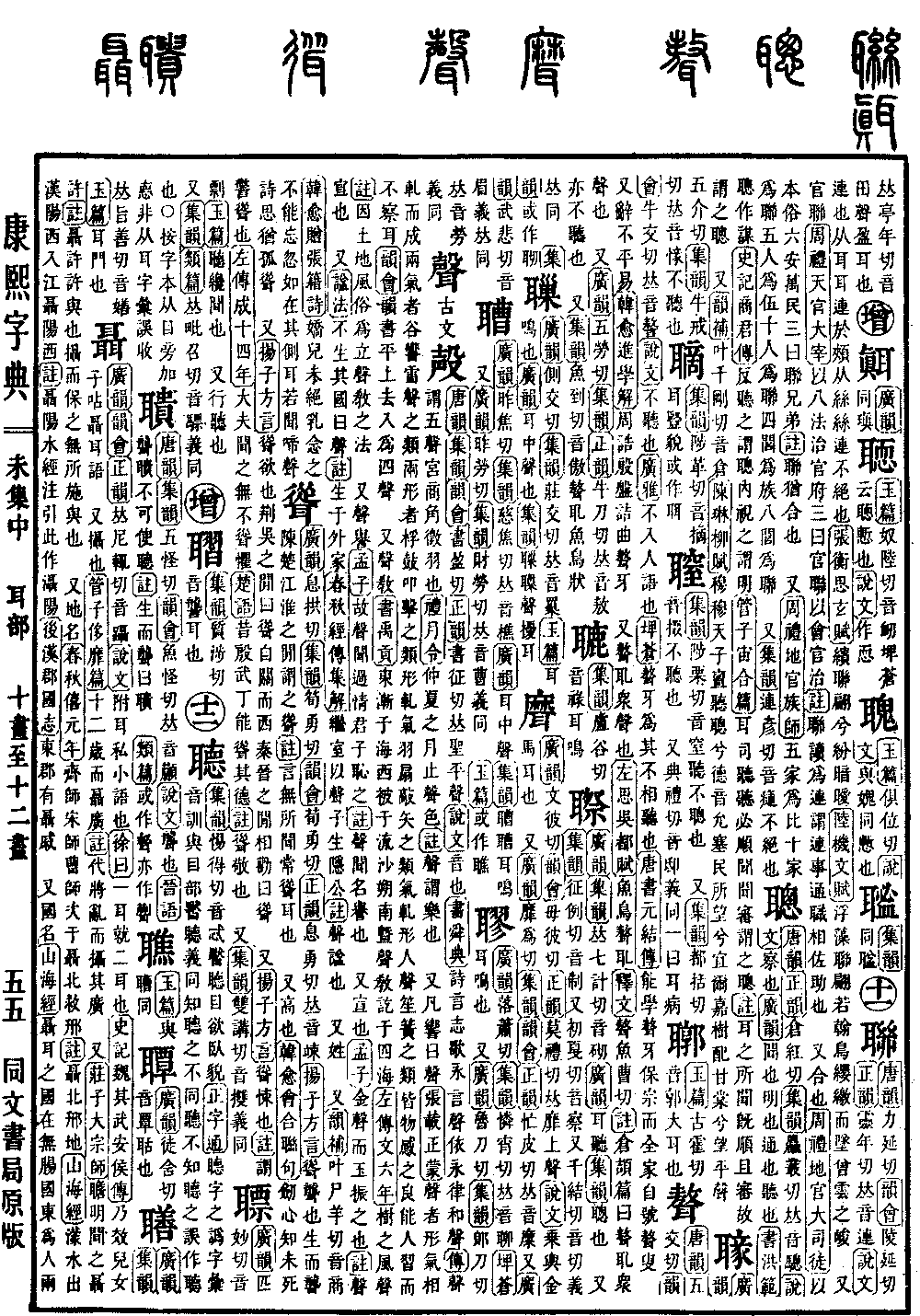
Wei Collection, Middle Volume
Radical: Ear (ěr)
Nie; Kangxi strokes: 18; Page 969
According to the Guangyun (Guangyun), Yunhui (Yunhui), and Zhengyun (Zhengyun) dictionaries, pronounced nie (entering tone).
According to the Shuowen Jiezi (Shuowen), it refers to whispering in someone's ear.
Xu states that this is one ear approaching two ears.
In the Records of the Grand Historian (Shiji), Biography of Marquis Weiqi and Wuan, it is said that they imitated the whispering of children and women.
It also means to assist or hold.
In the Guanzi (Guanzi), chapter on Extravagance, it says after twelve years the width is compressed.
The commentary notes this refers to the upcoming chaos where one must secure the breadth.
In the Zhuangzi (Zhuangzi), Great and Venerable Teacher, it mentions the hearing of Niexu.
The commentary notes that Niexu means to promise or grant. It implies securing and protecting without bestowing.
It is also a place name.
In the Spring and Autumn Annals (Chunqiu), first year of Duke Xi, the armies of Qi, Song, and Cao were stationed at Niebei to rescue Xing.
The commentary notes that Niebei is in the territory of Xing.
In the Classic of Mountains and Seas (Shanhaijing), the Meng River emerges from Hanyang and flows west into the Nieyang River.
The commentary notes that in the Commentary on the Water Classic (Shuijing Zhu), this is written as the She River.
In the History of the Later Han (Hou Hanshu), Treatise on Geography, it is noted that Dong Commandery has Nieqi.
It is also the name of a country.
In the Classic of Mountains and Seas (Shanhaijing), the country of Nie'er is located east of the Wuchang country; the people there use their hands to hold their ears.
The commentary notes that because their ears are long, they must hold them with their hands while walking.
It is also a surname.
In the Records of the Grand Historian (Shiji), Biographies of Assassins, it mentions Nie Zheng, who was a native of Shenjing village in Zhi.
According to the Genealogy of Surnames (Xingpu), an official of the state of Chu held a fief in Nie and adopted it as his surname.
It is also a personal name.
In the Records of the Grand Historian (Shiji), Biographies of Assassins, it mentions that Jing Ke once traveled to Yuci to discuss swordsmanship with Gai Nie.
The commentary notes that Gai is the surname and Nie is the personal name.
According to the Jiyun (Jiyun), pronounced zhe (entering tone). It also means to whisper.
According to the Zhengzitong (Zhengzitong), pronounced zhe (entering tone). It is the same as thin slices of meat.
In the Book of Rites (Liji), Shanyi section, it mentions that raw beef, lamb, and fish should be thinly sliced into fillets.
The commentary notes that to slice thinly means to layer. It involves first slicing with leaves, then re-slicing to form fillets.
According to the Jiyun (Jiyun), pronounced ye (entering tone). It is the same as die. It describes the appearance of movement.
According to the Jiyun (Jiyun), pronounced sha (entering tone). It is the same as she. It refers to a creeping vine.
According to the Jiyun (Jiyun), pronounced zhe (entering tone). It describes the movement of tree leaves.