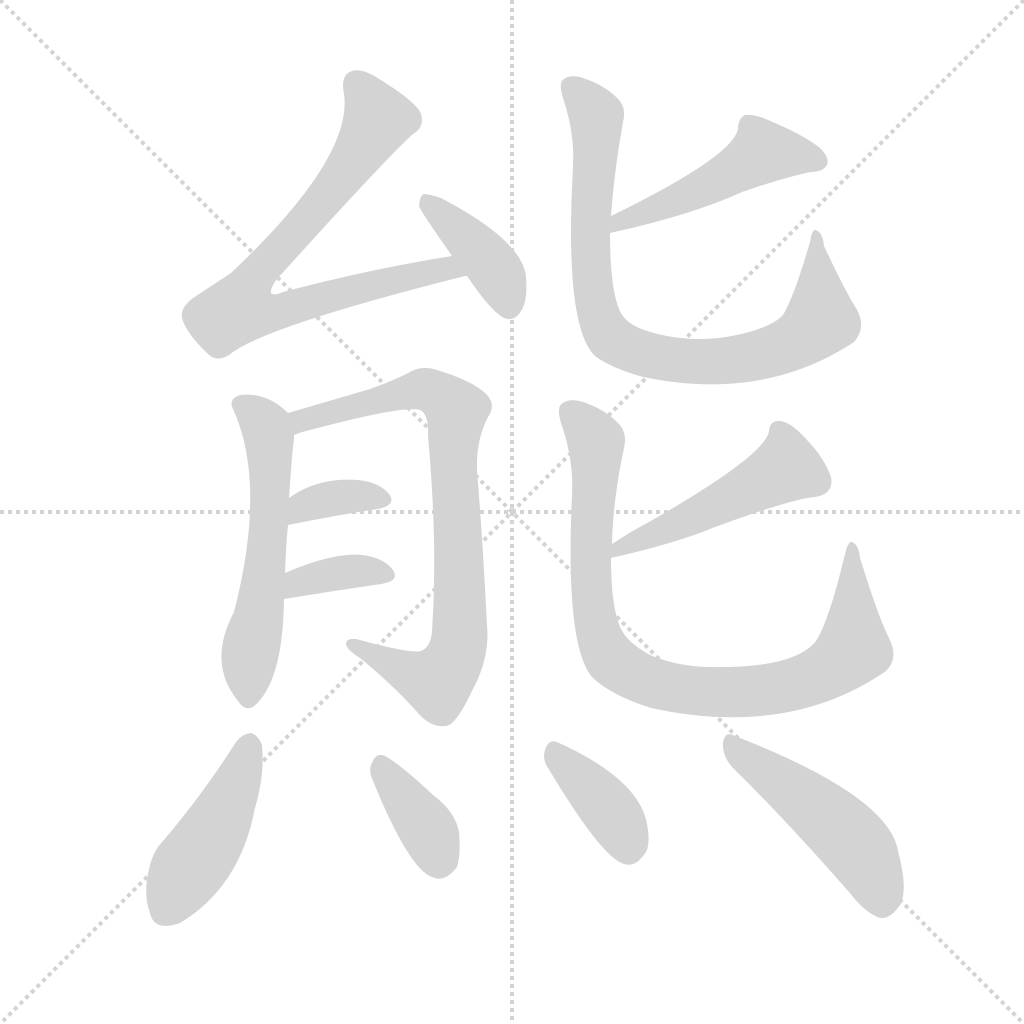
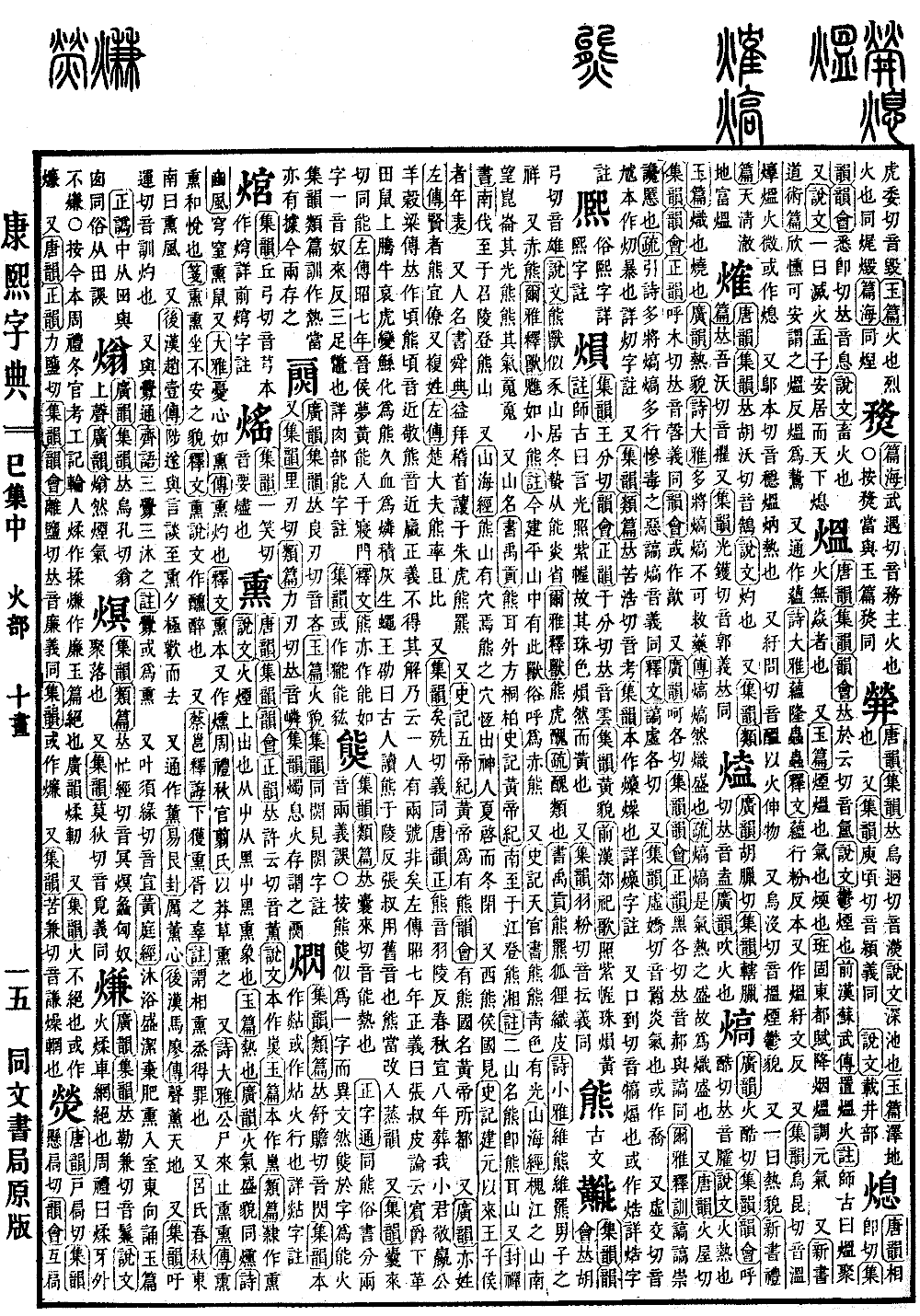
Si Collection, Middle Volume. Radical: Fire (huǒ). Kangxi stroke count: 14. Page 679, Entry 10.
In ancient scripts, according to Collection of Rhymes (Jiyun) and Rhyme Anthology (Yunhui), it is pronounced xiong. According to Explaining Graphs and Analyzing Characters (Shuowen), the bear is a beast resembling a pig that lives in the mountains and hibernates in winter; the character is composed of the graph for able (neng) and an abbreviated form of the graph for blaze (yan). According to Literary Expositor (Erya), in the chapter on animals, the bear is classified within the tiger category. The commentary explains this means they are of the same class. In the Book of Documents (Shangshu), in the Tribute of Yu (Yu Gong) chapter, it is mentioned alongside the fur of the brown bear, fox, and raccoon dog. In the Book of Odes (Shijing), in the Lesser Odes (Xiaoya) section, it is stated that dreaming of bears and brown bears is a favorable omen for the birth of a son.
There is also the red bear. In the Literary Expositor (Erya), the chapter on animals notes that the zhui animal resembles a small bear. The commentary states that such beasts currently inhabit Jianping Mountain and are commonly known as red bears.
Also, in the Records of the Grand Historian (Shiji), in the Treatise on the Celestial Offices (Tianguan Shu), it is written that the light of the bear is greenish and radiant. In the Classic of Mountains and Seas (Shanhai Jing), it is noted that from Huaijiang Mountain, one looks south toward the Kunlun Mountains, where the light is intense and the aura is grand.
It is also a mountain name. In the Book of Documents (Shangshu), in the Tribute of Yu (Yu Gong) chapter, Xiong'er, Waifang, and Tongbai are all listed as mountain names. In the Records of the Grand Historian (Shiji), in the Annals of the Yellow Emperor (Huangdi Ji), it states that the emperor traveled south to the Yangtze River and climbed Xiong Mountain and Xiang Mountain. The commentary notes that these are the names of two mountains, and that Xiong refers to Xiong'er Mountain.
According to the Treatise on the Suburban Sacrifices (Fengshan Shu), during a southern military expedition, the emperor reached Zhaoling and climbed Xiong Mountain.
In the Classic of Mountains and Seas (Shanhai Jing), it states that Xiong Mountain contains a cavern which is the den of a bear; divine beings often appear there, and the cave opens in summer and closes in winter.
There is also Western Xiong, which was a marquisate, as seen in the Records of the Grand Historian (Shiji) in the Chronological Table of Princes and Marquises.
It is also a personal name. In the Book of Documents (Shangshu), in the Canon of Shun (Shun Dian), it is recorded that Yu kowtowed and knelt, yielding to Zhu, Hu, Xiong, and Pi.
In the Records of the Grand Historian (Shiji), in the Annals of the Five Emperors (Wudi Ji), it is stated that the Yellow Emperor belonged to the Youxiong clan. The Rhyme Anthology (Yunhui) notes that Youxiong was the name of a state and the capital of the Yellow Emperor.
According to the Extensive Rhymes (Guangyun), it is also a surname. In the Zuo Tradition (Zuo Zhuan), the worthy man Xiong Yiliao is mentioned.
There is also a double-character surname. In the Zuo Tradition (Zuo Zhuan), the Chu official Xiong Shuqiebi is mentioned.
According to the Collection of Rhymes (Jiyun), it is also pronounced yi. The meaning is the same. According to the Tang Rhyme Corrections (Tangyun Zheng), the sound of bear is pronounced like yu followed by ling. In the eighth year of Duke Xuan of the Spring and Autumn period (Chunqiu), the wife of the ruler, Jingying, was buried. The Zuo Tradition (Gongyang Zhuan) and the Grain of Wheat Tradition (Guliang Zhuan) write this as Qingxiong. The pronunciation of qing is similar to jing, and xiong is similar to ying. The orthodox interpretations could not understand this and thus claimed one person held two titles, which is incorrect. In the seventh year of Duke Zhao of the Zuo Tradition (Zuo Zhuan), the commentary states: Zhang Shu, in his Treatise on Hides, says that when guests' birds fly into the grass and field mice jump upward, if cattle become tigers or mud-dragons (gun) transform into bears, the accumulated blood turns into ghost fire and piles of ash produce flies. Wang Shao says that the ancients read the character for bear with a pronunciation similar to yu ling. Zhang Shu used this older pronunciation. The character for bear should be reclassified under the zheng rhyme.
According to the Collection of Rhymes (Jiyun), it is also pronounced nang lai. It is equivalent to the character for able (neng). In the Zuo Tradition (Zuo Zhuan), in the seventh year of Duke Zhao, it is written that the Duke of Jin dreamed that a yellow neng entered the palace gate. The Exegesis (Shiwen) notes that bear is also written as neng. According to the original graph reading, one pronunciation is nu lai. This refers to a three-footed turtle, details of which are in the commentary for the character able (neng) under the flesh radical. The Collection of Rhymes (Jiyun) also notes that it is sometimes written as neng.