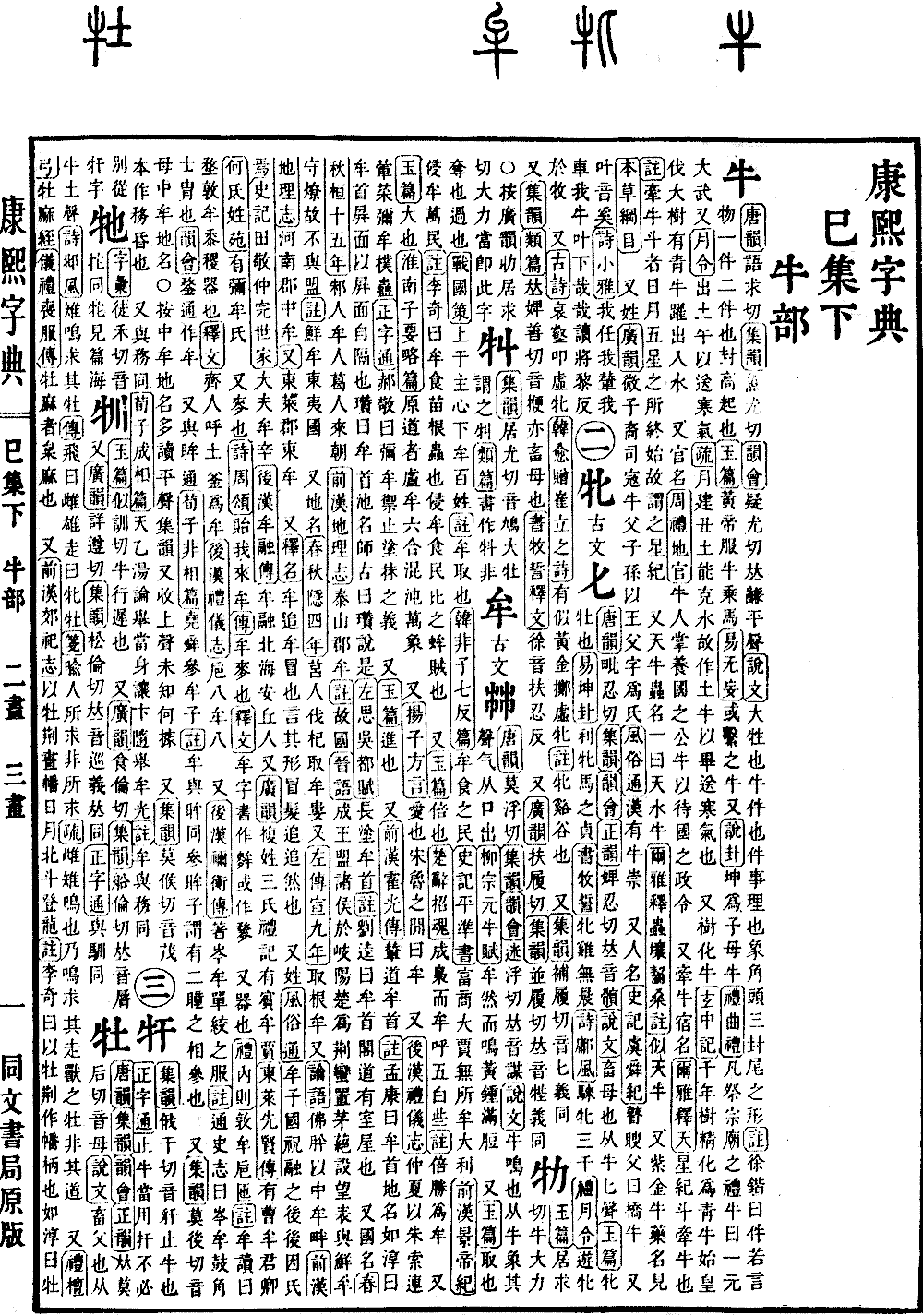
Si Collection, Lower Volume
Radical: Ox (niú)
Kangxi Strokes: 7
Page 697, Entry 11
Tang Rhymes (Tangyun), Collection Rhymes (Jiyun), Rhyme Compilation (Yunhui), Correct Rhymes (Zhengyun): Pronounced mu (falling tone), same pronunciation as mu (rising tone).
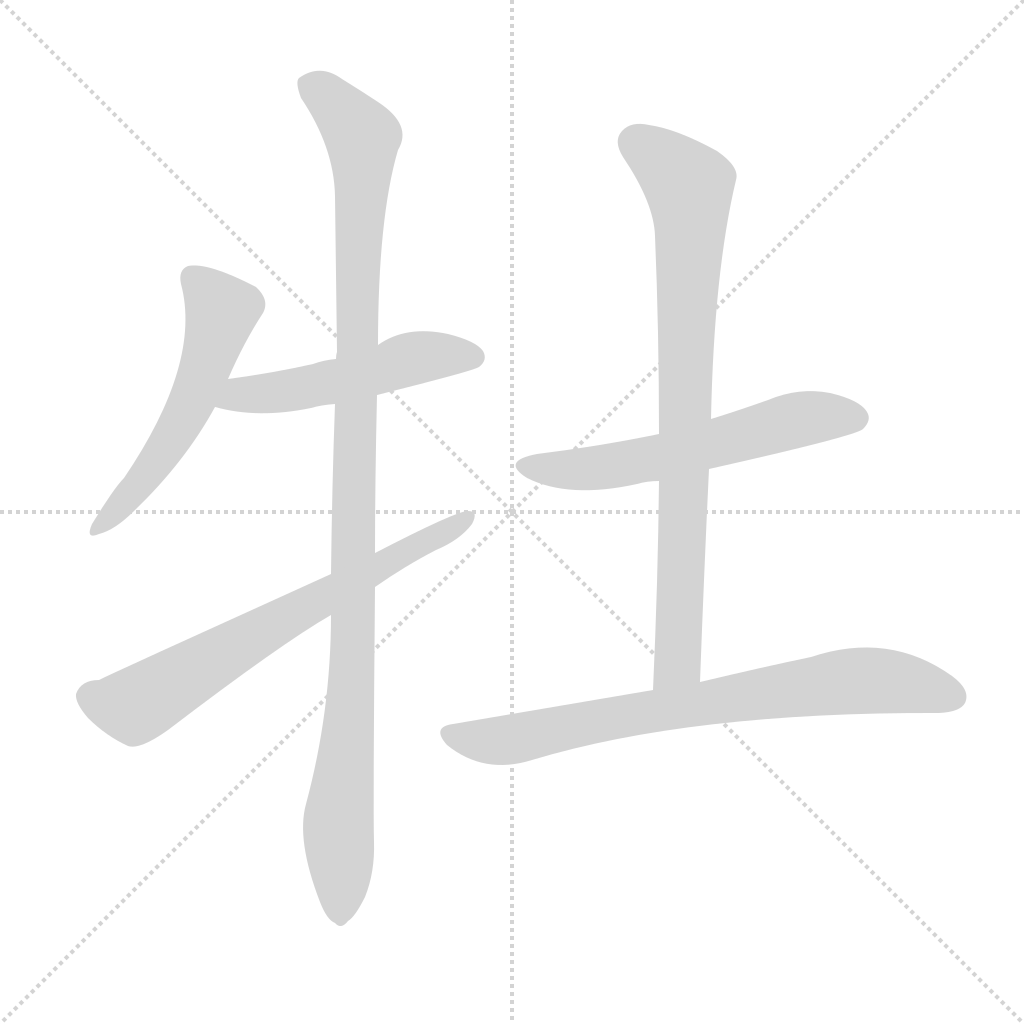
Shuowen Jiezi (Explaining Simple and Compounding Characters): Refers to a male animal. The character is formed by the radical for ox and the phonetic component for soil (tǔ).
Book of Odes (Shijing), Odes of Bei (Beifeng): The wild pheasant cries, seeking its male mate.
Commentary (Zhuan): In birds, sex is referred to as female and male; in beasts, sex is referred to as female (pìn) and male (mǔ).
Notes (Jian): A metaphor for someone pursuing that which they ought not to pursue.
Sub-commentary (Shu): The female pheasant cries, yet calls out seeking the male of the beasts; this is contrary to reason.
Also, Book of Rites (Liji), Tan Gong: Refers to mourning headbands made of male hemp fibers.
Book of Etiquette and Ceremonial (Yili), Transmission of Mourning Apparel (Sangfu Zhuan): Male hemp is the same as male nettle-hemp (xǐ).
Also, History of the Former Han Dynasty (Qian Hanshu), Treatise on Suburban Sacrifices (Jiaosi Zhi): Use vitex (mǔjīng) to paint banners and flags, decorated with the sun, moon, Big Dipper, and flying dragons.
Annotation (Zhu): Li Qi states: Use vitex as the handle for the banner. Ru Chun states: Vitex is the variety of chaste tree that does not bear fruit. Jin Zhuo states: Male (mǔ) refers to the joints being asymmetrical. During a lunar halo, one carves it into a talisman to heal the sick.
Also, History of the Former Han Dynasty (Qian Hanshu), Treatise on Astronomy (Tianwen Zhi): At the Zhangcheng Gate of Chang'an, the door bolt (mǔ) went missing of its own accord.
Annotation (Zhu): Yan Shigu states: The bolt (mǔ) is the object used to lock a door from the inside. Made of iron.
Also, Muqiu, a place name.
Spring and Autumn Annals (Chunqiu), 15th Year of Duke Xi: Alliance meeting held at Muqiu.
Also, the name of a mountain.
Classic of Mountains and Seas (Shanhaijing): Mount Mu, on which many patterned stones are produced.
Also, Collection Rhymes (Jiyun): Pronounced mu (rising tone), same pronunciation as mu (rising tone). The male of birds is also called mǔ.
Collection Rhymes (Jiyun): Sometimes also written in a variant form.