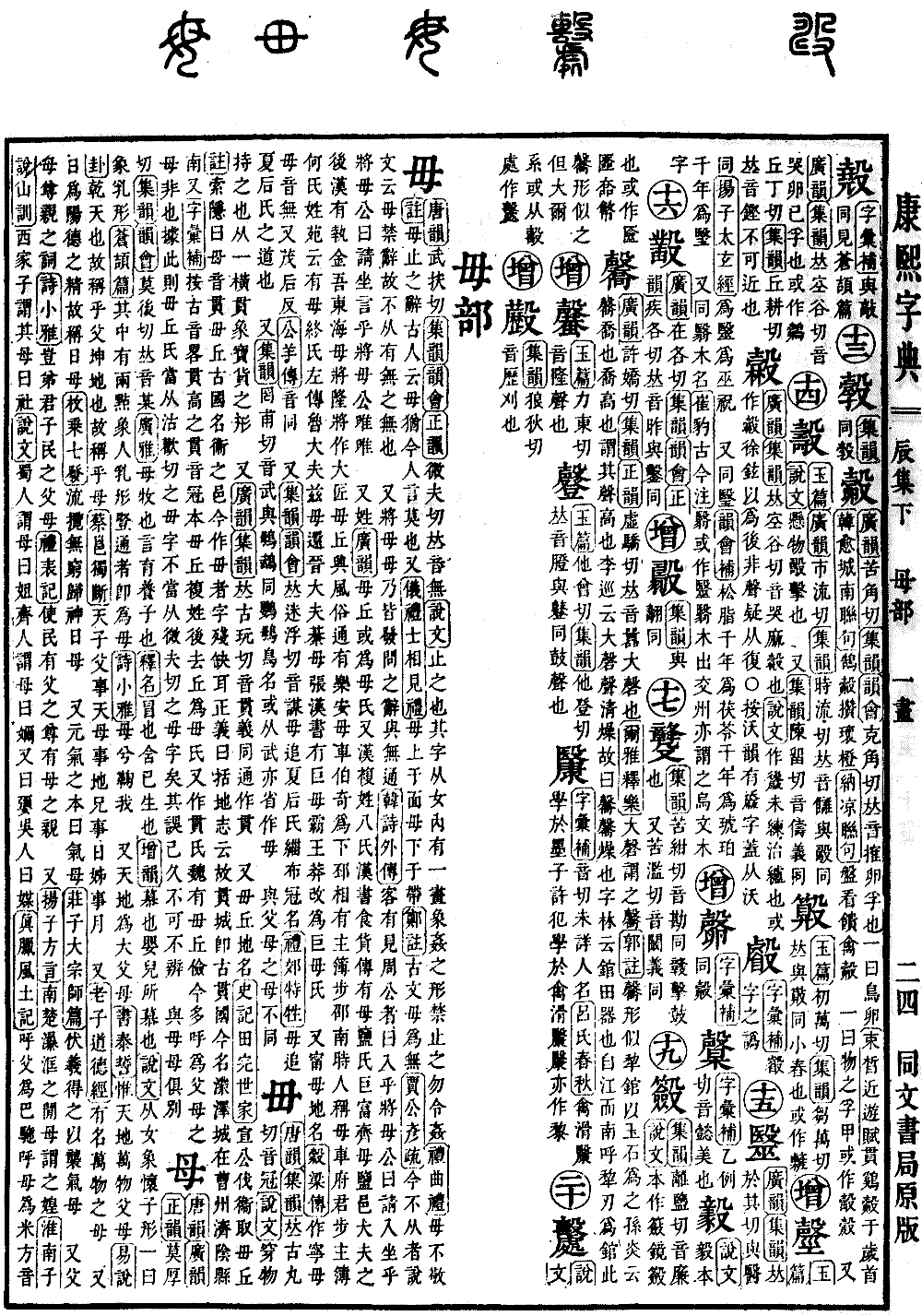
Chen Collection, Lower Volume. Radical: Mother (mǔ). Page 588, Entry 25.
Tang Yun, Guang Yun, Zheng Yun: Pronounced mou. Ji Yun, Yun Hui: Pronounced mou.
Guang Ya: Mother means to pasture or raise. It refers to the rearing of children.
Shi Ming: Mother means to cover or encompass, referring to containing and gestating life.
Zeng Yun: Mother means to yearn, as the person a baby clings to.
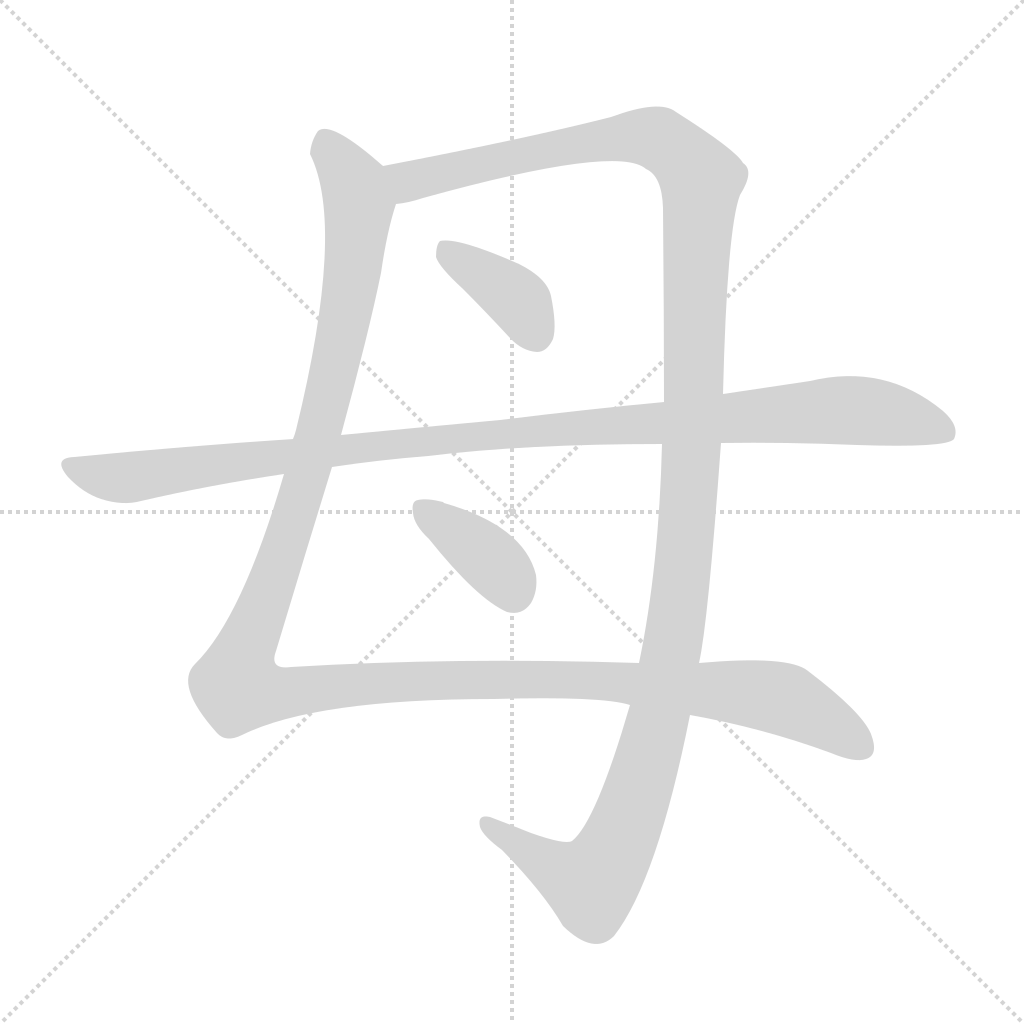
Shuowen Jiezi: The character shape originates from woman, resembling the form of someone pregnant. Another explanation suggests it resembles a breast.
Cangjie Pian: The center of the character contains two dots, resembling human breasts. The vertical stroke connecting them forms the character for mother.
Book of Odes (Shijing), Xiao Ya: O mother, you raised me.
Also, Heaven and Earth are the great parents of all things.
Book of Documents (Shangshu), Tai Shi: Only Heaven and Earth are the parents of all things.
Classic of Changes (Yijing), Shuo Gua: Qian represents Heaven, hence it is called Father. Kun represents Earth, hence it is called Mother.
Cai Yong, Du Duan: The Son of Heaven serves Heaven as he serves a father, serves Earth as he serves a mother, serves the sun as he serves an elder brother, and serves the moon as he serves an elder sister.
Also, Laozi, Dao De Jing: Named is the root (mother) of all things.
Also, the sun is the essence of yang energy, hence it is called the Mother of Days.
Mei Cheng, Qi Fa: The gaze flows to admire endless scenery; the spirit returns to the sun.
Also, the origin of vital energy (qi) is called the Mother of Qi.
Zhuangzi, Da Zong Shi: Fuxi obtained it and used it to harmonize vital energy.
Also, parents is a term for respected elders and relatives.
Book of Odes (Shijing), Xiao Ya: A gentle and harmonious gentleman is the parent of the people.
Book of Rites (Liji), Biao Ji: To cause the people to have the same respect for their superiors as for a father, and the same closeness as for a mother.
Also, Yangzi, Fang Yan: In the Nan Chu region near the Shui River, mothers are called huáng.
Huainanzi, Shuo Shan Xun: A child from a western family calls his mother shè.
Shuowen Jiezi: People in the Shu region call a mother jiě, people in the Qi region call a mother niáng (also written in a variant form), and people in the Wu region call a mother méi.
Zhenla Fengtu Ji: Fathers are called bātuó and mothers are called mǐ. Local dialects vary, but all evolved from the sound of mother.
Also, a wet nurse is also called a mother.
Yue Yu: If three children are born, the state provides a wet nurse.
Also, female creatures are all called mothers.
Mencius: Five hens, two sows.
Book of the Later Han (Qian Hanshu), Emperor Zhao's Annals: Stop requisitioning mares from the empire's postal stations.
Zhang Hua, Qin Jing: When nestlings are about to hatch, they chirp inside the egg and the mother bird responds. Once hatched, the mother chirps and the nestlings respond.
Su Shi, Chou Chi Bi Ji: In Meizhou County, there is a small Buddha shrine popularly known as the Sow Buddha.
Also, Ten Mothers refers to the ten Heavenly Stems (jia, yi, etc.). The twelve Earthly Branches are the Twelve Children. See Book of History (Shiji), Lü Shu.
Also, Queen Mother of the West (Xi Wang Mu) is the name of a deity. See Classic of Mountains and Seas (Shanhaijing). The Book of Rites of the Elder Dai (Da Dai Liji) states: During the time of Shun, the Queen Mother of the West presented a white jade pipe.
Also, Treasure Mother is an object used to gather treasures.
Xiang Yi Ji: Wei Sheng once obtained a beautiful stone; later, a foreigner saw it and said: This is a Treasure Mother. By setting up an altar on the seaside on the fifteenth of every month, one can gather jewels.
Also, there is a miasm mother (zhàng mǔ) in Lingnan.
Zheng Xiong, Panyu Za Ji: In the Wuyang Ridge area, things were seen falling from the sky; initially like pellets, they grew to the size of carriage wheels before dispersing. People who touched them became ill, hence they are called miasm mothers.
Also, Ghost Mother is the name of a deity.
Kuo Yi Ji: In the Xiaoyu Mountains of the South Sea, there is a Ghost Mother who can give birth to one thousand ghosts at once. She gives birth in the morning and eats them by evening. The Ghost Aunt deity in Cangwu is the same entity.
Also, everything with a size pairing is called child and mother.
Book of Odes (Shijing), Zheng Feng, Lu Zhong Huan, Mao Commentary: A zhonghuan is a child-and-mother ring.
Commentary: This refers to a large ring threaded with a small ring.
Also, currency has child-and-mother coins.
Zhou Yu Zhu: Heavy coins are called mother coins, and light coins are called child coins. When both circulate, the people obtain what they need.
Also, cattle have child-and-mother cows.
Classic of Changes (Yijing), Shuo Gua: The Kun hexagram symbolizes the child-and-mother cow. Justice Commentary states: It is because they are prolific and docile.
Also, child-and-mother bamboo is the modern cizhu (bambusa emeiensis). See Ren Fang, Shu Yi Ji.
Also, child-and-mother melon is named for the harvesting of its seeds. See Qimin Yaoshu.
Also, Ningmu is a place name.
Spring and Autumn Annals (Chunqiu), Duke Xi, Year 7: Duke Xi of Lu met with the Marquis of Qi and formed an alliance at Ningmu.
Book of the Later Han (Hou Hanshu), Geography Annals: In Shanyang Commandery, Fangyu County, there is a Nimu Pavilion; some say this is the ancient Ningmu.
Also, Cimu (Motherly) and Yumu (Rain Mother) are names of mountains.
Danyang Ji: Thirty li south of Jiangning County is Cimu Mountain, which produces bamboo for making flutes.
Jingzhou Ji: In Xiangdong, there is Yumu Mountain.
Also, yunmu is a name for a type of fan and a type of screen.
Xijing Za Ji: The Zhaoyang Palace had yunmu fans and yunmu screens.
Also, yunmu bamboo is a type of large bamboo. See Guo Yigong, Guang Zhi.
Also, Zan Ning, Sun Pu: Mentions yunmu bamboo shoots.
Also, yimu (motherwort), beimu (fritillaria), and zhimu (anemarrhena) are all names of medicinal herbs. Canmu and guomu are names of birds. Ximu is the name of an insect. All appear in Er Ya, Zhu Shu.
Also, wine dregs are called laomu; see Bencao.
Also, Humu is a compound surname.
Book of the Later Han (Hou Hanshu), Emperor Xian's Annals: There was a Humu Ban. Fengsu Tong states: Humu is a surname; it originated as descendants of Duke Hu of Chen. A younger brother of King Xuan of Qi shared the same mother and was enfeoffed in Mu Township. Tracing back to the distant origin of Duke Hu and the recent fief of Mu Township, the name became the Humu clan.
Also, Ji Yun: Pronounced mó. Refers to cooked pastries.
Book of Rites (Liji), Nei Ze: Minced meat cooked and placed on millet, drizzled with fat, is called chunmu.
Zheng Xuan Commentary: Mu is pronounced mó. Mó means to imitate. This refers to imitating the chun'ao (steamed-meat) method.
Also, poetic pronunciation: Pronounced mǐ.
Book of Odes (Shijing), Zheng Feng: How could I be stingy with it? I fear my parents. Rhymes with the preceding characters qǐ and lǐ.
Lu Song: Duke Lu feasts happily, making his wife beautiful and his mother long-lived.
Cai Yong, Cui Furen Lei: In the past, Gong Jiang was the mother of a minor official. Diligent and humble, she spun and wove, and Confucius recorded her in the Book of Odes.