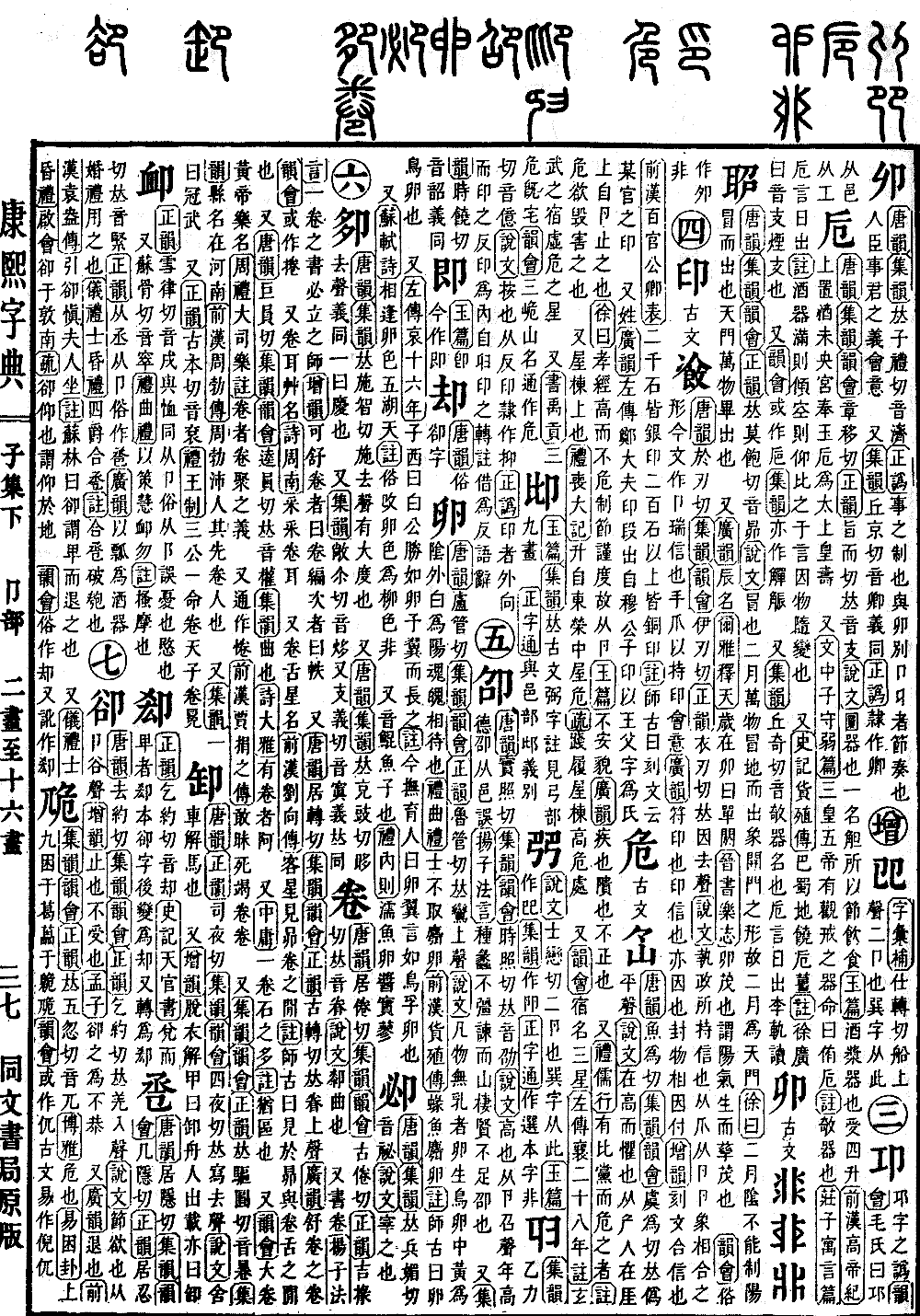
Zi Collection, Page Position: Lower
Radical: Seal (jié)
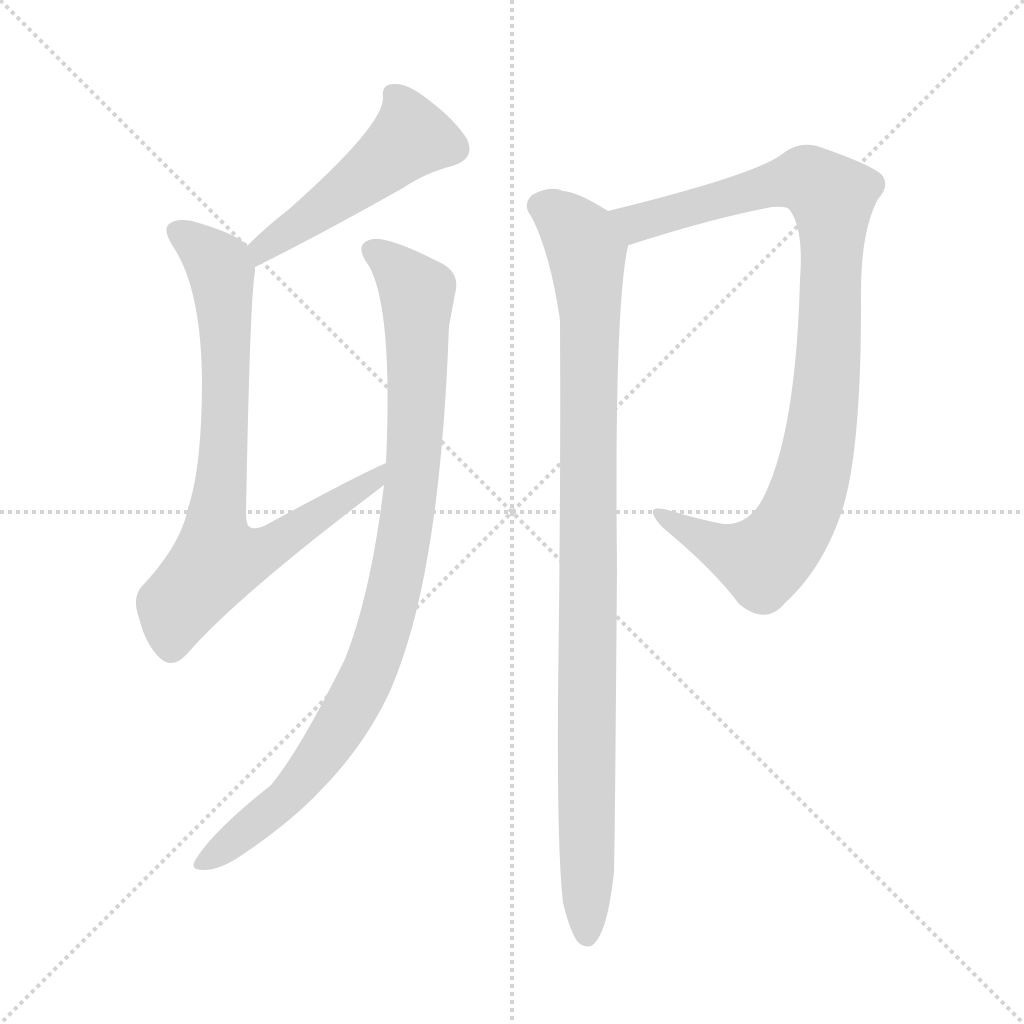
卯
Kangxi stroke count: 5
Page 159, entry 5
Ancient script
From Tang Rhyme (Tángyùn), Jiyun (Jíyùn), Yunhui (Yùnhuì), and Zheng Yun (Zhèngyùn), read as mǎo. In Shuowen Jiezi (Shuōwén Jiězì), it means to emerge. In the second month, all things sprout and emerge from the earth, resembling the shape of an opening door. Therefore, the second month is called the Gate of Heaven. Xu Kai remarks: In the second month, yin cannot restrain; yang emerges and sprouts. The Gate of Heaven is where all things fully emerge. Also, from Guangyun (Guǎngyùn), it is a name for a terrestrial branch. In Erya, Explanation of Heaven (Ěryǎ Shìtiān), when the year is in the Mao terrestrial branch, it is called Dān'è. In Book of Jin, Treatise on Music (Jìnshū Yuèzhì), Mao means "lush" or "flourishing," referring to the vital yang energy being born and growing luxuriantly. Yunhui states that it is commonly written as 夘, which is incorrect.
戼
In Shuowen Jiezi, this is the original form of Mao. It is different from the character 丣 where the upper stroke is connected. 丣 is pronounced yǒu. In Liushu Zhenge (Liùshū Zhèngé), 戼 means to open a door. It is formed from two "户" (doors), resembling the shape of a double-leaf door opening. It was borrowed for its sound to represent the characters 寅 (yín) and 卯 (mǎo), symbolizing the rising sun and the birth of things.