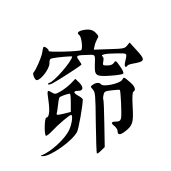
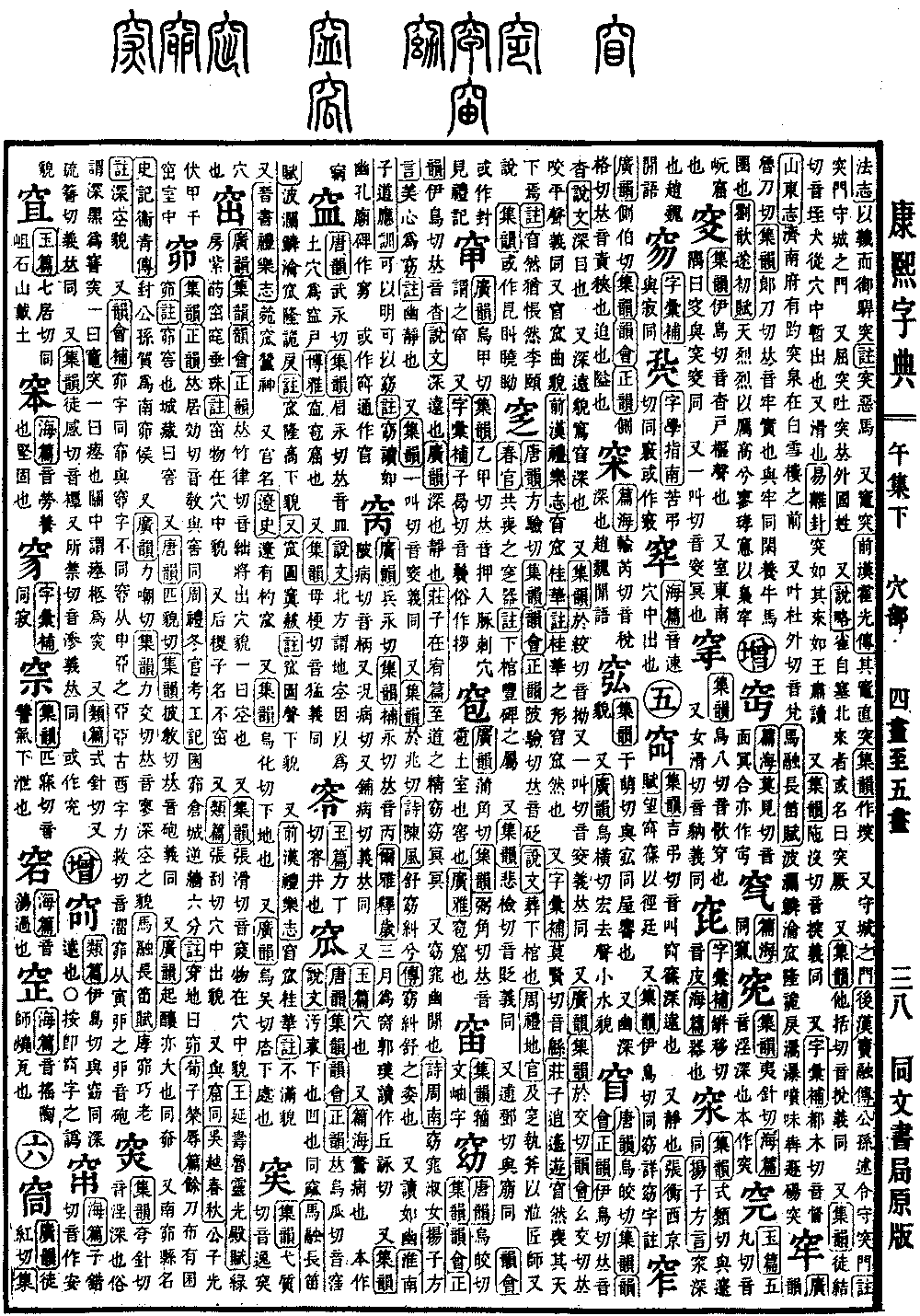
Wu Collection, Lower Volume
Radical: Cave (xué)
Kangxi Strokes: 10
Page 864, Entry 29
According to the Collected Rhymes (Jiyun) and Orthography of Rhymes (Zhengyun), it is pronounced jiao. It is synonymous with the character for cellar (jiao).
In the Rites of Zhou (Zhouli), section Winter Officials, Artificers Record (Kaogongji), it states: Round granaries, cellars, storehouses, and city walls are constructed with a ratio of six to one. The commentary states: Digging an earthen hole is called a jiao.
In the Xunzi, chapter Honor and Disgrace (Rongru pian), it states: My knives and cloth currency are in the granaries and cellars. The commentary states: A jiao is a cellar. An underground pit used for storing items within a city is called a cellar.
Also, according to the Tang Rhymes (Tangyun), it is pronounced pao. The meaning is the same.
Also, according to the Extensive Rhymes (Guangyun), it is pronounced qiniang. It also carries the meaning of being large. It is synonymous with the character for hollow (pao).
Also, Nanjiao, the name of a county. In the Records of the Grand Historian (Shiji), Biography of Wei Qing, it states: Gongsun He was enfeoffed as the Marquis of Nanjiao.
Also, according to the Extensive Rhymes (Guangyun), it is pronounced liao. It describes something deep and empty. In Ma Rong's Rhapsody on the Long Flute (Changdi fu), it mentions deep, hollow spaces. The commentary states: It describes the appearance of being deep, vast, and empty.
Also, according to the Supplement to the Rhyme Treasury (Yunhui bu), the character is identical to a variant form, though distinct from another character. Derived from the character for the tenth earthly branch (you), it is pronounced liu. Derived from the character for the fourth earthly branch (mao), it is pronounced pao. The latter is an ancient form of the character for the fourth earthly branch (mao).