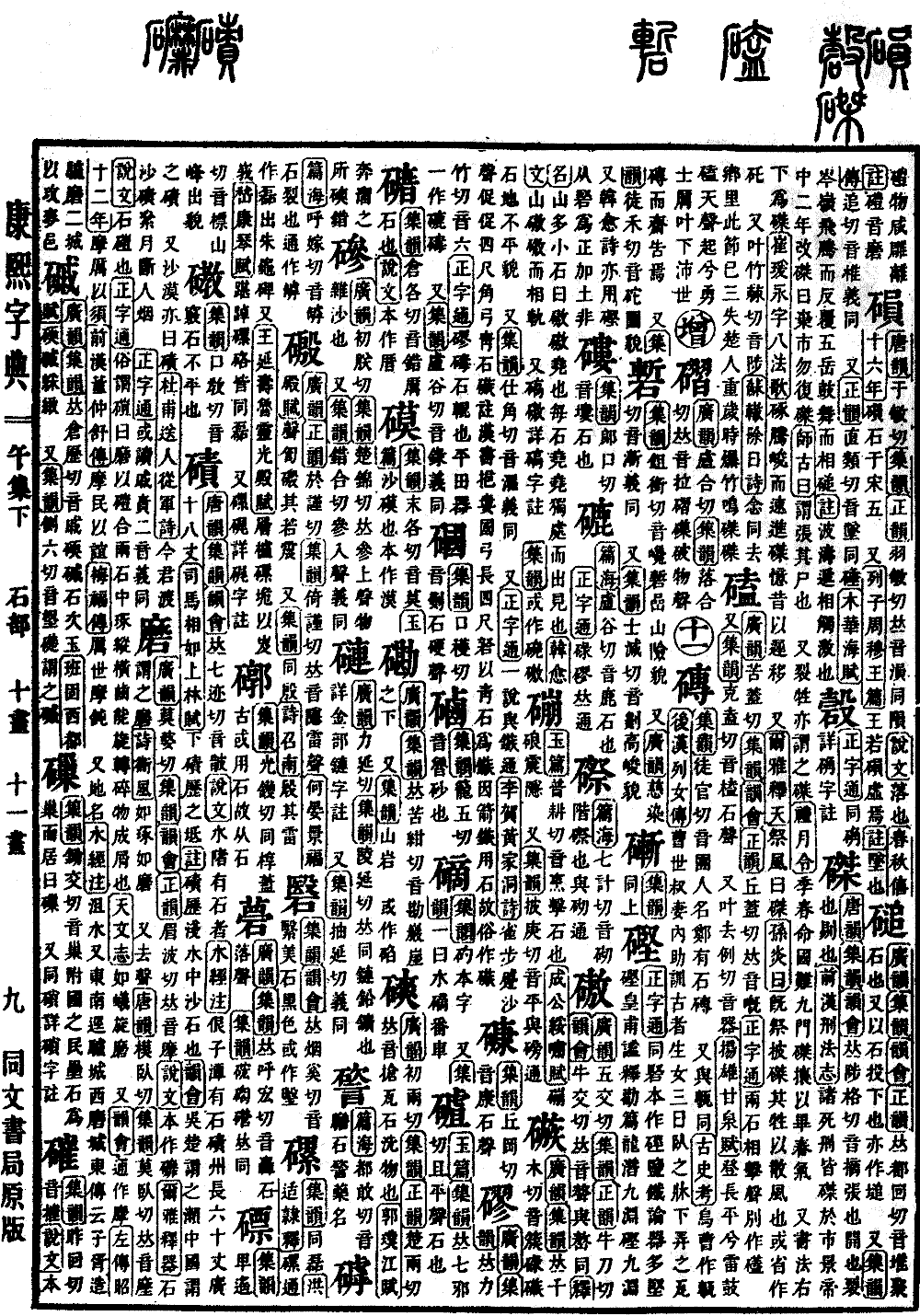
Wu Collection, Lower Volume
Radical: Stone (shí)
Kangxi Strokes: 16
Page 835, Entry 39
Pronounced mo. According to the Analytical Dictionary of Characters (Shuowen Jiezi), it was originally written with a different character. In the Er Ya, which is a dictionary of standard linguistic usage, it states that a stone tool used for grinding is called a mo. In the Book of Odes (Shijing), it says: as if cutting and grinding.
Also pronounced mo (falling tone). According to the Tang Rhyme (Tangyun), it refers to a stone mill. The Zhengzitong Dictionary notes that common speech refers to a mill as a mo, where two stones are joined together, the inner surfaces carved with horizontal and vertical teeth, capable of rotating to crush items into powder. In the Treatise on Astronomy (Tianwenzhi), it mentions like ants rotating a mill.
It is also used interchangeably with the character mo (to rub). In the Zuo Tradition (Zuozhuan), it says: to sharpen the blade in preparation. In the Biography of Dong Zhongshu in the History of the Former Han (Qian Hanshu), it says: to polish the people with righteousness. In the Biography of Mei Fu, it says: to sharpen the world and polish away dullness.
Also a place name. The Commentary on the Water Classic (Shuijingzhu) states that the Ju River flows southeast, passing west of Lu City and east of Mo City. The tradition says: Wu Zixu built Lu City and Mo City to attack Mai Yi.