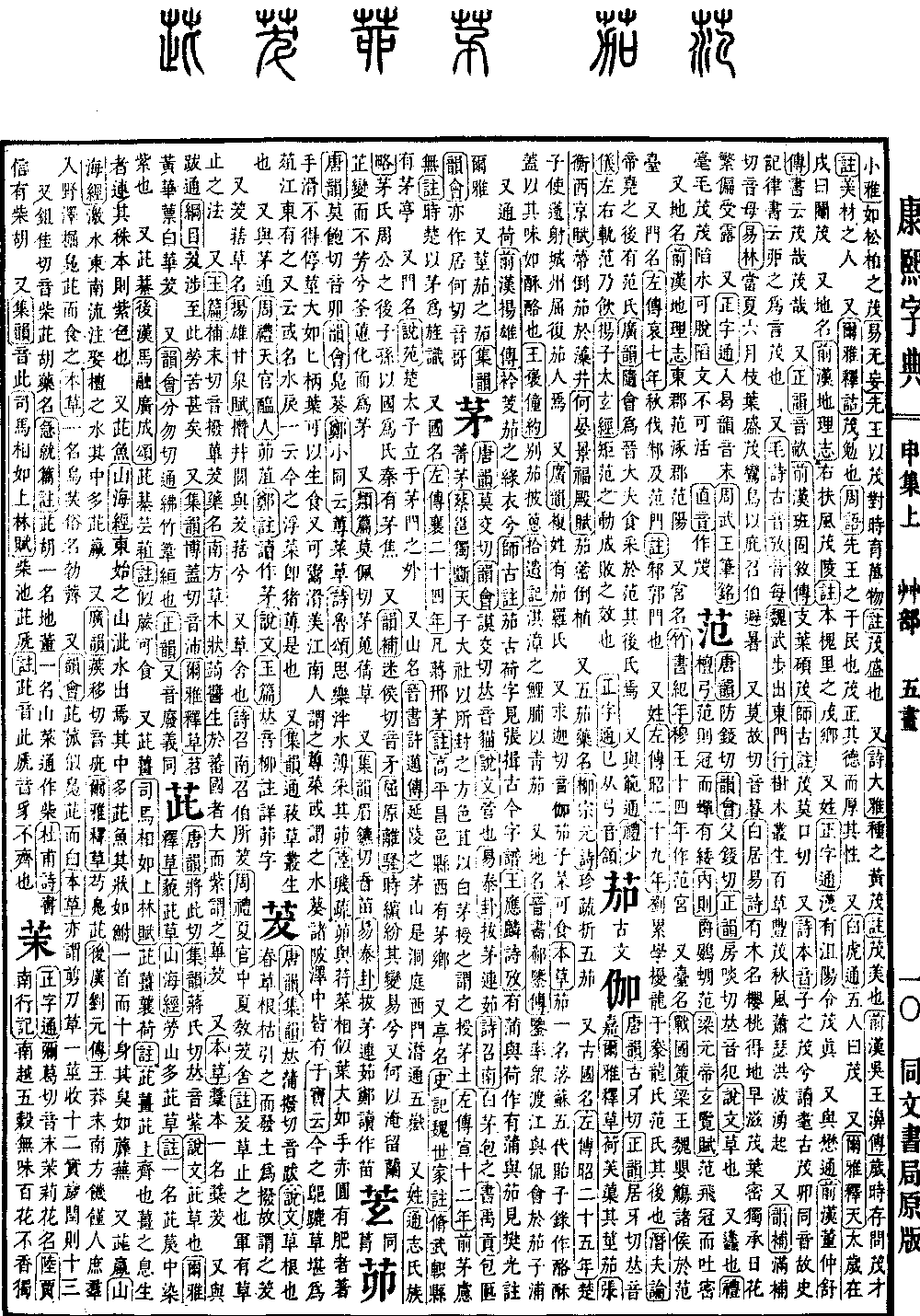
Shen Collection, Upper Volume
Radical: Grass (cǎo)
Kangxi Strokes: 11
Page 1026, Entry 09
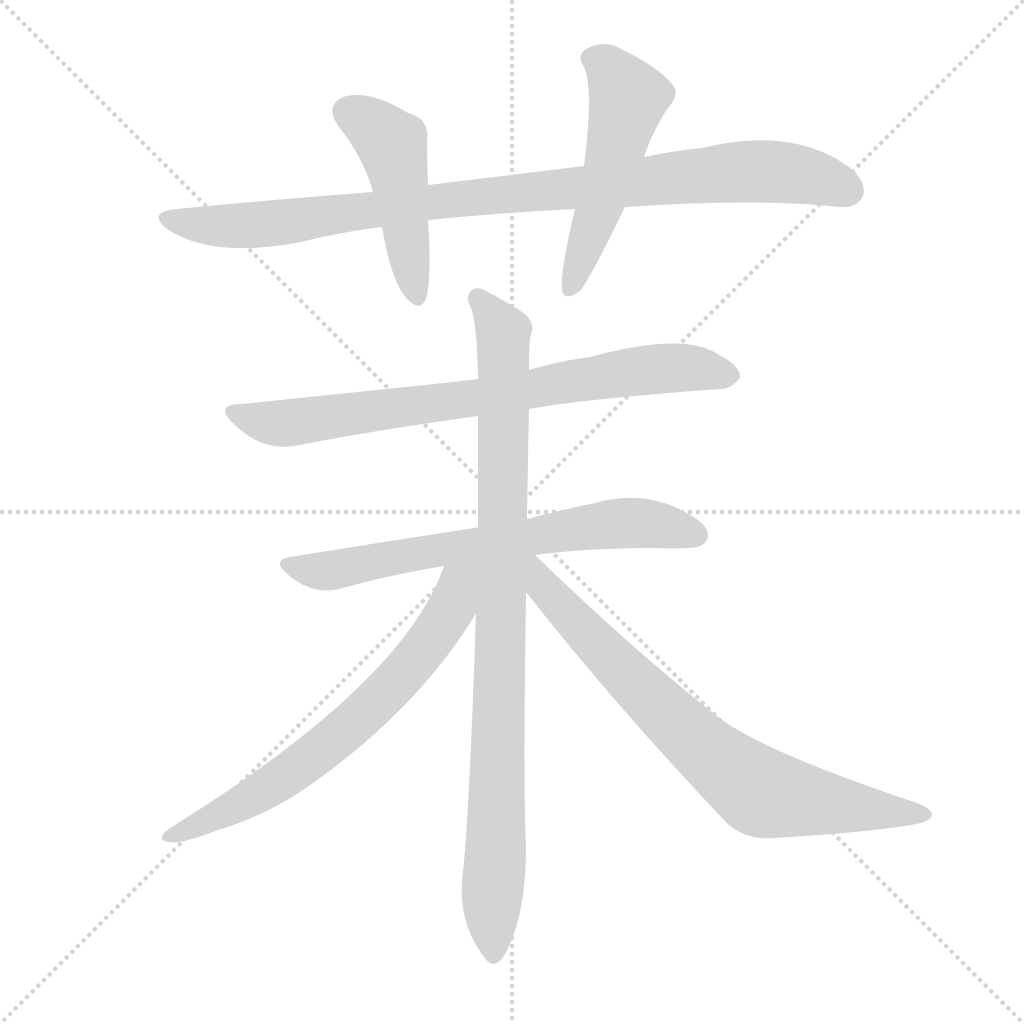
Zhengzitong (Correct Meaning Dictionary): Pronounced mo. Jasmine (moli) is the name of a flower.
Lu Jia, Record of Travels to the South (Nanxingji): Records that the five grains in the Nanyue region lack flavor, and the various flowers are not fragrant, yet only the jasmine does not alter its characteristics based on the soil and water environment.
Bencao (Materia Medica): Ji Han, Records of Plants and Trees (Caomuzhuang) writes it as mo-li; Record of the Famous Gardens of Luoyang (Luoyang Mingyuanji) writes it as mo-li; Buddhist scriptures write it as mo-li; Collection of Wang Guiling writes it as mei-li; Collection of Hong Mai writes it as mo-li. This is likely because the term moli is originally a phonetic transliteration of a foreign word, and thus there is no fixed way of writing it, with individuals recording it according to their own interpretation.
Yang Shen, Danqianlu (Records of Red Lead): The nai flower worn in the hair by people in the capital as mentioned in the Book of Jin (Jinshu) is the jasmine flower of today. The jasmine flower mentioned in Buddhist scriptures refers to the nai flower.
Zheng Songchuang, Poetry Talks (Shihua): In Guangzhou, there is a place called Jiuli Flower Field, where jasmine and jasmine officinale (suxin) are planted.