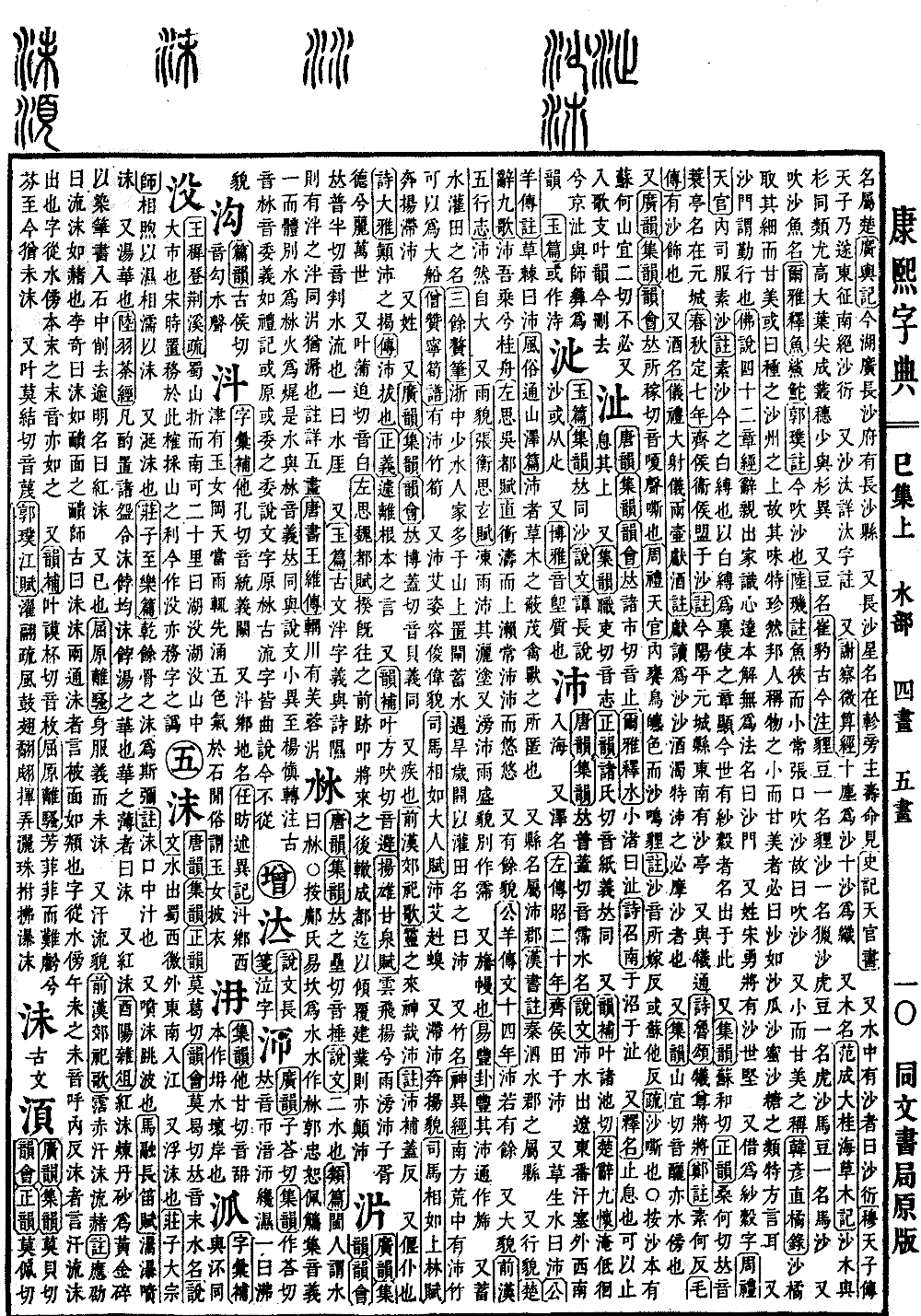
Si Collection, Upper Volume
Radical: Water (shuǐ)
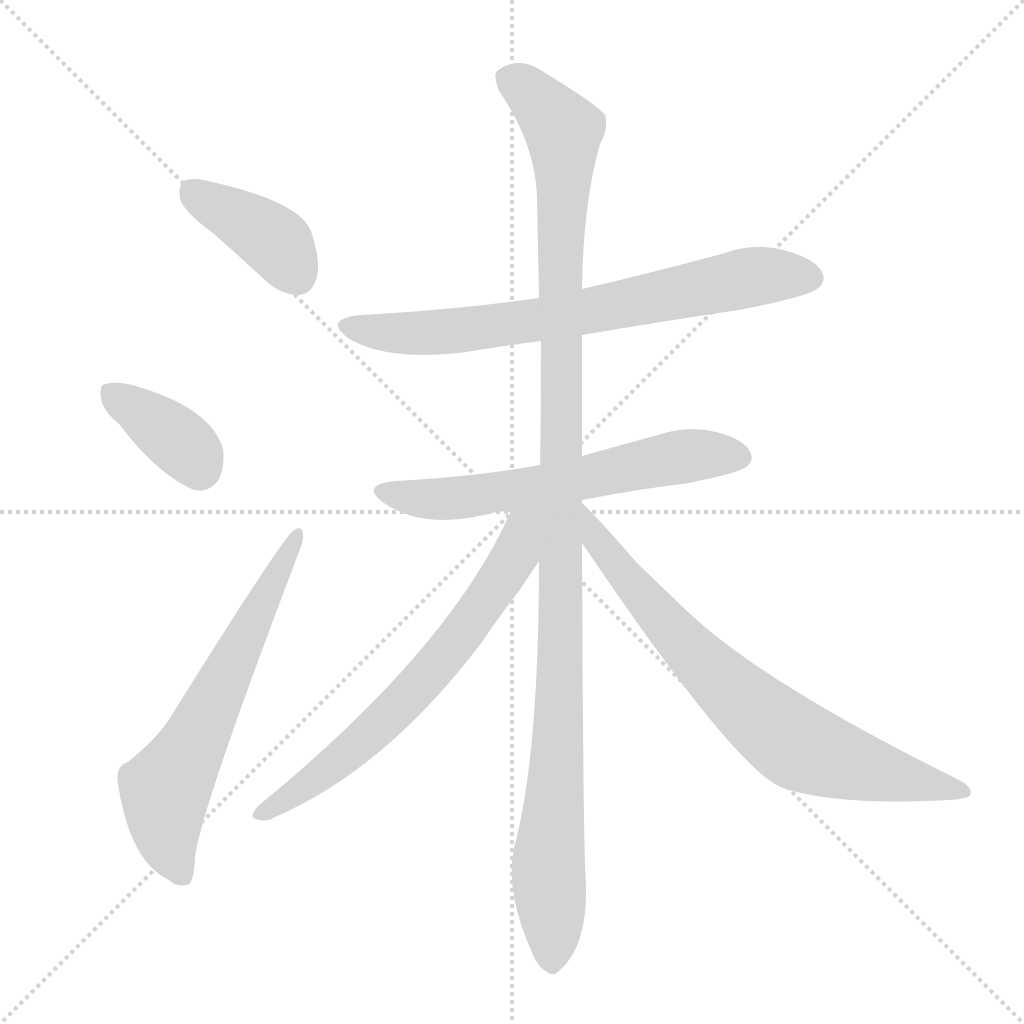
沫
Kangxi strokes: 9
Page 612, Entry 13
Tang Rhyme (Tangyun), Collection Rhyme (Jiyun), Standard Rhyme (Zhengyun): Pronounced mo. Rhyme Gathering (Yunhui): Pronounced mo. The pronunciation is the same as mo.
A river name. Explaining Characters (Shuowen): Refers to a river originating outside the western borders of the Shu region, flowing southeast into the Yangtze River.
Also refers to foam. Book of Zhuangzi (Zhuangzi): Dampening each other with breath, wetting each other with saliva.
Also refers to saliva. Book of Zhuangzi (Zhuangzi): The saliva on dry bones turned into insects. Commentary: Mo is the fluid in the mouth.
Also refers to spraying or foaming, describing leaping water waves. Ma Rong, Rhapsody on the Long Flute (Changdi Fu): Water flows, sprays, and splashes.
Also refers to the froth on the surface of tea. Lu Yu, Classic of Tea (Chajing): When pouring tea into a bowl, ensure the froth and foam are uniform. Foam and froth refer to the scum on the tea soup. The light part of this scum is called mo.
Also refers to red foam. Miscellaneous Morsels from Youyang (Youyang Zazu): Red foam is created by refining cinnabar into gold, crushing it to dye a brush, writing into stone, and scraping the surface to make it more prominent; this is called red foam.
Also refers to ceasing or disappearing. Qu Yuan, Encountering Sorrow (Lisao): Personally practicing virtue without ceasing.
Also refers to the appearance of sweat flowing. Former Han (Qianhan), Suburban Sacrifice Songs (Jiaosige): Stained with red sweat, flowing with ochre-colored foam. Commentary: Ying Shao says the flowing foam resembles ochre. Li Qi says the foam is like the water used for washing one's face. Shi Gu says mo and mei are interchangeable. Mei means the face is full of fluid as if washed, written with the water radical and the character wei, pronounced nei. Mo means sweat flows out as foam, written with the water radical and the character mo, and pronounced the same way.
Rhyme Supplement (Yunbu): Rhyme sound changed to pronounced mei. Qu Yuan, Encountering Sorrow (Lisao): The fragrance is rich but difficult to maintain; the scent has not yet dispersed.
Also rhyme sound changed to pronounced mie. Guo Pu, Rhapsody on the Yangtze (Jiangfu): Washing feathers in the water, facing the gentle breeze, flapping wings. Scattering water droplets, striking the splashing waterfall foam.